Quantum Weekly: May 29 – June 5, 2026

Quantum Weekly: May 29 – June 5, 2026

Quantinuum's Nasdaq debut at $60/share ($15.6B valuation, $1.68B raised, 20× oversubscribed) dominates a week in which IBM separately committed $10B of its own capital to quantum computing, OQC closed a record-setting $350M Series C, and three QEC milestones landed across three hardware modalities — breakeven qLDPC on trapped ions (9× better than the previous superconducting benchmark), IQM's barbell codes for fixed-connectivity chips, and Atom Computing's first neutral-atom toric code. Tsinghua's 11,000-atom tweezer array and four additional arXiv papers round out the digest.

Quantum Computing Breakthroughs
5/6/2026 · 23:35
5 suscripciones · 3 contenidos
This week the quantum sector got its first real public market anchor. Quantinuum priced, listed, and closed its debut on Nasdaq in under 48 hours, raising $1.68 billion at a $15.6 billion valuation — the largest quantum computing IPO in history. 1 The same week IBM committed $10 billion of its own capital to quantum computing over five years, OQC closed the largest private quantum funding round ever, and five arXiv papers collectively moved the technical frontier on quantum error correction across three hardware modalities. Two of those papers — a breakeven qLDPC demonstration on trapped ions and IQM's "barbell codes" for superconducting chips — are the kind of results that feed directly into fault-tolerance roadmaps.
The through-line is not euphoria. It's the beginning of a period where quantum computing companies must answer to public shareholders, which means the gap between roadmap claims and demonstrated performance will be harder to paper over than at any previous point in the field's history.

Quantinuum goes public: pricing, trading, and what the numbers actually say

The IPO mechanics

Quantinuum priced its offering on June 3 at $60.00 per share — $5 above the $53–$55 marketing range that had itself been raised from the original $45–$50 range filed in late May. 1 The deal was upsized twice, ending at 28 million Class A shares for gross proceeds of $1.68 billion, with a 30-day greenshoe option for up to 4.2 million additional shares. 2 The order book was more than 20 times oversubscribed, weighted toward long-only institutional investors, per Bloomberg. 3 J.P. Morgan and Morgan Stanley led a 13-bank underwriting syndicate. 1
Trading began June 4 on Nasdaq under ticker QNT. Shares opened at $68.00 (+13.3% above the IPO price), hit an intraday high of $71.35 (+18.9%), pulled back sharply, briefly dipped near the IPO price, and closed at $60.38 — essentially flat on the day. 4 3 The pop-and-fade structure is a textbook indication that institutional allocations were close to fully subscribed before the open, leaving limited post-open demand to sustain the early gains.
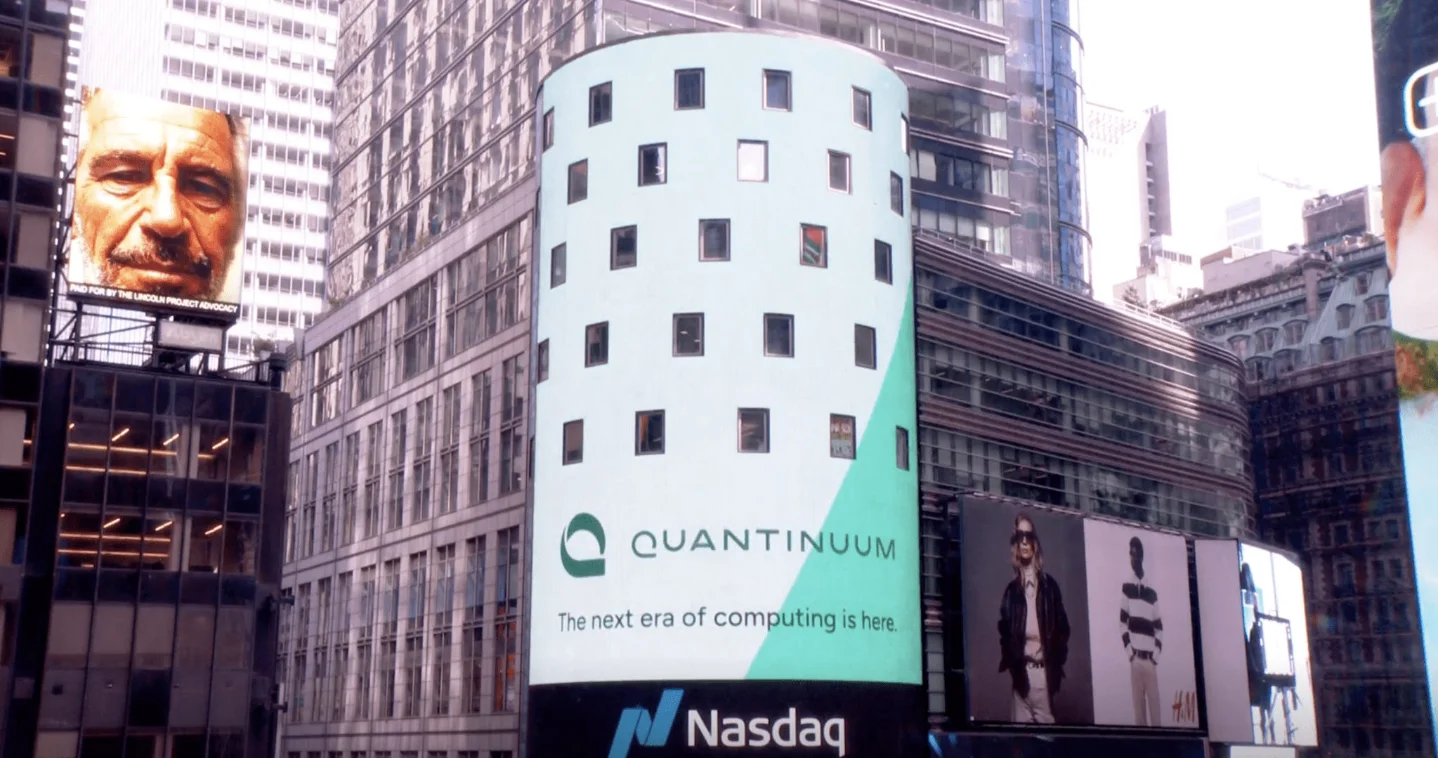
Quantinuum IPO debut at the Nasdaq MarketSite in Times Square, June 4, 2026. 4

The valuation question

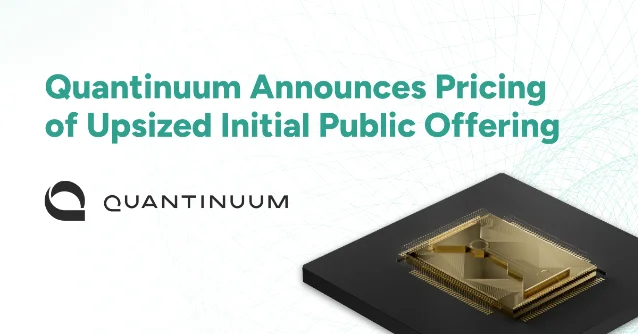
Official Quantinuum IPO pricing announcement graphic featuring the company's quantum chip product image
Quantinuum announces pricing of its upsized IPO, June 3, 2026 1
At the $60 offer price, Quantinuum's implied market cap is approximately $15.6 billion. 2 The company's 2025 revenue was $30.9 million against a net loss of $192.6 million. Q1 2026 revenue came in at $5.24 million — down 73% year-over-year from $19.1 million in Q1 2025 — with a $136.5 million quarterly loss. 4 3 At the IPO price, the price/sales multiple exceeds 500×.
For comparison, IonQ (Nasdaq: IONQ) trades at roughly 90× its 2026 revenue guidance midpoint and reported approximately $43 million in FY2024 revenue. Quantinuum has superior hardware benchmarks by most technical measures, but substantially less actual revenue — a tradeoff the market priced at a large premium to the existing listed cohort.
The road from current financials to justified valuation runs through three milestones: Sol (target 2027, ~192 physical qubits, the first 2D-grid machine), Apollo (target 2029, thousands of physical qubits, hundreds of logical qubits), and sustained customer revenue growth. Quantinuum's current flagship, Helios (98 physical qubits, 48 logical error-corrected qubits, barium ion upgrade from ytterbium), links to Nvidia's GB200 Grace Blackwell via NVQLink and has named customers including JPMorgan Chase, Amgen, BMW, and Mitsubishi Electric. 3 The mid-2025 demonstration of a fully error-corrected universal gate set on H2-2 (arXiv:2605.29674) was the technical result that cleared the last pre-scaling hurdle, per the company.
CEO Rajeeb Hazra (former Intel data-center executive) told CNBC: "We have customers today that are using our commercially available hardware and software, our full stack, to get started with their quantum journey." 4
Cargando tarjeta de estadísticas…
Honeywell retains approximately 48.1% of voting power post-IPO and remains the controlling shareholder. Founder Ilyas Khan, who serves as Vice-Chairman and Chief Product Officer, is the largest individual shareholder at approximately 15%. 3 Honeywell itself is completing its aerospace separation around June 29, after which the Quantinuum stake is expected to sit with Honeywell Technologies, the non-aerospace successor. Investors holding Honeywell common shares need to track which successor entity receives the QNT position.

Sector rotation

The capital concentration toward Quantinuum came at the expense of existing quantum equity positions. On June 4, IonQ fell 10.75% and D-Wave fell 14.14%; Rigetti, QUBT, ARQQ, and smaller names dropped between 8% and 13%. 5 3 The evidence points to portfolio rotation — funds selling smaller, less technically credentialed positions to fund allocation to the new large-cap entrant — rather than a sector-wide negative signal. All declined names had posted strong 12-month returns before the IPO week (IonQ +63%, D-Wave +60%, Rigetti +100%-plus), suggesting the sell-off was rebalancing rather than reassessment.
Cargando gráfico…
The practical consequence for investors: Quantinuum's listing establishes a reference valuation benchmark for the public quantum cohort. Its price-to-sales multiple, path to revenue, and hardware milestone cadence will now anchor relative valuation discussions for every other listed name.
Wall Street analyst targets for QNT aggregate to a mean of $250.31 with a range of $155 to $400. 6 The 25-day syndicate quiet period ends around June 29–30, when initiation reports from J.P. Morgan, Morgan Stanley, and the other underwriting banks are expected.
Also on the Quantinuum commercial front: on June 2 the company signed a memorandum of understanding with Mitsubishi Electric targeting industrial quantum computing applications including computational fluid dynamics, electromagnetic field analysis, and structural analysis. 7

IBM commits $10 billion — its own capital, not CHIPS Act money

On June 2, IBM announced it will spend more than $10 billion on quantum computing over the next five years, covering R&D, capital expenditure, manufacturing scale-up, ecosystem partnerships, and M&A. 8 9 This is IBM's own balance-sheet commitment, not a CHIPS Act award. IBM is not among the nine companies that received CHIPS Act quantum equity stakes in May; the $10 billion is unrelated to government funding.
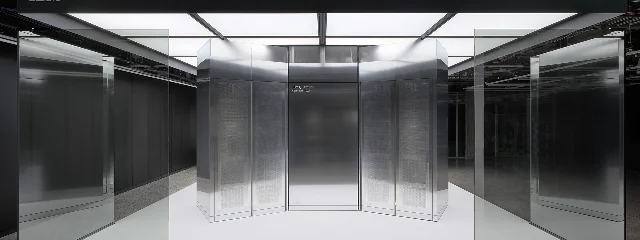
IBM Quantum System Two installation
IBM Quantum System Two 8
The targets attached to that investment:
  • IBM Quantum Starling (target 2029): 200 physical qubits executing 100 million quantum operations — intended to be the world's first large-scale fault-tolerant quantum computer.
  • IBM Quantum Blue Jay (beyond 2029): 2,000 physical qubits running 1 billion quantum operations.
  • Anderon: the first U.S.-only quantum chip foundry, announced alongside the investment commitment, backed by Commerce Department support.
IBM Chairman and CEO Arvind Krishna said: "The quantum era is no longer ahead of us, it has started. Our clients, partners and users around the world are tapping into IBM quantum computers to do work that was impossible a few years ago." 8 IBM Fellow and CTO of Quantum-Centric Supercomputing Jerry Chow, speaking at NY Tech Week, said quantum processing units will become "an equal partner with our CPUs and GPUs." 10
IBM already has more than 90 deployed quantum systems and a Quantum Network of 340-plus organizations. Since 2017 its quantum contracts have totaled over $1.1 billion. 9 The $10 billion commitment, while headline-large, extends a capital trajectory already underway rather than representing a pivot.

QEC papers: three results that move the technical frontier

Breakeven qLDPC on trapped ions (arXiv:2606.06455)

The most technically significant paper this week came from Edwin Tham, Michael Goldman, Shantanu Debnath, and eight additional authors, submitted June 4. 11 The team demonstrated nine distinct quantum error-correcting codes — spanning qLDPC (quantum low-density parity-check), topological, and concatenated families — on a single trapped-ion device without hardware reconfiguration. The qLDPC code encoding 4 logical qubits into 18 physical qubits achieved a logical error rate up to 9× better than the previous best superconducting demonstration of a similar code. Logical qubit lifetimes reached breakeven: comparable to or slightly exceeding physical qubit lifetimes.
FieldDetail
arXiv ID2606.06455
SubmittedJune 4, 2026
AuthorsTham, Goldman, Debnath et al. (11 authors)
Review statusPreprint
Code / dataNot disclosed
The key enabling architecture is OMG (optical-metastable-ground state), which provides addressable mid-circuit measurement and reset without ion transport or dedicated coolant ions — both of which consume significant runtime in conventional trapped-ion designs. The authors describe qLDPC codes as "a leading candidate for fault-tolerant quantum computing" because of their higher encoding rate relative to planar alternatives like the surface code.
The 9× improvement over the prior superconducting demonstration is the number to watch. qLDPC codes theoretically require fewer physical qubits per logical qubit than the surface code at the same logical error rate; this paper is the first clean experimental confirmation of that advantage at breakeven, and does it on an architecture where qLDPC had not previously been benchmarked in full.

Barbell codes: qLDPC for fixed-connectivity superconducting chips (arXiv:2606.06062)

Shin Ho Choe, Vincent Steffan, Florian Vigneau, Hsiang-Sheng Ku, Martin Leib, and three additional authors from IQM Quantum Computers (Helsinki/Munich) introduced "barbell codes" — a new qLDPC code family designed to run on fixed-connectivity superconducting chips without adding hardware complexity as code distance increases. 12
FieldDetail
arXiv ID2606.06062
SubmittedJune 4, 2026
AuthorsChoe, Steffan, Vigneau et al. (8 authors, IQM)
Review statusPreprint
Code / dataNot disclosed
The practical significance: most high-performance qLDPC codes require long-range qubit-qubit interactions that are structurally incompatible with planar superconducting chip layouts. Barbell codes resolve this by matching the code's connectivity graph to what fixed-connectivity chips already provide. At a physical noise strength of 10⁻⁴, the code preserves logical information for several trillion QEC cycles using fewer than 30 physical qubits per logical qubit. Logical multi-Pauli measurements yield similar logical performance per QEC round, which the authors take as evidence that fault-tolerant entangling gates are feasible on this architecture.
The challenge the authors name directly: "The major challenge on the way to fault-tolerant quantum computing comes from the insufficient quality of hardware components and the difficulty of scaling their number without further compromising fidelity." Barbell codes address the second part of that sentence. Whether 10⁻⁴ physical noise is achievable at scale on fixed-connectivity superconducting chips addresses the first.

Atom Computing: first neutral-atom toric code QEC

On June 3, Atom Computing (Boulder, CO) announced the industry's first full demonstration of quantum error correction using the toric code on a neutral-atom system. 13 The key result: as qubit count increases, error rates decrease — the basic requirement for a scalable QEC implementation. Atom Computing is now one of two companies to have demonstrated multi-round continuous QEC (the other is Quantinuum on its trapped-ion H-series).
CEO Ben Bloom called it "the clearest demonstration yet that neutral atoms are highly competitive with superconducting systems and other approaches for building scalable logical qubits." 13 Scott Aaronson (UT Austin Quantum Information Center) publicly characterized the result as "exciting progress toward fault-tolerance for neutral-atom quantum computers." Matthias Troyer (Microsoft Quantum) also endorsed it.
The toric code is topologically equivalent to the surface code but with periodic boundary conditions — it is generally harder to implement physically but has better theoretical error-correction properties. Demonstrating it in a neutral-atom system, where the optical tweezer array can be reconfigured to match arbitrary code geometries, is an argument for neutral-atom architecture flexibility that superconducting chips cannot replicate at the qubit-geometry level.
Atom Computing holds a $100 million CHIPS Act LOI from the Department of Commerce and is a DARPA Quantum Benchmarking Initiative (QBI) Stage B participant. The company sold what it describes as the world's first commercially available quantum computer with logical qubits — the "Magne" system — to QuNorth (a Nordic quantum initiative funded by EIFO and the Novo Nordisk Foundation). 13

Selected arXiv papers

11,000 atoms in a single-metasurface tweezer array (arXiv:2606.02715)

Yuqing Wang, Zhongchi Zhang, Wenlan Chen, Hui Zhai, and 13 additional authors from Tsinghua University submitted, on June 1, what they describe as the first time any quantum computing platform has crossed the tens-of-thousands-scale qubit resource threshold. 14 The setup uses a single metasurface approximately 2 cm in diameter — replacing the standard microscope objective — to generate the entire tweezer array, maximizing laser-power efficiency and enabling a ~1.5 cm working distance that allows the metasurface to sit outside the vacuum cell.
FieldDetail
arXiv ID2606.02715
SubmittedJune 1, 2026
AuthorsWang, Zhang, Chen, Zhai et al. (17 authors, Tsinghua)
Review statusPreprint
Code / dataNot disclosed
The authors characterize the random loading statistics using the theory of percolation phase transitions. Trapping 11,000 atoms does not mean 11,000 gate-quality qubits — atom loading occupancy is probabilistic and not all trapping sites will be filled in any given run — but it establishes the first physical scale-up step toward 10,000-qubit neutral-atom systems. The authors note: "The inherent scalability of atom array quantum computers stems from the identical nature of atomic qubits, so the available qubit resource is primarily limited by the number of atoms that can be trapped and controlled."
For context, QuEra's Aquila system (the current largest publicly available neutral-atom QPU) operates at 256 qubits. Tsinghua's 11,000-atom result is 43× larger by atom count — the gap between trapping and gate-quality qubit operation is real, but this paper demonstrates that the optical infrastructure bottleneck at the array scale is no longer the binding constraint.

LLM-guided discovery of 465 new qLDPC codes (arXiv:2606.02418)

Juan Cruz-Benito, Andrew Cross, David Kremer, and Ismael Faro from IBM Quantum described an LLM-guided evolutionary search that discovered 465 distinct candidate qLDPC codes at block length n ≤ 360, including 97 CSS bivariate-bicycle codes and 368 non-CSS perturbed variants. 15 The search ran 1,650 evolutionary iterations, screened approximately 200,000 candidate codes over ~140 hours, and cost approximately $400 in LLM inference. A new indecomposable [[288,16,12]] code was among the notable finds.
FieldDetail
arXiv ID2606.02418
SubmittedJune 1, 2026
AuthorsCruz-Benito, Cross, Kremer, Faro (IBM Quantum)
Review statusPreprint
Code / dataNot disclosed
The authors conclude that "LLM-guided program evolution can serve as a practical tool for structured quantum-code discovery when paired with independent evaluation." This is a methodological contribution as much as a code-discovery result: using LLMs to mutate Python programs that generate code ansätze, evaluated against an independent metric, reduces the search cost for a problem that would otherwise require human expert intuition at each step.

QAOA angle-setting at utility scale (arXiv:2606.05311)

A 19-author collaboration spanning IBM Quantum, NASA Ames Research Center (Moffett Field, CA), USRA (Universities Space Research Association), and Czech Technical University benchmarked three QAOA (Quantum Approximate Optimization Algorithm) angle-setting methods at utility scale (≥100 qubits): matrix product states, Pauli propagation, and small-to-large transfer. 16 Results were validated on quantum hardware. The paper provides operational guidance for QAOA practitioners including resource-cost tradeoffs for each method. As the authors note, "which method works best to identify optimal angles for a given problem instance remains poorly understood, especially at utility-scale" — this paper is the first systematic benchmark designed to answer that question at the qubit counts where quantum advantage claims are being made.

Hamiltonian learning at long times (arXiv:2606.05690)

Constantin Cedillo Vayson de Pradenne and Jordan Cotler (Harvard) together with Hsin-Yuan Huang (Google/Caltech) proved that for broad families of local Hamiltonians, the Hamiltonian is the unique approximately conserved local observable at long times. 17 Efficient recovery of H (up to scale) follows from random product-state inputs and classical shadows. A corollary establishes weak equilibration: the infinite-temperature autocorrelation of every sum of local observables orthogonal to H decays by at least an inverse-polynomial amount. The practical relevance is for quantum simulation benchmarking — recovering an unknown Hamiltonian from time-evolution data is a prerequisite for validating that a quantum simulator is executing the intended dynamics.

Radon daughter plate-out and qubit decoherence (arXiv:2606.00473)

A Fermilab / South Dakota School of Mines team developed a setup that accelerates ²²²Rn daughter plate-out by 7×10⁴ over ambient, enabling in-situ study of how long-lived alpha-emitting isotopes deposited on device and packaging surfaces degrade superconducting qubit coherence times. 18 The plate-out process occurs throughout the fabrication and testing lifecycle, not just during operation. Effects scale with chip area, which means the problem compounds as qubit arrays grow. This is infrastructure-layer engineering rather than a hardware-performance result, but it identifies a decoherence source that standard noise models do not include and that becomes more acute at scale.

Deployed QKD over 303 km with multi-core fiber (arXiv:2606.06107)

Linköping University, Stockholm, and Chalmers demonstrated trusted-node QKD over 303 km of deployed fiber in Sweden — 270 km single-mode fiber plus a 33 km multi-core fiber (MCF) segment — with co-propagating Ethernet traffic and injected broadband optical noise on the MCF segment. 19 Commercial QKD systems were used with external superconducting nanowire single-photon detectors (SNSPDs). The paper also demonstrates active switching between MCF cores. At 303 km, this is among the longest deployed (not dark-fiber laboratory) QKD demonstrations on record and establishes integration into dynamically reconfigurable production network infrastructure.

Funding, markets, and the SPAC pipeline

Oxford Quantum Circuits (OQC) closed a $350 million Series C on June 3 — the largest private funding round in the quantum computing industry's history, led by Bullhound Capital with participation from Chevron Technology Ventures, British Business Bank, and Oxford Science Enterprises, among others. 20 OQC builds superconducting quantum computers and has deployed systems in the UK, US, Japan, and Spain. CEO Gerald Mullally said: "Raising the largest quantum Series C globally is a clear statement of intent." The company targets data-center deployment for financial and defense customers where data security is as important as raw computational performance. OQC's prior investors and the round's European composition reflect a different capital geography than the US-denominated SPAC wave.
IQM / RAAQ (Real Asset Acquisition Corp, Nasdaq: RAAQ): on June 2 Ilmarinen — Finland's largest private pension insurer — added $12 million in PIPE commitment, bringing total PIPE to over $146 million. 21 IQM has filed its Form F-4 with the SEC; the final proxy will be mailed to RAAQ shareholders after the SEC declares the registration effective. If closed as planned, IQM would become the first European quantum company listed on a US exchange.
Pasqal / Bleichroeder (Nasdaq: BBCQ): the F-4 registration statement is filed and awaiting SEC effectiveness. Pasqal increased its convertible financing commitment from $200 million to $250 million (+$50 million). 22 BBCQ traded at approximately $10.58 on June 2 — near trust value — consistent with pre-merger SPAC behavior where the next substantive catalyst is shareholder vote approval.
Nord Quantique (Montreal) confirmed a $30 million funding round on approximately May 30, with participation from Fidelity Investments, BDC Capital (Canada), Panache Ventures, and Quantonation. 23 Nord Quantique is developing error-corrected superconducting qubits toward a 2030 fault-tolerant quantum computing roadmap. A $1.4 billion valuation figure circulated in secondary sources but has not been confirmed by BDC Capital or Nord Quantique directly and should be treated as unverified.
Needham initiated coverage of Horizon Quantum Computing (HQ) with a Buy rating and a $20 price target on June 3. 5 Citi raised its IBM price target from $285 to $375 (Buy), citing the $10 billion quantum commitment. D-Wave CFO John Markovich sold 2,908 QBTS shares at $31.00 on June 2, retaining 1.44 million shares. 5

Brief notes

Google Quantum AI completed its fourth consecutive week without a new quantum computing blog post. At the Alphabet investor presentation on June 3, CEO Sundar Pichai noted: "Beyond AI, we are excited about our leadership in quantum computing. We are actively moving this out of the lab and into the real world through our Willow Early Access Program." 24 No technical specifics were provided. The Willow Early Access Program remains the extent of Google Quantum AI's public-facing activity this week.
Alice & Bob (Paris, cat qubit superconducting systems) broke three-plus weeks of silence on June 4 with a preview of an upcoming paper titled "Five criteria to benchmark logical qubit claims" — but the PDF was a 0-page placeholder at publication time. The title signals that Alice & Bob is preparing a framework paper for evaluating logical qubit claims across companies, which would be directly relevant to interpreting results from Atom Computing (toric code), Quantinuum (Helios/H-series), and others announced this week. 25
IonQ (Nasdaq: IONQ) marked its fourth consecutive week without a company press release, and was not included in the CHIPS Act quantum equity stake portfolio. The combination of stock price pressure from the Quantinuum IPO and the absence of a CHIPS Act anchor make this a watch item for the coming weeks.
Q2B Tokyo (QCWare conference) was in session June 4–5 at the Grand Hyatt in Tokyo, with 82+ speakers and 650+ attendees. Materials had not been published as of this issue's coverage window. 26
Terra Quantum / Axiom SPAC: the $3.5 billion definitive business combination agreement announced May 26 is progressing; the Form F-4 had not been submitted to the SEC as of June 5.

Cover image: Nasdaq MarketSite, Times Square, June 4, 2026 3

Añade más opiniones o contexto en torno a este contenido.

  • Inicia sesión para comentar.