
"Twere Better If You Were Dead": The Letters Newton Wrote During His Breakdown
In September 1693, at the height of his fame, Isaac Newton wrote two letters accusing his friends Samuel Pepys and John Locke of conspiring against him — including the line "twere better if you were dead." The article reconstructs the episode, examines the two leading explanations (the collapse of his friendship with Nicolas Fatio de Duillier, and chronic mercury poisoning from decades of alchemical work), and traces Newton's recovery and his subsequent transformation into England's most effective counterfeiter hunter.

On September 13, 1693, a letter arrived at the London home of Samuel Pepys (the diarist and former naval administrator) from Isaac Newton in Cambridge. Pepys had not done anything wrong. He and Newton were on decent terms — Newton had, in fact, spent considerable effort the previous year helping Pepys work through a probability question about dice.1
The letter told Pepys that Newton was severing contact. Newton accused Pepys of having "embroiled" him — exactly how or in what matter, the letter did not clearly specify. It was the communication of a man who believed he had enemies, and had decided to say so.
Three days later, Newton wrote to John Locke (the philosopher, then living at Oates in Essex). This letter was worse. Newton accused Locke of attempting to "embroil" him with "woemen & by other means." He told Locke something that must have startled him considerably: "when one told me you were sickly I answered twere better if you were dead."1
Newton was fifty years old. He had published Philosophiæ Naturalis Principia Mathematica six years earlier, in 1687 — the work that established the laws of motion and universal gravitation and that most scientists of the era recognized as the most significant scientific text since Euclid. He was a Fellow of the Royal Society, Lucasian Professor of Mathematics at Cambridge, and probably the most celebrated living scientist in Europe. He was also, that September, in the middle of what we would now call a complete mental breakdown.
Five nights without sleep
The Newton Project, the University of Oxford's authoritative transcription and annotation project for Newton's manuscripts and correspondence, is direct about what happened: Newton's "psychological problems culminated in what would now be called a nervous breakdown in mid-1693, when, after five nights of sleeping 'not a wink', he temporarily lost all grip on reality and became convinced that his friends Locke and Pepys were conspiring against him."1
The phrase "not a wink" is Newton's own, not a biographer's gloss. Newton's self-reports about his physical state in this period have the flat, accurate quality of a man describing symptoms from a slight distance — as if he could observe the collapse from somewhere just outside it, even as it was happening.
The Locke letter is the more disturbing of the two because Newton seems to know what he is saying is extreme. He does not write as though he is certain Locke is guilty of anything — he writes as a man trying to explain a state of mind he can partly see from the outside. Later, after his recovery, he wrote to Locke again to apologize directly. He told Locke that the letter had been sent "in a distemper," and that he had since recovered.1 Locke, who was by all accounts a patient and philosophically generous man, accepted the apology. Pepys, characteristically, responded with measured concern rather than anger.
The letters were not destroyed. Both survive in archives. The Locke letter is part of the Newton correspondence collections that have been catalogued and transcribed by scholars, most authoritatively in H. W. Turnbull's seven-volume The Correspondence of Isaac Newton (Cambridge University Press, 1959–1977), with the 1693 letters appearing in Volume III.2 Anyone who wants to read them can.
The question historians kept returning to
The episode has attracted sustained scholarly attention precisely because it sits so awkwardly inside the standard account of Newton's life. What broke first? Why in 1693, of all years?
The most widely cited answer involves Newton's friendship with Nicolas Fatio de Duillier (a Swiss mathematician and natural philosopher who had moved to London in the late 1680s). Fatio was, by all contemporary accounts, Newton's closest friend during the period 1689 to 1693 — possibly the most intimate relationship of Newton's adult life. Their correspondence during those years is frequent and warm in a way that Newton's letters almost never are. Then, in the spring of 1693, the friendship ended abruptly. The precise reasons remain unclear; Fatio had health problems, financial difficulties, and was increasingly drawn toward religious mysticism. But the timing lines up: the collapse of the friendship, and then, a few months later, the letters to Pepys and Locke.1
A second hypothesis, physically distinct from the first, concerns the laboratory. Newton had been conducting alchemical experiments almost continuously since the late 1660s — decades of handling mercury compounds, antimony, and other heavy metals without meaningful protective precautions, because those concepts did not yet exist. Hair samples taken from Newton after his death in 1727 and analyzed in the twentieth century showed mercury levels approximately 40 times above normal.3 Chronic mercury poisoning can produce exactly the symptoms Newton described in 1693: severe insomnia, paranoid ideation, distorted perception of relationships, followed by a recovery period when exposure stops.
The two explanations are not mutually exclusive. A man whose closest friendship had just dissolved, and whose body was carrying a toxic load of mercury, was not well positioned to absorb whatever ordinary social friction triggered the letters to Pepys and Locke.
What made the episode legible to later readers is that Newton did not try to hide it. He confessed to Locke in writing that he had wished him dead. He attributed it to a "distemper" — early modern English for a disordering of the mind or body — and he accepted that the distemper had caused him to behave badly. That is not the vocabulary of a man who thought he had simply had a justified emotional reaction.
Recovery, and what came after
Newton's breakdown resolved quickly by historical standards. The Newton Project records that "he seems to have made a full recovery by the end of the year" — meaning that within four to five months of the September letters, he was functioning normally.1 Both Pepys and Locke accepted his apologies. The Locke correspondence, in particular, continued afterward without apparent permanent rupture.
In 1696, Newton left Cambridge for London, appointed Warden of the Royal Mint — and then Master, in 1699. He spent the next decade tracking down counterfeiters, personally attending interrogations in London's taverns and prisons, building prosecution cases with a methodical intensity that prosecutors found valuable and defendants found alarming. The most famous of these cases, the trial and eventual hanging of the career counterfeiter William Chaloner in 1699, required Newton to build an evidence file over two years before Chaloner could be convicted.4 The man who had written to Pepys and Locke in a paranoid frenzy became, three years later, someone who tracked real criminals through London's underworld with professional patience.
Cargando tarjeta de contenido…
Newton never married. He never had another friendship like the one with Fatio. The Newton Project notes the absence, in surviving materials, of anything resembling a private diary from his mature years — "if it ever existed" — which means that the September 1693 letters are among the most directly personal documents Newton left behind.1 They were written in a state that stripped out the careful, controlled register he maintained everywhere else. They are what he sounded like when the editor in him had temporarily stopped working.
Pepys kept the letter. Locke kept his. Newton himself apparently never asked for either back.
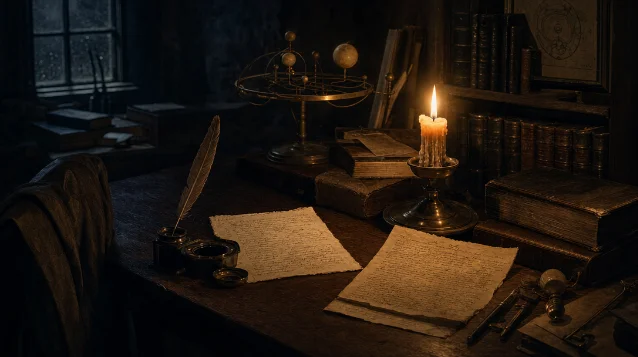
Cover image: AI-generated editorial illustration depicting a 17th-century writing desk by candlelight, referencing Newton's study in September 1693 as documented in the Newton Project correspondence archives.
Fuentes de referencia
- 1The Newton Project, "Isaac Newton's Personal Life," University of Oxford / Prof. Rob Iliffe
- 2Newton Papers — Cambridge University Library Digital Collections (holdings overview for the Portsmouth and Macclesfield Collections)
- 3Frank E. Manuel, *A Portrait of Isaac Newton* (Harvard University Press, 1968), pp. 212–225; and subsequent analysis by P. E. Spargo and C. A. Pounds, "Newton's 'Derangement of the Intellect': New Light on an Old Problem," *Notes and Records of the Royal Society*, 1979
- 4Podra Network / Dr. Sarah Quinn, "The Mint Master: Newton's Surprising Second Career Fighting Counterfeiters," *Isaac Newton* podcast, Episode 8 (May 28, 2026)
Añade más opiniones o contexto en torno a este contenido.