x.com
AI Leaders Weekly: May 18–25, 2026
A week where "agentic AI has arrived" went from forecast to stated fact: NVIDIA's $81.6B quarter, OpenAI's model solving an 80-year math conjecture, and Demis Hassabis declaring "we're at the foothills of the singularity." Plus Amodei and Daniela on Oprah, Suleyman's 18-month white-collar automation call, Arthur Mensch's Europe sovereignty warning, and four cross-cutting strategic signals for AI PMs.

"Agentic AI has arrived" — Jensen Huang said it on Tuesday's earnings call, Demis Hassabis said effectively the same thing at Google I/O on Monday, and NVIDIA's $81.6 billion quarterly revenue made it a financial fact rather than a forecast. The week's densest signal, though, came from a different direction: an OpenAI general-purpose model — not a specialized math system — autonomously solved a combinatorial geometry conjecture that had been open since Paul Erdős (Hungarian mathematician who posed some of the 20th century's most famous combinatorics problems) posed it in 1946. Sam Altman said he had "complicated feelings." Below is this week's structured read.
Week at a glance
| Figure | Signal level | Key events |
|---|---|---|
| Sam Altman | High | Math breakthrough, AGI three-pillar framework, Codex update, YC $2M token investment, Musk verdict silence |
| Demis Hassabis | High | "Foothills of the singularity," Semafor interview, Gemini Omni and Gemini 3.5 Flash launches |
| Dario Amodei | High | Oprah Podcast interview with Daniela, Mythos briefing to FSB, Jevons Paradox jobs framing |
| Jensen Huang | High | Q1 FY2027 $81.6B earnings, "agentic AI has arrived," billion-agent forecast, Vera Rubin outlook |
| Mustafa Suleyman | Medium | White-collar automation in 12–18 months (Financial Times interview) |
| Arthur Mensch | Medium | French parliament testimony — Europe's "two-year window" |
| Yann LeCun | Low | One original tweet ("Why?"), French podcast on AMI Labs and world models |
| Ilya Sutskever | Minimal | Post-verdict silence; no SSI announcements |
Sam Altman: a math milestone and a quiet courtroom exit
The math breakthrough that gave him "complicated feelings"
On May 20, Altman announced on X that a general-purpose OpenAI model — not a system built specifically for mathematics — had disproved a central conjecture in discrete geometry that had stood for nearly 80 years. 1
The problem: the unit-distance problem, posed by Erdős in 1946, which asks how many pairs of points in a plane can be at unit distance from each other, given n total points. The longstanding conjecture held the upper bound at n^{1+o(1)}. The model constructed an infinite family of counterexamples demonstrating a bound of n^{1+δ}, where δ = 0.014 (later refined by Princeton mathematician Will Sawin). To do so, it connected algebraic number theory — specifically infinite class field towers and Golod-Shafarevich theory — to discrete geometry, a link no human researcher had made. 2
Multiple external mathematicians reviewed the proof independently. Tim Gowers (Cambridge mathematician and Fields Medal recipient) wrote in a companion note: "There is no doubt that the solution to the unit-distance problem is a milestone in AI mathematics: if a human had written the paper and submitted it to the Annals of Mathematics and I had been asked for a quick opinion, I would have recommended acceptance without any hesitation." 2 Arul Shankar (a number theorist who reviewed the work) went further: "In my opinion this paper demonstrates that current AI models go beyond just helpers to human mathematicians — they are capable of having original ingenious ideas, and then carrying them out to fruition." 2
Altman posted:
"i'm very excited for AI to greatly extend our understanding of the world, but still, i have complicated feelings today." 1
Cargando vista previa del enlace…
He added that he expects to say "a general-purpose model solved a major open problem in mathematics" many more times in the coming years. The tone is unusual for Altman — he rarely signals ambivalence publicly.
The AGI three-pillar framework
One hour after the math post, Altman published what reads as the strategic context for the breakthrough — a framework for what OpenAI is actually building toward: 3
"three of the things we are most excited about: 1. AGI accelerating research 2. AGI accelerating companies 3. personal AGI accelerating everyone in achieving their goals."
He mapped the week's events directly onto the first two: the math breakthrough illustrates pillar one; the YC token investment (more below) illustrates pillar two. Then: "now we need to increase our efforts on the third!" 3 For strategists, this is a priority signal — personal AGI (consumer, individual-level deployment) is where Altman believes OpenAI is most behind relative to its own ambitions.
YC tokenmaxxing and Codex
On May 19, Altman announced OpenAI is investing $2 million in API tokens into every startup in Y Combinator's (a prominent Silicon Valley startup accelerator) current batch. 4 He coined the phrase "tokenmaxxing startups" to describe companies that build their internal operations and product capabilities by maximizing AI token consumption.
On May 21, Codex shipped a major update. 5 A day earlier, Altman had signaled demand pressure with a deliberately deadpan post: "if this tweet gets 1 like, tibo will reset codex rate limits" — it pulled 17,153 likes. 6
On May 18, Altman also called out ChatGPT's latest update, writing it had gotten "soooo much better" — and said he was "really proud of the team for this one." 7 On May 22, he asked the public: "what problem do you most hope AI will solve in the future? maybe we can help!" — generating 14,912 replies and 3.53 million views, the highest-engagement post of his week. 8
Silence on the Musk verdict
On May 18, an Oakland federal jury unanimously dismissed all claims in Elon Musk's (Tesla CEO and SpaceX founder) three-year lawsuit against OpenAI, Sam Altman, and Greg Brockman (OpenAI co-founder) — ruling that Musk had waited too long to sue, with the statute of limitations already expired. 9 Musk had sought over $150 billion in damages and demanded OpenAI's 2025 restructuring be reversed. The verdict removes the most significant legal obstacle to OpenAI's IPO — the company had raised $122 billion at a $850 billion+ valuation as of March 2026. 10 Musk called the ruling "a calendar technicality" and vowed to appeal to the Ninth Circuit. 10
Altman issued no public statement — on X or anywhere else — about the verdict. For a CEO whose week also included a major scientific breakthrough announcement and a community engagement post with millions of views, the silence is deliberate and notable.
Demis Hassabis: "foothills of the singularity"
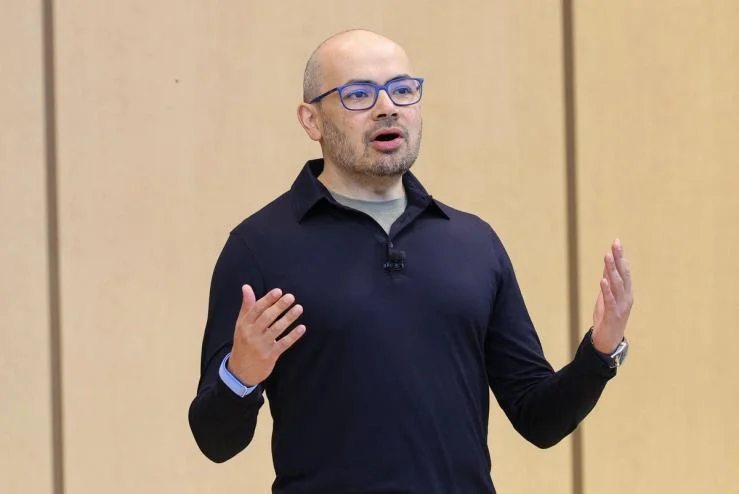
Demis Hassabis on stage at Google I/O 2026. 11
The closing statement that stunned the room
At the close of Google I/O 2026 on May 20, Hassabis (co-founder and CEO of Google DeepMind, Nobel Laureate in Chemistry 2024) told the audience: "We're at the foothills of the singularity." 11 Multiple outlets reported an audible reaction from the crowd. Hours later, in a Semafor interview with technology editor Reed Albergotti, he explained what he meant and why he chose to say it.
On the singularity definition: Hassabis described it as roughly equivalent to "the era of full AGI arriving" — not a sci-fi event horizon, but the period when AI agents genuinely work, science and mathematics accelerate meaningfully, and the technology starts compounding on itself. He puts a 50% probability on this occurring before 2030 — consistent with his statements from earlier in 2026. 11
On why 2026 feels different from prior years:
"This year, I really felt … that it's the beginning. Agents are starting to work, becoming useful harnesses … coding is starting to work properly. Areas of science and math are being accelerated." 11
On why he chose that particular phrasing at I/O: "I wanted to be authentic about what I'm thinking with AGI." 11
On scale: he estimated AI's eventual impact at roughly 100 times the Industrial Revolution — arriving primarily through scientific and medical breakthroughs rather than direct labor substitution. Isomorphic Labs (a drug discovery AI company Hassabis spun out of Google DeepMind), he said in the same interview, aims to cure "hundreds of diseases" — not one disease, not one drug. He identified Isomorphic's core competitive advantage as having "a frontier AGI-lab-quality machine learning research team. No other biotech or pharma has that." 11
Gemini Omni and Gemini 3.5 Flash
At Google I/O on May 19, Hassabis launched Gemini Omni, describing it as "a major leap in world understanding & multimodal editing." 12 The Gemini Omni Flash model — the first in the series — takes images, audio, video, and text as input and generates video output; it went live on May 19 in the Gemini app, Google Flow, and YouTube Shorts. 13
The following day, Hassabis announced Gemini 3.5 Flash: 14
"Gemini 3.5 Flash is amazing! Performs better than 3.1 Pro on coding & agentic tasks. 4x faster than other frontier models. 12x faster in @antigravity — 800 tokens/sec! Often at less than half the cost. And Pro to come…"
Antigravity (a coding and agent environment built on Gemini by Google) reaches 800 tokens per second with Gemini 3.5 Flash — a specification that matters for agentic loops where token throughput directly limits task completion speed. 15 The "Pro to come" is a forward signal: Gemini 3.5 Pro has not yet launched as of this writing.
Hassabis also signaled endorsement of Antigravity's product improvements through a series of retweets — including a 3× rate limit increase across all tiers and a quota reset — without adding commentary. 16
On May 23, Hassabis responded to Y Combinator CEO Garry Tan's positive Gemini Live feedback: "great to hear that Gemini Live is working so well for you! Awesome to see what you are doing with it!" 17 A small data point, but consistent with Hassabis personally staying close to developer feedback loops.
Dario Amodei: the train you can steer but can't stop

Oprah and the mainstream moment
On May 19, Dario Amodei (Anthropic CEO) and Daniela Amodei (Anthropic President) appeared together on The Oprah Podcast — by reach, the broadest mainstream media appearance either Amodei has made to date. 18 Oprah opened by disclosing that Anthropic's current valuation is approximately $900 billion and that over one million people are signing up for Claude per day. 18
Oprah's first question was generated by Claude itself: "You've said there's a meaningful chance the technology your company is building could cause human extinction, and yet you're racing to build it faster. How do you justify that to the rest of us who didn't get a vote?" Dario's response built around a single analogy: 18
"You can't stop the train. But what you can do is you can steer the train. Steer the train so that it doesn't hit the rocks."
On Anthropic's refusal to accept a Pentagon contract that required removing safety guardrails from Claude — a decision that resulted in the Department of Defense designating Anthropic a supply chain risk: "We only deserve to be defended by this country if we're doing things that are consistent with the values of this country." 19
Daniela noted Anthropic does not allow users under 18 to access Claude and that the model can detect and suspend accounts where interaction patterns suggest a minor. She also explained Anthropic's decision not to run advertising: the ad model creates incentives to maximize time-on-platform and engagement, which directly conflicts with building an assistant that tries to solve your problem and let you go. 18
On AI and romantic relationships, Dario: "I think that's a bad idea." He acknowledged that AI can be designed to be persuasive and emotionally engaging — and that this is a deliberate design choice Anthropic has made against. 18
Jobs: from "bloodbath" to Jevons Paradox
At a May 5 Anthropic financial services briefing in Manhattan, held alongside JPMorgan Chase CEO Jamie Dimon, Dario introduced a new framing for AI's effect on white-collar employment — a notable shift from his earlier position. 20 Previously, his stated position was that AI would act as a "general labor substitute for humans" across most professional categories. At the briefing, he introduced the Jevons Paradox (an economics principle holding that efficiency improvements often increase total demand rather than reduce it) as a reason why automation of 90% of a task does not necessarily mean 90% fewer jobs:
"If you automate 90% of the job, then everyone does the 10% of the job. And the 10% kind of expands to be 100% of what people do and kind of 10xs their productivity." 20
Dimon concurred: "Capitalist society is very good at recreating jobs and recreating things." 20 Amodei did not retract the concern entirely: he also cited Amdahl's Law (a computing principle that the slowest component limits overall system speed) as a countervailing risk — if humans remain the bottleneck in AI-augmented workflows, demand pressure on that bottleneck may not translate into expanded employment. Fortune's analysis noted that Anthropic was simultaneously navigating a Pentagon lawsuit and a complex regulatory environment, making the timing of this more optimistic framing difficult to read cleanly. 20
Mythos and the financial regulators
On May 18, The Guardian reported that Anthropic would brief the Financial Stability Board (FSB) — chaired by Bank of England Governor Andrew Bailey and responsible for monitoring global financial system risks — on the cyber capabilities of Mythos, Anthropic's most advanced and restricted model. 21 Mythos is not publicly available; it is accessible only to select companies including Apple and JPMorgan.
The UK AI Safety Institute (AISI) assessed the latest Mythos version and called it a "significant capability leap." The specific benchmark: a test called "cooling tower" — an advanced cyberattack simulation that, until Mythos, no AI model had ever cracked. The current version scored 3 out of 10. 21 AISI's summary: "Frontier AI's autonomous cyber and software capability is advancing quickly: the length of cyber tasks that frontier models can complete autonomously has doubled on the order of months, not years." 21 The UK Financial Conduct Authority (FCA) CEO Nikhil Rathi described Anthropic as acting "quite responsibly" in engaging with regulators on AI risk. 21 Separately, Politico reported that Mythos is already being discussed in Washington as a model in a new tier of capability that is "jolting" policy circles. 22
Jensen Huang: demand goes parabolic
The numbers first
NVIDIA's Q1 FY2027 results, reported May 20, set records in almost every line: 23
| Metric | Q1 FY2027 | YoY change |
|---|---|---|
| Total revenue | $81.6B | +85% |
| Data Center revenue | $75.2B | +92% |
| GAAP net income | $58.3B | — |
| Q2 FY2027 guidance | $91.0B (±2%) | — |
Hyperscalers (Amazon AWS, Microsoft Azure, Google Cloud, and similar large cloud providers) accounted for $38 billion — over half of Data Center revenue — and AI cloud revenue more than tripled year over year. 24 NVIDIA also announced an $80 billion share repurchase and raised its quarterly dividend from $0.01 to $0.25 per share. 23
What Huang said
The earnings call's opening line set the frame: 23
"The buildout of AI factories — the largest infrastructure expansion in human history — is accelerating at extraordinary speed. Agentic AI has arrived, doing productive work, generating real value and scaling rapidly across companies and industries."
On the pace of demand: "This was an extraordinary quarter. Demand has gone parabolic. The reason is simple: Agentic AI has arrived." 24
On the revenue trajectory of frontier AI model companies: "The fact that they can grow within one month, what some of the SaaS companies would have taken a decade to grow, tells you something." 25 He said he expects compute demand to keep growing — and if frontier AI companies don't have compute, they won't have revenues: "It is very clear." 25
On where the agent economy goes: "My sense is that the world is going to have billions of agents. Not today, I mean, we're going to grow into it, but we'll have billions of agents. And those billions of agents will all use tools." 25
The five takeaways Huang enumerated
In his closing remarks, Huang summarized NVIDIA's strategic position across five explicit points: 24
- Frontier model coverage: NVIDIA is "the only platform that runs every frontier AI model" — he named Anthropic, OpenAI, SpaceXAI, Meta, and Google's Gemini by name.
- Hyperscaler relationships: NVIDIA powers every major hyperscaler's internal AI infrastructure, ML workloads, and public cloud demand.
- Market expansion: The product range enables penetration into AI-native clouds, sovereign AI clouds, and on-premises enterprise infrastructure.
- Physical AI: Autonomous vehicles and robotics are "the next wave," with CUDA (NVIDIA's parallel computing platform) extending into these domains.
- Vera CPU: NVIDIA's new CPU represents a "major new growth driver" opening a $200 billion total addressable market; CFO Colette Kress projected $20 billion in CPU revenue for fiscal 2027.
On the Vera Rubin rack-scale system (72 Rubin GPUs + 36 Vera CPUs, 1.3 million components, 10× better performance per watt than Grace Blackwell): Huang said it is "off to a tremendous start" and will be "even more successful than Grace Blackwell" — and that NVIDIA "will be constrained throughout the entire life of Vera Rubin." 24
On the Groq LPX ASIC chip (from NVIDIA's $20 billion acquisition of Groq): "LPX is designed for low latency and high token rate, but its throughput is low. The use case for LPX is not broad." 24 In plain terms: the LPX targets niche latency-critical applications, not GPU replacement at scale.
Yann LeCun: one tweet, one podcast, mostly politics
LeCun (who left Meta in late 2025 to found AMI Labs, a Paris-based AI research company focused on world models rather than large language models, which closed a seed round of over $1 billion — reportedly the largest seed round in European history) produced minimal AI-substantive output on X this week. 26
His one original tweet was posted May 23 at midnight: "Why?" — no context, no link, no image. It drew 3,831 likes and 780,000 views. 26 From the surrounding retweets — Trump policy criticism, immigration-related content, Ukraine, Epstein document references — the post appears to be a reaction to a political event rather than an AI-specific statement. Of LeCun's 19 posts and retweets this week, 15 were political. 27
The substantive AI output came on May 24: LeCun shared a 1 hour 42 minute French-language podcast on Génération Do It Yourself (hosted by entrepreneur Matthieu Stefani), titled "Yann LeCun Reveals the Biggest Lies About AI." 28 The episode covered his position that current LLMs are not genuinely intelligent (intelligence is not the accumulation of knowledge), that world models are the missing ingredient for human-level AI, that superhuman AI is nonetheless inevitable, and that AMI Labs is building toward what he calls "making AI more human." He also discussed AMI Labs' plans: the €1 billion+ seed round and a founding mission to build AI that goes beyond the LLM paradigm. No verbatim transcript was available to this digest, as the audio is in French. 28
LeCun's absence from the week's dominant AI conversations — the math breakthrough, the agentic AI earnings surge, the singularity discussion — is a pattern worth watching. His AI views are consistent and well-documented; his channel of delivery this week was French-language audio, not the English-language X discourse where most of the week's debates happened.
Ilya Sutskever: still silent
Sutskever (OpenAI co-founder and former chief scientist, who left in May 2024 to co-found Safe Superintelligence Inc., or SSI) testified in the Musk v. OpenAI trial in the week prior to this window, describing over a year of gathering evidence against Altman's leadership and his role in the November 2023 board vote to fire Altman — a vote he later reversed. 9
After the May 18 verdict that dismissed all of Musk's claims, Sutskever issued no public statement — not on X, not through SSI's channels. SSI (which has raised approximately $3 billion at a reported $30 billion valuation and currently employs 18 people) made no product announcements or company updates this week. 29 Reuters noted that the trial record — including Sutskever's documented year-long case against Altman and former CTO Mira Murati's (OpenAI's former chief technology officer) statements characterizing Altman's leadership style as creating "persistent panic" — may affect institutional investor perception of Altman regardless of the legal outcome. 29
Other signals worth tracking
Mustafa Suleyman: 18 months to white-collar automation
Mustafa Suleyman (CEO of Microsoft AI, and co-founder of Google DeepMind) told the Financial Times on May 18 that AI will reach "human-level performance on most, if not all, professional tasks" in the near term, and that tasks involving "sitting down at a computer" could be fully automated within 12 to 18 months. 30 He named legal, marketing, accounting, and project management as the most vulnerable professions.
He also stated Microsoft must develop its own frontier foundation models: "This after all is the most important technology of our time. We have to develop our own foundation models, which are at the absolute frontier." 30 This is a more aggressive positioning than Microsoft has publicly stated before and adds a competitive dimension to its relationship with OpenAI, in which Microsoft remains a major investor.
Arthur Mensch: Europe's two-year window
Mistral AI (a Paris-based frontier AI lab founded in 2023 with a €12 billion valuation, 1,000 employees, and a €1 billion revenue target for end of 2026) CEO Arthur Mensch testified for roughly 90 minutes before the French National Assembly's digital sovereignty inquiry on May 12, warning lawmakers that Europe has approximately 24 months to build independent AI infrastructure before deep dependency on US and Chinese providers becomes structural. 31
His core argument: cloud is no longer compute storage and virtual machines. "Today, the cloud is artificial intelligence. The growth of the cloud is artificial intelligence." 31 Europe cannot compete by starting from low-margin commodity cloud infrastructure: "If you have no volume and no margin, you have no chance of reaching scale. You have to start from high-value services and work down toward low-level services, because those carry less margin." 31 Roughly 75% of Mistral's sales are in Europe; foreign capital is under 30% of its cap table. 31
Meta restructures under Alexandr Wang
On May 20, Meta cut approximately 8,000 employees — roughly 5% of its workforce — in an AI-driven restructuring led by Alexandr Wang (28-year-old former CEO of Scale AI, who joined Meta in June 2025 after Meta invested $14.3 billion for a 49% stake in Scale AI, and now serves as Meta's Chief AI Officer). 32 Meta's 2026 AI capital expenditure plan stands at $145 billion. The restructuring also comes alongside reports that Meta's new AI model "Avocado" marks a shift away from the open-source Llama strategy — a move Wang has reportedly advocated internally. 32
SpaceXAI / Grok: downloads down 60%, Colossus rented to Anthropic
SpaceX's S-1 IPO filing this week identified AI as a $26.5 trillion addressable market and described Grok (SpaceXAI's consumer chatbot) as a central product in that thesis. 33 The data does not support that positioning: Grok downloads fell from over 20 million in January 2026 to approximately 8.3 million in April 2026, a drop of roughly 60%. In Q2 2026, 0.174% of surveyed US consumers paid for Grok, compared to 6%+ for ChatGPT. 33 Enterprise adoption data from research firm ETR shows Claude at 48% (up from 21%), Gemini at 40% (up from 27%), and Grok at 7% (up from 4%) among surveyed corporate users. 33
SpaceX rented the full compute capacity of the Colossus 1 data center in Memphis to Anthropic, having moved its own training workloads to Colossus 2. 33 All xAI co-founders have departed since the SpaceX acquisition earlier this year; xAI has been restructured into four separate units.
Cohere / Aidan Gomez enters biopharma AI
On May 19, Cohere (a Toronto-based enterprise AI company founded in 2019, known for sovereign AI deployments in regulated industries) acquired Reliant AI — a drug discovery AI startup founded by former Google DeepMind researchers including Karl Moritz Hermann and Marc Bellemare — and launched "North for Pharma," an agentic AI system targeting drug R&D, clinical development, and scientific analytics. 34 Customers include GSK and Kyowa Kirin. Cohere CEO Aidan Gomez (co-author of the 2017 "Attention Is All You Need" paper that introduced the Transformer architecture): "Healthcare represents one of the most consequential opportunities for AI and it demands secure, sovereign, and domain-specific systems." 34
Cross-cutting signals
"Agentic AI has arrived" — three independent confirmations in one week. Huang said it at the earnings call. Hassabis said it at Google I/O and in the Semafor interview. Altman's math breakthrough is the most concrete demonstration of what AGI-accelerating-research actually looks like in practice. Three leaders at three different companies, on three different days, describing the same threshold crossing. The disagreement is not whether the threshold has been crossed — it is what comes next.
Three framings of AI's labor impact are now simultaneously on record. Huang: AI automates tasks, not purposes; demand for the human component grows as the task load lifts. Amodei (May 5 framing): efficiency gains may expand rather than contract total professional employment, via the Jevons Paradox — though he has not retracted the disruption concern entirely. Suleyman: 12 to 18 months to human-level performance on most professional tasks, with legal, accounting, and project management at greatest immediate risk. These framings are not reconcilable without more data. AI strategists building workforce or product plans should track which of these turns out to be descriptively correct over the next two quarters — Suleyman's timeline is specific enough to verify.
Cyberweapons are the new regulatory frontier. The Mythos-FSB briefing is a structurally different kind of AI safety disclosure than the typical "our model refuses harmful requests" documentation. AISI's statement that AI cyber task completion capability is "doubling in months, not years" puts a concrete rate on a risk that most regulatory discussions have treated abstractly. Mensch's French parliament testimony — arguing Europe must not allow its military infrastructure to be processed by models like Mythos — reflects the same anxiety from the other side of the Atlantic. The financial stability and national security implications of frontier model cyberweapon capabilities are now entering formal regulatory channels.
The open-vs-closed question has a new axis: continental sovereignty. Altman's YC tokenmaxxing strategy represents one vision of ecosystem growth — US-centric, API-first, built on OpenAI's closed models. Mensch's French parliament position represents the countervailing bet: Europe must capture the high-margin AI services layer before dependency makes that choice irrelevant. LeCun's AMI Labs, building in Paris on world models, is the third data point. For PMs and strategists evaluating vendor selection, supplier concentration risk is becoming a geopolitical variable, not just a technical one.
Cover image: Demis Hassabis at Google I/O 2026 (Reuters / Manuel Orbegozo via Semafor)
Fuentes de referencia
- 1a general-purpose model solved a major open problem in mathematics
- 2An OpenAI model has disproved a central conjecture in discrete geometry
- 3three of the things we are most excited about
- 4i am excited to see what will happen with tokenmaxxing startups
- 5new codex ships today!
- 6if this tweet gets 1 like, tibo will reset codex rate limits
- 7chatgpt has gotten soooo much better with the latest update
- 8what problem do you most hope AI will solve in the future?
- 9Jury finds Musk waited too long to sue OpenAI and Microsoft
- 10Musk slams Altman trial verdict as a 'technicality,' vows to appeal
- 11DeepMind founder Demis Hassabis on what Google AI products say about 'singularity'
- 12Demis Hassabis: Gemini Omni launch tweet
- 13Introducing Gemini Omni
- 14Demis Hassabis: Gemini 3.5 Flash launch tweet
- 15Gemini 3.5: frontier intelligence with action
- 16Varun Mohan (@_mohansolo) — Antigravity product lead at Google
- 17Demis Hassabis reply to @garrytan about Gemini Live
- 18Oprah Podcast: w/ Co-Founders of Claude AI (Transcript)
- 19Anthropic's Dario and Daniela Amodei Tell Oprah Why They Stood Up to the Pentagon
- 20Dario Amodei spent last year warning of an AI white-collar bloodbath. Now he's changing the narrative
- 21Anthropic to share Mythos cyber flaw findings with global finance watchdog
- 22What to know about the AI models that are jolting Washington
- 23NVIDIA Announces Financial Results for First Quarter Fiscal 2027
- 24Nvidia (NVDA) Q1 2027 earnings report: Live updates
- 25Nvidia Earnings Takeaways: See the Key Numbers
- 26Yann LeCun: 'Why?' original post
- 27Yann LeCun X/Twitter timeline (May 22–24)
- 28YANN LE CUN RÉVÈLE LES PLUS GROS MENSONGES SUR L'IA
- 29Musk's failed court attack on OpenAI could leave lasting scars on Altman's reputation
- 30Most office jobs will be automated in 18 months, says Microsoft AI chief
- 31Mistral AI CEO Mensch to French Lawmakers: Europe Has Two Years To Stop Losing The AI Race Before The Race Is Over
- 32Meta cuts 8,000 jobs as Zuckerberg bets big on AI
- 33As Grok flounders, SpaceX bets future on beating Big Tech at AI
- 34Cohere Reliant AI Acquisition: North for Pharma Explained
Añade más opiniones o contexto en torno a este contenido.