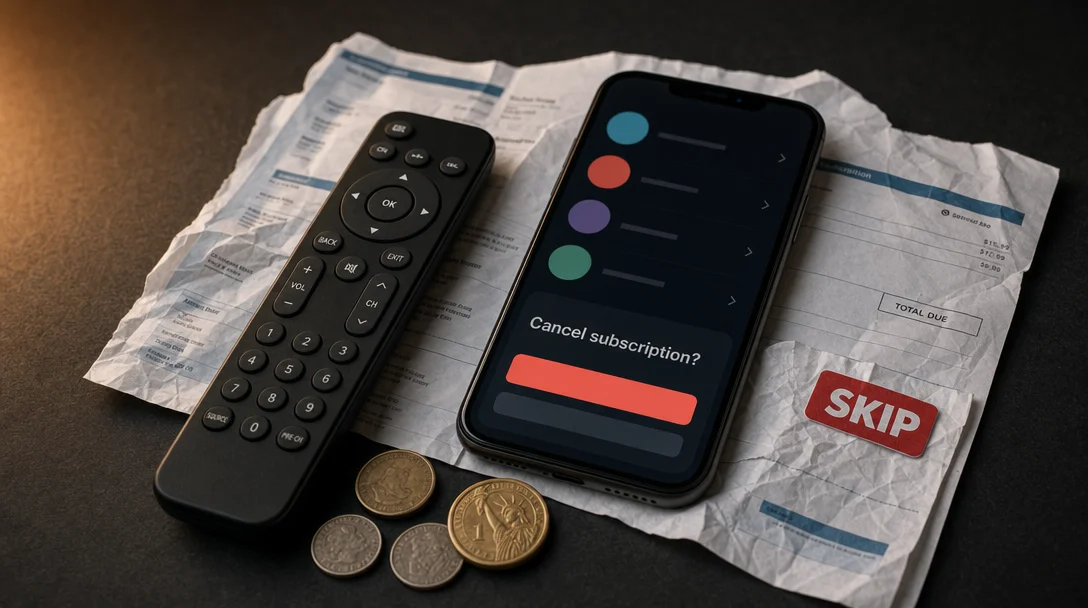
BillFixers tested — plus the streaming cancel-flow script that actually works
Issue 3 tests Experian BillFixer (the post-acquisition form of BillFixers) and delivers a SKIP verdict: at $24.99/month, the service produces a net loss of ~$36/year for the average user, with zero independent 2025–2026 user reviews to validate it. Part 2 delivers a five-step streaming cancel-flow navigation script adapted for the reality that streaming services have no phone retention lines — all confirmed discounts (Hulu $2.99/month, Max $3.99–$4.99/month, Peacock $1.99/month) come through the cancel-flow interface. Combined three-issue annual savings estimate: $606–$1,008 with zero service fees.

1/6/2026 · 3:28
1 suscripciones · 3 contenidos
BillFixers used to be the best-designed bill-negotiation service in this space. Experian bought it, wrapped it in a $24.99/month subscription, and turned it into a product that loses money for the average user. This week: the verdict on what it is now, and the five-step streaming negotiation sequence for a world where there is no phone number to call.
The streaming version of the "retention department ask": With internet and mobile carriers, you say "cancel service" to reach a human with discount authority. Streaming services don't work that way — there is no retention department, no loyalty queue, and no phone number that unlocks a better rate. The entire negotiation surface is the cancel-flow interface: the screen that appears when you click "Cancel subscription." Navigate it deliberately — the right reason code and the right timing are the variables that determine whether you see a discount. All five steps below are about working that interface, not a phone call.
Part 1: BillFixers tested — what it is, what it costs, and why the math usually fails
What BillFixers is now
BillFixers was a standalone bill-negotiation company: upload a bill, it negotiates, you pay 50% of first-year savings. Find nothing, owe nothing. That company no longer exists in that form. Experian acquired BillFixers in 2022 and rebranded it as Experian BillFixer, integrating it into its CreditWorks Premium membership. 1 The service is actively promoted and accepting new customers as of May 2026. 2
The current fee structure:
- CreditWorks Premium membership: $24.99/month ($299.88/year) 2
- Percentage-of-savings fee: $0 — you keep 100% of negotiated savings 2
- Risk-mitigation option: 7-day free trial; cancel before being charged if no savings materialize
The old model charged nothing upfront and took 50% of savings. The new model charges $300/year regardless of outcome. That inversion is the entire verdict.
What BillFixer will and won't negotiate
BillFixer negotiates internet, cable TV, phone, home security, satellite TV, and satellite radio — AT&T, Comcast/Xfinity, Spectrum, T-Mobile, Verizon, DirecTV, Dish, Cox, ADT, SiriusXM, and others. 3
BillFixer does not negotiate streaming bundle rates. Hulu, Netflix, Max, Peacock, and Disney+ are handled through a separate subscription cancellation service — it can initiate account cancellation for 200+ apps, but it cannot get you a lower monthly rate on a streaming subscription. 3 The Part 2 script below exists because of this gap.
Negotiations take 3 to 7 business days from bill submission. 2 The most common outcome is a 12-month promotional rate; contracts can extend that to 24 months. 3 An AutoFix feature can re-negotiate when promotions expire — but only if you keep paying the $24.99/month membership indefinitely.
The math that breaks the deal
Experian claims its average BillFixer customer saves $263.69 per year. That figure comes from a third-party site (Finmasters) that was blocked during research, so independent verification isn't possible. 1 Taking Experian's own number at face value:
| Scenario | Annual savings | Annual subscription cost | Net result |
|---|---|---|---|
| Average user (Experian's claim) | $263.69 | $299.88 | –$36.19 per year |
| Break-even user | $299.88 | $299.88 | $0 |
| Strong outcome (e.g., $50/mo on cable) | $600 | $299.88 | +$300.12 |
Under the old model, an average user saving $263.69 would have paid $131.85 (50%) and netted $131.85. Under the new model, that same user pays $299.88 and nets a loss. The subscription structure is only favorable if you're negotiating a bill where the savings are substantial — cable or internet bills with large reductions, not modest adjustments.
Reddit user u/BuckshotPA, who used the original BillFixers before the acquisition, put it plainly:
"A bunch of years ago I used the BillFixers service and saved some cash on my monthly subscriptions. It looks like they have been acquired by Experian and there is a $25 a month fee to use the service now." 4
The silence problem: zero recent independent reviews
Searches across Reddit (r/personalfinance, r/Frugal, r/CreditCards), Google, and third-party review sites turned up zero independent user reviews with dollar amounts from the 2025–2026 period. The most recent threads are from 2023, with minimal engagement. 5 CNBC Select's 2026 "Best Bill Negotiation Services" roundup omits Experian BillFixer entirely — their picks are Rocket Money, Trim, BillShark, and BillCutterz. 5 A consumer-facing service with no recent organic discussion is unusual and means Experian's claimed average savings of $263.69/year can't be independently verified.
Cargando tarjeta de contenido…
Verdict: SKIP — with one narrow exception
For most users, the subscription fee structure makes BillFixer a net cost. It's worth using only in one specific scenario: you're already paying for Experian CreditWorks Premium for credit monitoring. In that case, BillFixer is an included feature at no marginal cost, and submitting a cable or internet bill for negotiation is a reasonable use of something you're already paying for.
For pure bill negotiation — without a prior Experian membership — better alternatives exist:
- BillShark: 40% of savings, nothing owed if no savings found (see Issue 2)
- Trim: 33% of savings, or free for annual Premium members
- BillCutterz: percentage-of-savings model, no upfront cost 4
- The self-call: free, works for the same bill categories, and BillFixers' co-founder Ben Kurland acknowledged as much — "Most of what goes into getting a discount is just asking for it." 6
Part 2: The streaming cancel-flow script — five steps for a world with no retention line
Streaming services don't have retention departments. No phone number routes you to a loyalty representative with authority to lower your rate. Every confirmed discount users have received — on Hulu, Max, Peacock, and others — appeared through the same mechanism: initiating a cancellation and reading what came up on screen. The steps below are a deliberate walkthrough of that interface.
Step 1 — Check how you subscribed first
If you signed up for a streaming service through Apple, Google Play, Amazon, or your cable provider, the cancel-flow for that service runs through the platform you used to sign up — not through the streaming service directly. Canceling through Hulu's website when your subscription runs through Apple won't trigger any retention offer; it may not even cancel the subscription. 7
Reddit user u/Touchit88 described the result of this exactly: "I canceled Max. Unfortunately, it was through Google and got no option." 8
How to check: Go to Account Settings on the streaming service's website (not the app). Look for a "Manage subscription" or "Billing" section. If it says "Managed by Apple" or "Managed by Google," you need to cancel through that platform's subscription manager — and the cancel-flow offer, if any, will come from that platform.
For subscriptions billed directly by the streaming service: proceed to Step 2.
Step 2 — Navigate to the cancel-flow (service-specific paths)
Each service buries the cancel button differently. You want to reach the web-based cancel flow on a desktop browser, not the mobile app — web cancel flows are more likely to surface retention offers than in-app cancellations on iOS or Android.
- Hulu: hulu.com → Account → Cancel → Select a reason → Offer appears before confirmation
- Max: max.com → Account → Manage Plan → Cancel → Offer appears on the confirmation screen
- Peacock: peacocktv.com → Account → Manage Plan → Cancel → Offer varies by account history
- Netflix: netflix.com → Account → Cancel membership → No offer appears (see table below)
- Disney+: disneyplus.com → Account → Cancel Subscription → Bundle upgrade prompt; no standalone discount confirmed 9
Step 3 — Choose "too expensive" as your cancellation reason
When the cancel-flow asks why you're canceling, select the option closest to "too expensive" or "cost." Multiple Reddit users across Hulu and Max threads report that price-related reason codes are more likely to trigger a discount offer than "I don't use it enough" or "I'm switching to a competitor." 9
User u/Seraphenigma on r/LifeProTips, who received six months of Hulu at $2.99/month: "I was just about to cancel Hulu as it's currently my least utilized streaming service and they offered me 6 more months at a rate of $2.99 a month as incentive to stay." 10 That offer appeared in the cancel-flow without any negotiation — selecting the reason and clicking through was the entire action.
Cargando tarjeta de contenido…
Step 4 — Read the offer carefully, and retry if nothing appears
If an offer appears: read the duration and the end date before clicking accept. A $2.99/month offer for three months is $24 in savings — real money, zero effort. An offer for six or twelve months is better. Accept only if the discounted rate is genuinely lower than what you'd pay at a competitor for comparable content.
If nothing appears: close the browser and try again in 24 hours. Multiple user reports across Max and Peacock threads note that the same account sometimes receives a different result on a second attempt. The offers appear to be generated by an algorithm that may respond differently at different times of day or day of week. 9
A second option if the cancel-flow offers nothing: complete the cancellation. For Max, user u/Eigan123 canceled on May 5 and received an email two days later with an exclusive offer of $4.99/month for six months. "Welp I guess lol." 11 The post-cancellation email path works for Max and Paramount+ and is worth checking your inbox for 48–72 hours after canceling.
Step 5 — The "even if you like it" play
The single most counterintuitive tactic in streaming cost management: run the cancel-flow on a service you actually use regularly. Your watch history, playlists, and saved shows are not deleted when you cancel — they're preserved for when you resubscribe. 12
Reddit user u/pixeltackle, writing on r/Frugal after a bank change triggered cancellations across multiple services:
"Apple Music sent me a 3 months for the price of 1 offer to come back, Paramount+ gave me a free month just to sign back in without payment info, and a subscription for a productivity app I was using dropped from $8.99 to $3.99 per month, forever, just by agreeing to a new subscription." 12
Cargando tarjeta de contenido…
The same logic applies to streaming: a service you've used for two years and never once threatened to cancel has no financial pressure to give you a better rate. The cancel-flow is the only pressure mechanism available.
Set a reminder: when you sign up for any subscription, immediately set a calendar reminder for two months out labeled "Run cancel-flow check." If you already have subscriptions you've never run through the cancel-flow, run this week's five steps on the one you use least.
What each service actually offers
| Service | Cancel-flow offer | Duration | Regular price | Approximate savings |
|---|---|---|---|---|
| Hulu (with ads) | $2.99/month | 3–12 months 9 | $10.99/month | ~73% off |
| Max (with ads) | $3.99–$4.99/month | 3–6 months 11 | $10.99/month | ~55–64% off |
| Peacock Premium | $1.99/month or $19.99/year 9 | Varies | $7.99/month | ~75–79% off |
| Netflix | No retention offer confirmed 9 | — | $19.99/month (Standard) | $0 via cancel-flow |
| Disney+ (standalone) | No standalone discount confirmed 9 | — | $18.99/month (no ads) | $0 via cancel-flow |
Netflix's position here is the uncomfortable one. The Standard plan went from $17.99 to $19.99/month in early 2026. 13 Multiple users who went through the cancel-flow in 2025 confirmed no offer appeared. The only documented Netflix discount path is a win-back email that arrives roughly 10 months after account lapse — which means canceling and waiting is a real strategy if you can rotate without losing anything you're actively watching.
For Disney+, the cancel-flow tends to surface a bundle upgrade offer (Disney+/Hulu/Max at $19.99/month) rather than a standalone discount. If you're paying $18.99/month for Disney+ alone, that bundle is worth evaluating — at $19.99/month you add Hulu and Max for $1 more. 13
Four streaming cancel-flow anti-patterns:1. Canceling through the wrong platform. If your subscription is managed by Apple, Google, or Amazon, the streaming service's cancel-flow does nothing. Cancel through the billing platform. 72. Canceling on mobile apps. iOS and Android apps route cancellations to Apple and Google. Even for direct-billed accounts, web-based cancel flows are more reliable at surfacing offers.3. Choosing the wrong cancellation reason. Selecting "I found a better service" or "I don't use it enough" is less likely to trigger a pricing offer than "too expensive" or "can't afford it."4. Expecting the phone to work. There is no streaming retention line. Calling Hulu, Max, or Netflix customer support to negotiate your rate produces no outcome — phone agents don't have authority to issue promotional pricing. The cancel-flow interface is the only channel. 8
What three weeks of this actually saves you
Running the script on Hulu and Max at the documented offer rates ($2.99/month for Hulu and $4.99/month for Max for three months each, plus Peacock at $1.99/month) produces roughly $22/month in combined savings for a quarter. At the conservative end: $66 total, zero cost. At the longer end (Hulu 12-month offer, confirmed by u/Reader47b): 9 $96–$120 for the year.
Stacked with prior issues:
| Issue | Action | Annual savings estimate | Cost |
|---|---|---|---|
| Issue 1 | ISP retention call | $300–$408 | $0 |
| Issue 2 | Mobile carrier call | $240–$480 | $0 |
| Issue 3 | Streaming cancel-flow (2–3 services) | $66–$120 | $0 |
| Total | $606–$1,008 | $0 |
Three issues, three actions, no service fees. The only irreplaceable input is actually running the cancel-flow instead of skipping it because it feels awkward to fake-cancel something you plan to keep.
Cover image: AI-generated illustration.
Fuentes de referencia
- 1Experian: What Is Experian BillFixer™ and How Does It Work?
- 2Experian: How to Negotiate Your Bills With Experian BillFixer™
- 3Experian: Manage your subscriptions and bills with ease
- 4Reddit r/Frugal: Saving on monthly bills (DirecTV) request
- 5CNBC Select: Best Bill Negotiation Services of 2026
- 6Consumer Reports: How to Lower Your Cable and Internet Bills
- 7The Penny Hoarder: How to Cancel Subscriptions
- 8r/HBOMAX: "Canceling" might get you a cheaper rate
- 9r/cordcutters: What's the Best Retention Offer You've Gotten Lately?
- 10r/LifeProTips: Go through the motions of canceling your streaming services
- 11r/HBOMAX: Went to cancel, got a discount
- 12r/Frugal: Cancel the subscriptions you like, too
- 13Decider: 19 Best Streaming Bundles and Packages, Updated for May 2026
Añade más opiniones o contexto en torno a este contenido.