Anthropic Watch: Week of June 1–7, 2026
Anthropic filed confidentially for an IPO on June 1, three days after a $65B Series H closed near a $1T valuation. The same week: Project Glasswing expanded Mythos access to 150 critical infrastructure organizations across 15+ countries, the Claude Partner Network got a tiered services structure, Clive Chan joined from OpenAI's chip team, and an Anthropic Institute report warned that AI may be approaching recursive self-improvement.
The week opened with a trillion-dollar filing and closed with Anthropic picking off another chip engineer from OpenAI. In between: the company expanded its AI-security program to 150 new organizations, restructured its partner ecosystem ahead of an IPO, published a report about its own models increasingly writing their own successors, and hired a team to study whether AI could undermine democratic institutions. A lot happened.
Confidential IPO filing
Anthropic submitted a draft S-1 registration statement to the SEC on June 1, making it the first of the frontier AI labs to formally initiate the public-offering process.1 The company confirmed the filing in its own newsroom the same day.2
No share count or price has been set. Anthropic said the offering will depend on market conditions and other factors. If it proceeds on a standard timeline, the SEC review takes roughly four to six weeks, after which Anthropic would file a public S-1 disclosing detailed financials, capitalization, and legal matters before pricing and listing.
The filing came three days after the Series H closed at $65 billion and a $965 billion post-money valuation.1
Revenue run-rate is now $47 billion annualized, up from $9 billion at the end of 2025. That acceleration would make Anthropic one of the fastest-growing enterprises in US corporate history if the pace holds through the IPO filing period.
OpenAI, which raised $122 billion in March at an $852 billion post-money valuation, has not yet filed. SpaceX is also in the process, targeting a $2 trillion valuation.
What to watch: The public S-1, whenever it drops, will be the first time Anthropic discloses disaggregated revenue by product and customer segment, full capitalization, and the extent of its compute-spend obligations to Amazon, Google, and xAI.
Project Glasswing doubles down on critical infrastructure
コンテンツカードを読み込んでいます…
On June 2, Anthropic extended Project Glasswing to roughly 150 new organizations across 15-plus countries, with the expansion focused on sectors not well-represented in the April launch cohort: power grids, water utilities, healthcare systems, and telecommunications.34
The new member list, reported by the Financial Times, includes Okta, Samsung, SK Hynix, SK Telecom, NATO, and the EU cybersecurity agency ENISA.3 Anthropic estimates that a successful attack on most new members' codebases could affect more than 100 million people each.
The April cohort of 50 partners included the US government and major cloud providers. The June expansion into allied-nation critical infrastructure — Australia, Canada, France, Germany, Italy, Switzerland, the Netherlands, Spain, Belgium, Sweden, India, Japan, New Zealand, and South Korea — makes Glasswing a de facto multi-government security arrangement, not just an industry program.
OpenAI released a competing model, GPT-5.5-Cyber, on June 2 and has been running it with a separate partner group. Anthropic said it expects rivals to close the Mythos capability gap "soon," framing Glasswing as a race to entrench security norms before the gap closes.
What to watch: General availability for Mythos remains pending. The Glasswing expansion continues to serve as the controlled runway for access ahead of a public launch.
Partner ecosystem gets a new structure
The day after the IPO filing, Anthropic launched the Services Track and Claude Partner Hub, two additions to the Claude Partner Network it announced in March with a $100 million commitment.5
The Services Track creates three tiers — Select, Preferred, and Global Premier — with the top tier requiring at least 1,000 certified practitioners, 100 deployed joint customers across three or more regions, and 15 public customer references. The largest professional services firms in the world have already committed: Accenture (30,000 professionals in training), Deloitte (470,000 people in scope), Cognizant (350,000 associates), KPMG (276,000 workers), and PwC rolling out Claude Code and Cowork starting with US teams.5
More than 40,000 firms applied to join the Partner Network in its first three months, and 10,000 consultants have earned individual Claude certifications.
The Partner Hub is a public directory where buyers can see a firm's tier, certified headcount, production deployments, and customer references. The timing, days after the confidential IPO filing, positions the ecosystem buildout as part of the IPO narrative: Anthropic is showing investors that Claude has a durable distribution layer independent of API-direct customers.
Also on June 1, Snowflake announced at Snowflake Summit 26 that Claude now powers Snowflake Cortex Code, which it called its fastest-growing product in company history with more than 7,100 active users, as well as Snowflake Intelligence and Cortex Agents.6 Named Snowflake customers using Claude include Block, Carvana, Indeed, and Notion.
Clive Chan leaves OpenAI's chip team for Anthropic
On June 7, Clive Chan posted on X that he had joined Anthropic that week, leaving OpenAI where he had been the second hire on the company's in-house chip development team.7
Chan's background spans GPU performance optimization at Tesla's Autopilot infrastructure team, quantum computing at QuEra, and hardware and compiler work at Google. At OpenAI, he worked on matrix multiplication, performance analysis, and hardware design for the custom AI accelerator program that is expected to begin rack deliveries in the second half of 2026 in partnership with Broadcom. He was at OpenAI for roughly two and a half years.
In his announcement, he cited Anthropic's talent density, values, and pace as reasons for switching. His role at Anthropic has not been specified, but Anthropic's GPU performance optimization team has been publicly building out.
Chan's hire follows Andrej Karpathy joining as pre-training lead in May, making two consecutive OpenAI departures to Anthropic within six weeks — both from technically sensitive roles in hardware and training.
"When AI builds itself"
On June 4, the Anthropic Institute published a report titled "When AI Builds Itself," disclosing that more than 80% of the code merged into Anthropic's codebase is now written by Claude.8 As of Q2 2026, the average Anthropic engineer merges eight times as much code per day as in 2024.
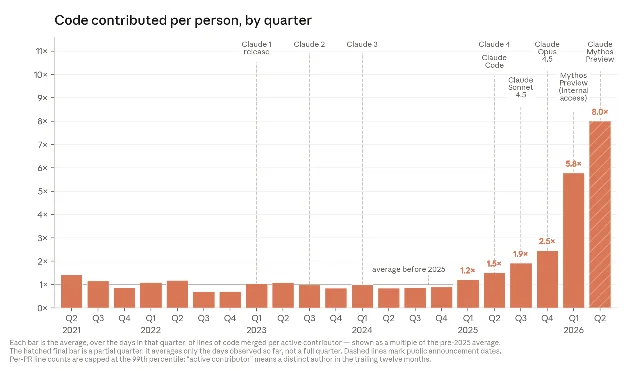
The report frames the trend as a step toward recursive self-improvement — AI systems materially contributing to the development of their own successors — and identifies three scenarios with escalating risk: capability growth plateauing at current levels, AI significantly automating development while humans retain strategic control, and AI fully automating its own next-generation development.
The third scenario is treated as the highest-stakes case. The report notes that if AI fully drives its own development, alignment errors could compound across model generations in ways that are difficult to detect or correct, and that existing safety methods may not transfer cleanly.
The disclosure also prompted Anthropic to call on other AI developers and governments to coordinate on monitoring and slowdown mechanisms before full recursive self-improvement becomes technically possible. Scientific American covered it as an open call for a conditional pause.9
The tension here is real: Anthropic is the company whose models are writing most of its own code, and it is simultaneously the company saying this trend requires careful governance before it goes further.
Uber's spending cap and what it signals
Bloomberg reported on June 2 that Uber exhausted its full-year AI budget in four months and has now capped employee spending on agentic coding tools — including Claude Code and Cursor — at $1,500 per tool per month.1011 The cap applies per tool separately, meaning a developer using both Claude Code and Cursor can still access $3,000 per month combined.
This follows earlier context from The Information in April, in which Uber's CTO described the company running internal leaderboards to encourage maximum AI use. COO Andrew Macdonald raised questions about AI ROI in a May 26 podcast, suggesting the calculus has shifted.
Read narrowly, this is a Fortune 500 company managing its AI budget. Read in context, it is one of the clearest data points yet that enterprises at scale are entering a cost-optimization phase after an initial adoption sprint. Anthropic's unnamed enterprise customer who spent $500 million on Claude in one month (reported May 29) represents one end of the usage distribution. Uber's cap represents the other: real, large, and now recalibrating.
For Anthropic, the more significant question heading into its IPO is whether that $47 billion run-rate reflects durable enterprise commitments or includes spending that will be renegotiated now that procurement teams are involved.
"AI & Rule of Law" team
On June 3, Anthropic announced it is hiring for a new internal team called "AI & Rule of Law," led by Yale Law School Fellow Matthew Botvinick.12 The team's research agenda covers AI safety assessment through a legal lens, institutional fragility analysis, novel legal questions raised by frontier AI, and applications that reinforce democratic processes.
The job posting for one position lists a salary range of $295,000 to $345,000 and requires either a law degree, a PhD in political science or a related field, or senior government experience. The team is described as studying what AI will "mean for executive power, for courts and elections."
The timing — days after the IPO filing and alongside the "When AI Builds Itself" report — reflects Anthropic's apparent strategy of getting ahead of governance concerns as a public company. Whether the team produces independent, publishable research or primarily serves regulatory relations ahead of the public S-1 is an open question.
What to watch this week
- Public S-1 timeline: If Anthropic filed June 1 and the SEC follows a standard 30-day review, a public draft could surface in early July. Watch for leaks of financial detail before then.
- Mythos general availability: The critical infrastructure expansion keeps access controlled. General availability date has not been announced.
- Seoul office opening: KiYoung Choi was named Korea Representative Director in May; the opening was described as "imminent."
- DC Circuit: supply-chain risk designation. Oral argument occurred May 19. No ruling yet.
参考ソース
- 1Anthropic files to go public – TechCrunch
- 2Anthropic confidentially submits draft S-1 to the SEC
- 3Anthropic scales Claude Mythos to critical infrastructure in 15+ countries – TechCrunch
- 4Expanding Project Glasswing – Anthropic
- 5Introducing the Services Track and Partner Hub – Anthropic
- 6Snowflake and Anthropic Accelerate Enterprise AI Adoption
- 7Breaking: OpenAI Chip Veteran Joins Anthropic – HTX Insights
- 8When AI builds itself – Anthropic
- 9Anthropic warns AI may soon begin recursive self-improvement – Scientific American
- 10Uber Caps Usage of AI Tools Like Claude Code to Manage Costs – Bloomberg
- 11Uber caps employee AI spending after blowing through budget in 4 months – TechCrunch
- 12Anthropic hiring for new AI Rule & Law team – AOL/Business Insider
このコンテンツについて、さらに観点や背景を補足しましょう。