Triformis leads a quiet week: FDA approvals, May 29–June 5, 2026
Edwards Lifesciences' Triformis Resilia — the first surgical valve purpose-built for the tricuspid position — anchors a week that also delivered a China-originated IV anesthetic (Cypsedo), a reformulated CML drug solving a key drug-interaction constraint (Cavhanza), and six device clearances spanning AI radiation planning, faster blood culture, handheld OR navigation, automated cardiac AI, and two imaging/fixation platforms.

Nine FDA actions closed this seven-day window — two drug approvals and seven device decisions, anchored by a structurally historic moment in cardiac surgery. Edwards Lifesciences received PMA approval for Triformis Resilia, the first surgical valve purpose-engineered for the tricuspid position. The drug side was deliberately modest by contrast: a China-originated anesthetic making its U.S. debut and a nilotinib reformulation solving a specific co-administration problem for CML patients. The six 510(k) clearances rounded out the week with AI-assisted radiation planning, blood-culture diagnostics, cardiac ultrasound, orthopedic navigation, intraoperative 3D imaging, and spinal fixation.
All actions at a glance
| Date | Name | Sponsor | Indication / use | Action type |
|---|---|---|---|---|
| May 29 | Cypsedo (cipepofol) | Haisco Pharmaceutical Group | General anesthesia induction in adults | NDA approval — Novel Drug #20 of 2026 |
| June 2 | Cavhanza (nilotinib ODT) | Cycle Pharmaceuticals | Ph+ CML, newly diagnosed or resistant/intolerant — adults | NDA approval — 505(b)(2) |
| June 3 | Edwards Triformis Resilia | Edwards Lifesciences (NYSE: EW) | Surgical replacement of native or prosthetic tricuspid valve | PMA approval — first dedicated surgical tricuspid valve |
| June 2 | Clarius Ejection Fraction AI | Clarius Mobile Health | Automated LVEF calculation via point-of-care ultrasound | 510(k) clearance |
| June 2 | Pulmera CBeam 3D | Pulmera, Inc. | Intraoperative 3D imaging from existing C-arms | 510(k) clearance |
| June 2 | Xenix Medical Riva | Xenix Medical | Modular posterior spinal fixation | 510(k) clearance |
| June 3 | GE HealthCare MIM Contour ProtégéAI+ 2.0 | GE HealthCare (Nasdaq: GEHC) | AI auto-contouring for radiation therapy planning | 510(k) clearance |
| June 3 | Waters BD BACTEC FXI | Waters Corporation (NYSE: WAT) | Automated blood culture — bloodstream infection detection | 510(k) clearance |
| June 3 | OrthAlign Lantern ASC | OrthAlign, Inc. | Handheld orthopedic navigation for ambulatory surgery centers | 510(k) clearance |
SKIA HEAD (AR surgical navigation, May 29) was covered in last week's edition.
Landmark PMA: Edwards Triformis Resilia — the tricuspid valve gets its first dedicated surgical implant
FDA date: June 3, 2026 (PMA supplement P150048S092) 1
Why this has never existed before
The tricuspid valve sits on the right side of the heart, controlling blood flow from the right atrium to the right ventricle. For decades, when surgeons needed to replace it, they reached for mitral or aortic valves designed for other positions and implanted them off-label. The three-leaflet annular geometry of the tricuspid is shallower and more irregular than the mitral position; no manufacturer had built and received regulatory authorization for a valve that fits it natively — until now. 1
This gap has had clinical consequences. The tricuspid valve earned the nickname "forgotten valve" partly because surgeons were reluctant to operate on it at all — early literature reported in-hospital mortality rates of 10%–25% for isolated tricuspid surgery — and partly because the off-label toolset was never optimized for the position. 2 A 2024 analysis of 13,587 isolated tricuspid operations in the Society of Thoracic Surgeons (STS) database (July 2017 – June 2023) recalibrated that picture: predicted surgical mortality was 5.6% overall, significantly lower than the historical figures, with a risk model C-statistic of 0.81. 3 The STS authors concluded that "the current mortality of isolated TV operations is lower than previously observed" and that their model "provide[s] a new benchmark for current and future isolated TV interventions." 3
What Triformis Resilia is
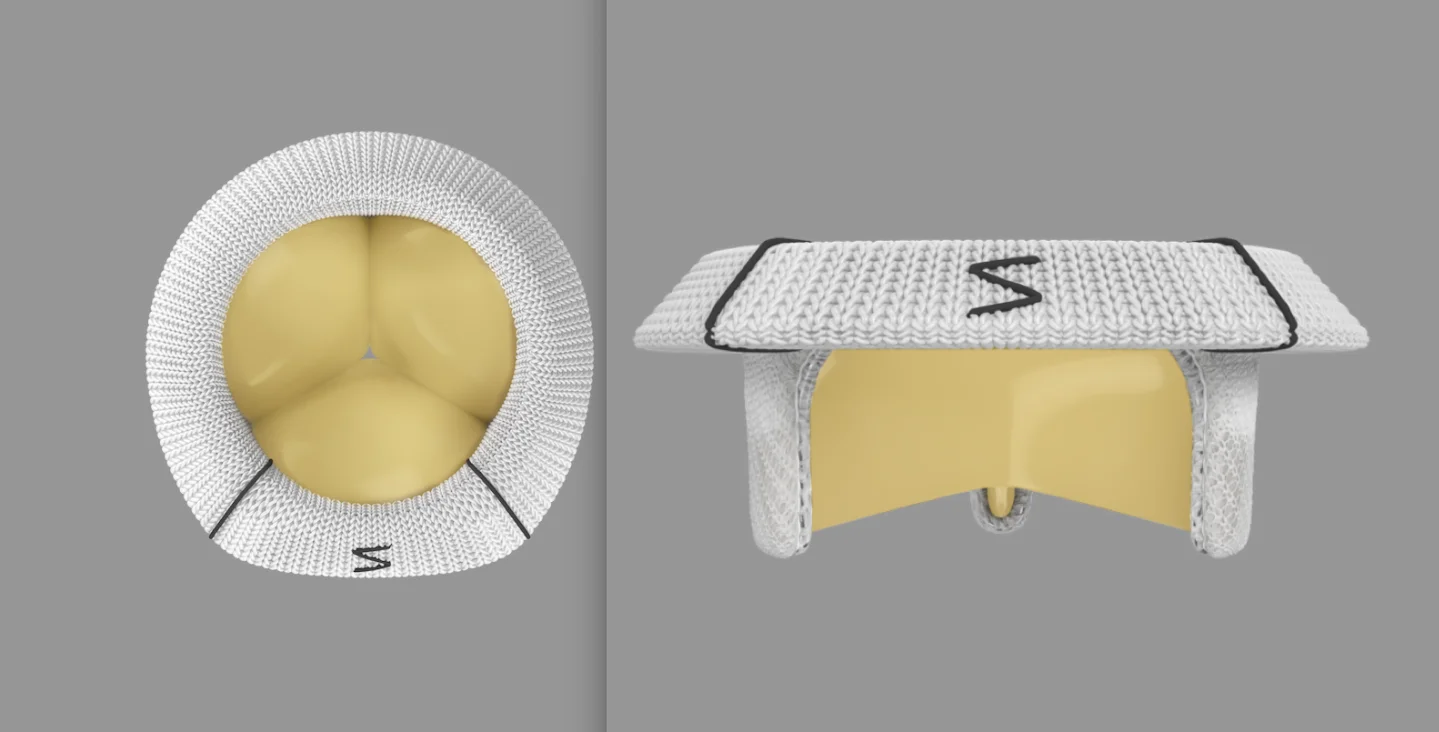
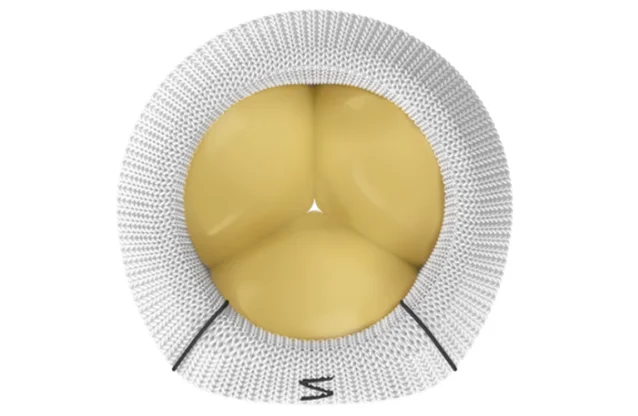
Triformis Resilia is a bioprosthetic surgical valve with five sizes (25–33 mm), bovine pericardial leaflets processed with Edwards' proprietary RESILIA tissue technology, and a distinctively flat sewing-ring profile engineered to match the native tricuspid annulus. 4 The sewing band includes explicit commissure and septal markers to aid orientation during implantation — a deliberate design choice that earlier off-label valves lacked. The valve shares its leaflet architecture with the Mitris Resilia mitral valve; the defining distinction is the tricuspid-specific sewing ring. Dry-storage capability (no glutaraldehyde wet storage required) is a practical benefit for OR logistics. 4
RESILIA tissue's durability credentials come from the COMMENCE aortic surgical valve trial: the 10-year follow-up, presented at the 2026 American Association for Thoracic Surgery (AATS) annual meeting, showed 97.9% freedom from structural valve deterioration, 97.8% freedom from SVD-related reoperation, and 98.6% freedom from non-structural dysfunction (excluding paravalvular leak). 1
How the FDA approved it — real-world evidence, no pivotal RCT
The approval pathway is worth examining. Rather than conducting a traditional prospective pivotal trial, Edwards submitted a retrospective real-world evidence (RWE) study: 204 patients who underwent off-label tricuspid valve replacement using Edwards mitral valves (Magna Mitral, Magna Mitral Ease, or Mitris Resilia) between January 2016 and August 2024, identified from electronic health records. 1 An Edwards spokesperson stated: "The real-world evidence demonstrated that the Triformis Resilia Tricuspid Valve is effective in replacing diseased and malfunctioning tricuspid valves in a representative patient population, as evidenced by reasonable incidence rates of all-cause mortality and heart failure hospitalization. Further, the real-world evidence demonstrated that the use of the valve did not raise any major safety concerns." 1
This RWE pathway was made possible because the clinical question was not "does this valve class work?" — surgeons had already been using Edwards bioprosthetic valves off-label in the tricuspid position for years — but rather "does the tricuspid-specific sewing ring design maintain equivalent outcomes?" The 204-patient dataset answered the safety and hemodynamic performance questions to FDA's satisfaction. The label does carry one contraindication: patients with untreatable hypersensitivity to nitinol (nickel and titanium). 4
Market context and Edwards' strategic position
Approximately 1.6 million Americans have moderate-to-severe tricuspid regurgitation (TR), yet fewer than 8,000 tricuspid valve surgeries are performed annually in the United States — roughly 10% of those as isolated tricuspid procedures, the rest combined with other cardiac surgery. 2 The surgical access gap is large; the market opportunity scales with willingness to refer earlier-stage patients as surgical risk data improves. Edwards plans a U.S. commercial launch in the second half of 2026. 1
Triformis does not compete in isolation — it completes a portfolio that already includes Evoque (transcatheter tricuspid valve replacement, FDA-approved 2024) and Pascal (transcatheter repair, pending FDA approval for tricuspid disease). No other company currently holds both a surgical and transcatheter tricuspid replacement product with U.S. authorization. 2 Abbott TriClip G4 (transcatheter edge-to-edge repair, approved April 2024) is a separate approach — repair rather than replacement — and targets a different patient selection pathway. 5
On the financial side, Edwards reported Q1 2026 TMTT revenue of $173 million (+40% year-over-year) and raised 2026 TMTT guidance to $740–$780 million. 5 EW closed at $87.45 on the approval date (June 3), up approximately 1.7% from the prior session; by June 5, the stock had partially retraced to ~$86.65, with a market cap of roughly $50 billion. 5 The market's muted reaction suggests the PMA was partially anticipated, consistent with Edwards' prior public guidance on H2 2026 availability.
For investors: Monitor TMTT quarterly revenue progression as Triformis commercial volumes begin in H2 2026; watch for Edwards Q3 2026 earnings call (expected October 2026) for launch commentary.For clinicians: Triformis is indicated for replacement of native or prosthetic tricuspid valves. Five sewing-ring sizes (25–33 mm) cover the anatomical range. U.S. availability expected H2 2026.For patients: For the ~1.6 million Americans with moderate-to-severe TR, this is the first FDA-approved surgical implant designed specifically for their valve — not an off-label adaptation. The STS risk data suggest operative mortality in experienced centers is substantially below the historical estimates that long discouraged referral.
Drug approvals
Cypsedo (cipepofol) — first China-originated IV anesthetic reaches the U.S. market
| Field | Detail |
|---|---|
| FDA date | May 29, 2026 (Novel Drug #20 of 2026) |
| Sponsor | Haisco Pharmaceutical Group (Shenzhen: 002653.SZ) |
| Indication | Induction of general anesthesia in adults undergoing surgery |
| Pathway | NDA; IND granted 2021; Phase 2 waived; pivotal Phase 3 completed 2024; NDA accepted July 2025 |
| Comparator | Propofol (head-to-head non-inferiority trial published in Anesthesiology) |
| Key differentiation | Greater hemodynamic stability vs. propofol in high-risk patients (severe aortic stenosis data published in JAMA Surgery); published data show reduced injection pain, respiratory depression, and cardiovascular adverse events |
| China track record | NMPA approval December 2020; deployed in 3,300+ Chinese hospitals; >40 million patient procedures |
| U.S. commercialization | Partner-led; EU filing planned |
Cypsedo is a Class 1 novel molecular entity — the first IV anesthetic originating in China to clear FDA. 6 Its IV anesthesia induction mechanism of action (positive allosteric GABA-A modulator, similar to propofol but with a distinct chemical structure) means it does not displace propofol entirely but competes in clinical scenarios where propofol's hemodynamic liability is a concern. 7 Commercial traction will depend on hospital formulary adoption and pricing against a commodity-priced generic propofol market.
Cavhanza (nilotinib ODT) — a co-administration fix for CML patients on acid-suppressing drugs
| Field | Detail |
|---|---|
| FDA date | June 2, 2026 |
| Sponsor | Cycle Pharmaceuticals (UK, private; with Flex Pharma) |
| Approved indications | (1) Newly diagnosed chronic-phase Ph+ CML; (2) CP or AP Ph+ CML resistant or intolerant to prior therapy including imatinib |
| Pathway | 505(b)(2) NDA — based on nilotinib capsule (Tasigna, Novartis, 2007) efficacy/safety data plus ODT bioequivalence |
| Key differentiation | Co-administration with PPIs and H2RAs without dose separation — an unmet need for ~25% of CML patients on acid suppressants; dissolves orally, no water required |
| Dosing | 120 mg BID (newly diagnosed); 160 mg BID (resistant/intolerant); ~12-hour intervals |
| Boxed warning | QT prolongation and sudden death; contraindicated with hypokalemia, hypomagnesemia, or congenital long QT |
| Patient support | Cycle Vita program |
The PPI interaction constraint on original nilotinib capsules (Tasigna) is well-documented — co-administration reduces nilotinib exposure — creating adherence pressure for the roughly one-quarter of CML patients who require chronic acid suppression. 8 Cavhanza's ODT formulation addresses this pharmacokinetically rather than requiring patients to time their medication around meals and acid suppression. Victoria Dickinson, Cycle Pharmaceuticals' Chief Product Officer, said the company is "excited to be able to offer the CML community another TKI option that may better suit their needs." 9
Cavhanza is not a new molecular entity. Nilotinib itself is generic-eligible (Tasigna's first U.S. patent exclusivity expired in 2021); the commercial story here is differentiation through formulation — capturing a defined patient subpopulation that the branded capsule and its generics handle imperfectly.
Device clearances
GE HealthCare MIM Contour ProtégéAI+ 2.0 — AI radiation therapy planning with pre-authorized future updates
FDA date: June 3, 2026 · Sponsor: GE HealthCare (Nasdaq: GEHC, ~$20.6B annual revenue) · 510(k)
AI auto-contouring software for radiation therapy planning, adding new MR brain and CT male pelvis models to the existing portfolio of clinical structures. The clearance includes a Pre-Specified Change Control Plan (PCCP) — an FDA framework allowing pre-authorized future model updates without individual 510(k) submissions for each iteration. 10 The PCCP is strategically significant: it lets GE iterate the AI models faster than the standard regulatory cycle would allow, compressing the timeline between model training and clinical deployment. Auto-contouring is one of the most time-intensive steps in radiation therapy planning — the primary clinical value is reducing plan preparation time so the care team can focus on patient-specific optimization.
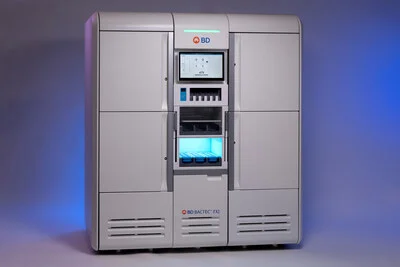
Waters BD BACTEC FXI — ~3 hours faster blood culture positivity detection
FDA date: June 3, 2026 · Sponsor: Waters Corporation (NYSE: WAT, ~16,000 employees) · 510(k)
The BD BACTEC FXI is a fully automated blood culture system that Waters acquired as part of the BD Diagnostic Systems portfolio. 11 Key performance claim from clinical study data: mean time-to-detection reduced by approximately 3 hours (from ~20 to ~17 hours, ~15% reduction). 11 The clinical relevance: a 2006 study (Kumar et al., Critical Care Medicine) documented 3.6%–9.9% increased mortality for each hour of sepsis treatment delay. The FXI also introduces first-in-class automated gravimetric blood volume measurement per bottle, reducing pre-analytical variability. Load capacity is 60 bottles per loading — 50% more than the competitive BACT/ALERT VIRTUO. Previously cleared in the EU (CE-IVDR) and Japan (PMDA). 11
OrthAlign Lantern ASC — handheld knee navigation built for ambulatory surgery economics
FDA date: June 3, 2026 · Sponsor: OrthAlign, Inc. (private) · 510(k)
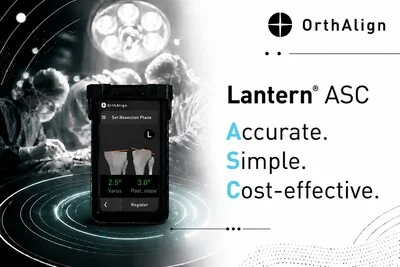
A reusable navigation unit paired with per-case Smart Pack Kits, designed from the ground up for ambulatory surgery centers rather than hospital ORs. Covers total knee, partial knee, and gap-balancing procedures (primary and revision), compatible with most implant systems. 12 The design avoids capital equipment cost — a known barrier to ASC adoption of computer-assisted surgery — while building on OrthAlign's base of 450,000+ procedures. ASC total joint replacement is projected to grow at a CAGR of 5.77% from 2024 to 2030 (DelveInsight). 12 Already holds CE Mark (EU MDR).
Clarius Ejection Fraction AI — objective LVEF from a wireless handheld scanner
FDA date: June 2, 2026 · Sponsor: Clarius Mobile Health (private) · 510(k)
Integrated into the Clarius ultrasound app, this tool automatically calculates left ventricular ejection fraction (LVEF) from compatible PA, PAL, and C3 HD3 scanners — replacing subjective visual estimation by clinicians in primary care, emergency, and critical care settings. 13 The AI model was trained on thousands of clinician-annotated cardiac ultrasound frames. The American Academy of Family Physicians (AAFP) has recognized cardiac point-of-care ultrasound (POCUS) as a core clinical competency; this clearance extends an objective computational layer to a scanner already deployed in 70+ countries. Emergency physician Dr. Brian Johnson described the capability in a company release as providing "a calculated EF just from a parasternal long or 4 chamber view." 13
Pulmera CBeam — 3D reconstruction added to 30,000 existing U.S. C-arms
FDA date: June 2, 2026 · Sponsor: Pulmera, Inc. (Palo Alto, CA) · 510(k)
CBeam attaches position sensors to an already-installed surgical C-arm and reconstructs a brief rotational X-ray sweep into a 3D dataset — converting existing 2D fluoroscopy infrastructure into intraoperative volumetric imaging for orthopedic and neurosurgical procedures (long spine, pelvis, acetabulum, facial skeleton, extremity fractures). 14 More than 30,000 C-arms are in active U.S. use; CBeam positions itself as a capital-efficient alternative to purchasing a standalone intraoperative CT system. Pulmera is an early-stage company, and this clearance is its commercial milestone.
Xenix Medical Riva — modular spinal fixation with tactile confirmation
FDA date: June 2, 2026 · Sponsor: Xenix Medical (private) · 510(k)
Riva is a modular posterior spinal fixation system with a one-step head-attachment-and-release mechanism that provides tactile and audible feedback confirming secure engagement. 15 A full range of tulip-head and screw-shaft configurations addresses complex anatomical variation. Texas Spine Consultants surgeon Dr. Andrew Park stated the system gives him "surgical control and operational efficiency that I just can't get with anything else," specifically citing the interface between the wide screw-head array and the shank options. 15 Planned extensions include NanoACTIV surface technology, sacropelvic fixation options, and MIS capability. Xenix is actively expanding its national distribution network.
Investor and market context
Edwards Lifesciences is the week's only name that moves institutional needles in a material way. The Triformis PMA gives EW a portfolio position no competitor currently replicates — the only company with FDA-authorized solutions across the entire tricuspid intervention spectrum (surgical replacement, transcatheter replacement, and a repair pipeline). The TMTT segment's Q1 2026 revenue of $173 million against a raised full-year guide of $740–$780 million embeds a significant H2 ramp assumption; Triformis commercial launch is one of the variables expected to contribute to that back-half acceleration. 5 Analyst commentary on the Triformis-specific revenue contribution was not yet publicly available as of this publication; the more detailed picture should emerge at the Q2 2026 earnings call (expected July 2026) and in the Q3 2026 report when launch is underway.
On the drug side, neither Cypsedo nor Cavhanza are publicly traded U.S. equities plays at launch. Haisco Pharmaceutical (Shenzhen: 002653.SZ) is a Chinese-listed company; its U.S. commercialization vehicle has not been disclosed. Cycle Pharmaceuticals (Cavhanza's sponsor) is a private UK company with no U.S. listing. Both approvals are meaningful milestones for their respective sponsors — Cypsedo as a first-ever FDA approval for Haisco, Cavhanza as a regulatory validation of Cycle Pharma's reformulation-focused model — but neither is expected to generate analyst coverage-shifting U.S. revenue at scale in the near term.
The device clearance set continues a pattern visible across the prior three weeks: AI-assisted diagnostic and planning tools (Clarius EF AI, GE MIM Contour ProtégéAI+ 2.0) and capital-efficient infrastructure plays (Pulmera CBeam, OrthAlign Lantern ASC) represent the FDA's device approval cadence as of mid-2026. Neither GEHC nor WAT moved materially on their respective 510(k) announcements this week.
Open items to track: Edwards Q2 2026 earnings call (expected July 2026) for Triformis launch data; SEC 8-K filing from Edwards for formal PMA disclosure; Cypsedo U.S. commercial partner announcement; Cavhanza pricing and formulary access announcement.
Cover image: Edwards Triformis Resilia surgical tricuspid valve. Image from Cardiovascular Business.
参考ソース
- 1Cardiovascular Business: FDA clears first dedicated tricuspid surgical valve
- 2MedTech Dive: Edwards gets FDA approval for surgical tricuspid valve
- 3PubMed: Outcomes of Isolated Tricuspid Valve Surgery — STS Analysis and Risk Model (Thourani VH et al., 2024)
- 4Edwards Lifesciences: TRIFORMIS RESILIA tricuspid valve — official product page
- 5MD+DI: Edwards Lifesciences Wins FDA Approval for First Tricuspid Surgical Valve Replacement
- 6PRNewswire / Haisco Pharmaceutical Group: China's Original Innovative Drug Cipepofol Approved for Marketing by the U.S. FDA
- 7BioPharma APAC: China Developed Anaesthetic Cipepofol Secures US FDA Approval
- 8WebMD: Cavhanza (Nilotinib) — FDA Approves Orally Disintegrating Tablet for Adults With Philadelphia Chromosome-Positive Chronic Myeloid Leukemia
- 9CURE Today: FDA Approves Cavhanza for PH-positive Chronic Myeloid Leukemia
- 10GE HealthCare / BusinessWire: GE HealthCare receives FDA 510(k) clearance for MIM Contour ProtégéAI+ 2.0
- 11Waters Corporation / PR Newswire: Waters Announces FDA 510(k) Clearance of BD BACTEC FXI Culture System
- 12OrthAlign / PR Newswire: OrthAlign, Inc. Receives FDA 510(k) clearance for the Lantern ASC system
- 13Clarius Mobile Health / PR Newswire: FDA Clears Clarius Ejection Fraction AI
- 14Pulmera / GlobeNewswire via Yahoo Finance: FDA Grants 510(k) Clearance for Pulmera's CBeam 3D Imaging Platform
- 15Xenix Medical / BusinessWire: Xenix Medical Announces FDA Clearance and Full Commercial Launch of the Riva Posterior Fixation System
このコンテンツについて、さらに観点や背景を補足しましょう。