
DeFi Week 24: TVL drops 9.3%, apxUSD breaks peg
Total DeFi TVL fell $7.42B to $72.24B (-9.31%) in Week 24 — the steepest single-week drop of 2026 — driven by the June 5 liquidation cascade. The apxUSD stablecoin depegged to $0.90 on STRC collateral stress; three exploits totaled ~$2.01M; Arbitrum DAO passed its Foundation budget temp check and Nova wind-down vote.

This is Week 24 (June 2–8, 2026). The June 5 crypto market selloff — $130B in crypto market cap wiped in a single session, alongside a $1.75T equity rout — dragged total DeFi TVL down $7.42B to $72.24B, the steepest single-week decline in 2026. All top 10 protocols posted losses. Three exploits were confirmed in-window for a combined ~$2.01M in losses. The apxUSD stablecoin, backed by Strategy's STRC preferred shares, depegged to $0.90 on June 4 — the week's most consequential DeFi stress event. Arbitrum DAO passed two governance votes despite the drawdown, including a near-unanimous decision to wind down Arbitrum Nova. 1 2
Week 24 quick scan
| Signal | Entity | Direction | Scale |
|---|---|---|---|
| TVL change | All DeFi | ▼ | $72.24B, -9.31% WoW |
| Chain hit hardest | Bitcoin-native DeFi | ▼ | -10.64% / -$500M |
| Biggest protocol loser (%) | Kelp | ▼ | -21.90% → $1.00B |
| Biggest protocol loser ($) | Lido | ▼ | -$2.51B → $15.01B |
| Only large-cap gainer | Rocket Pool | ▲ | +88.78% → $905M |
| Stablecoin depeg | apxUSD (Apyx Finance) | ▼ | ~$0.90 low; $476M supply at risk |
| Largest in-window exploit | Gnosis Pay | ▼ | ~$1.2M — Zodiac Delay Module |
| NFT liquidity exploit | Flooring Protocol | ▼ | ~$570K — Yuga Labs whitehat rescue |
| BSC exploit | ATM Protocol | ▼ | ~$243.5K — tax logic bug |
| Cross-chain bridge total (2026 YTD) | Industry-wide | ▼ | $340.7M across 14 incidents (PeckShield) |
| Governance passed | Arbitrum Foundation 2027 budget | ✅ | 66.7% For; 133.7M ARB |
| Governance passed | Minimize Arbitrum Nova | ✅ | 92.1% For; 195.7M ARB |
| On-chain vote pending | Arbitrum $43.5M budget | 🗳️ | Opens June 8 on Tally.xyz |
| CCIP migration wave | Virtuals Protocol | ▲ | $700M+ migrating from LayerZero |
| Yield spike (genuine) | Aerodrome Slipstream (Base) | ▲ | +600pp → 824.7% base APY |
| Yield collapse (incentive) | Aerodrome v1 (Base) | ▼ | -1,032pp from 6,501.8% APY |
TVL snapshot: the worst week of 2026
Total DeFi TVL fell from $79.66B (Week 23 close) to $72.24B, a $7.42B decline in seven days. 1 The drop is driven entirely by the June 5 session, when Bitcoin fell from ~$67,000 to $59,100 in 48 hours, forcing more than $3B in leveraged position liquidations across crypto derivatives markets and dragging every major asset class lower. 3 Spot Bitcoin ETFs recorded their 13th consecutive day of net outflows for a cumulative $4.33B — a streak that, combined with Mt. Gox moving 10,422 BTC and Strategy (MSTR) selling Bitcoin for the first time since 2022, left buyers with no institutional offset. 3
Chain breakdown
All six tracked chains posted declines. Bitcoin-native DeFi fell the hardest in percentage terms; Ethereum's absolute TVL loss was by far the largest.
| Chain | TVL (Jun 8) | WoW change | WoW $ change |
|---|---|---|---|
| Ethereum | $37.99B | -9.24% | -$3.87B |
| BSC | $5.21B | -7.95% | -$451M |
| Solana | $4.92B | -6.82% | -$360M |
| Tron | $4.42B | -7.92% | -$381M |
| Bitcoin | $4.20B | -10.64% | -$500M |
| Base | $4.00B | -7.26% | -$314M |
Ethereum's dominance held at 52.6%, essentially flat week-over-week. Hyperliquid L1 ($1.59B) and Provenance ($1.59B) entered the chain top 10 for the first time. 2
Protocol movers
Among the 58 protocols with TVL above $500M, only five posted positive seven-day changes. Three of those five are in the RWA (real-world asset) category — Invesco USTB (+1.53% → $750M), Anemoy Capital (+0.11% → $865M), and Centrifuge (+0.07% → $1.38B) — consistent with the flight-to-quality dynamic visible across the week. 1
The standout outlier was Rocket Pool, which surged +88.78% to $905M — nearly doubling in a week where every other liquid staking protocol lost double digits. 1 No official announcement from Rocket Pool explains the move. The most plausible interpretation is that a cohort of ETH holders, watching Lido and SSV Network shed $2.51B and $2.10B respectively, rotated toward Rocket Pool's more decentralized staking structure. That inference is not confirmed by any on-chain attribution.
The worst-performing category was liquid staking and restaking, which is also the largest by TVL. The declines ran across every protocol in the segment:
| Protocol | TVL (Jun 8) | 7d change |
|---|---|---|
| Lido | $15.01B | -13.79% (-$2.51B) |
| SSV Network | $12.43B | -14.47% (-$2.10B) |
| EigenCloud | $4.74B | -18.20% (-$1.06B)* |
| Kelp | $1.00B | -21.90% (-$281M) |
| Obol | $599M | -20.94% (-$159M) |
| Sanctum Validator LSTs | $916M | -20.57% (-$238M) |
| Binance Staked SOL | $747M | -17.70% (-$160M) |
| Jito | ~$3.0B est. | -15.74% |
*EigenCloud carries a persistent data quality caveat: the API reports -18.20% for the seven-day change while DeFiLlama's homepage displays -38.31% for the same period — a ~20 percentage point gap that has persisted since at least Week 23. Absolute TVL ($4.74B) is consistent across both data surfaces. Until this divergence is resolved via on-chain verification, both figures should be treated with caution. 4
The Spark ecosystem now tracks as three separate entities: SparkLend ($3.43B), Spark Liquidity Layer ($2.20B), and a newly carved-out Spark Savings ($1.87B) — a combined $7.51B. Spark Savings was not separately tracked in Week 23, making direct WoW comparison for that entity unavailable. 1
Exploit roundup: three incidents, ~$2.01M in losses
Three exploits were confirmed within the June 2–8 window for a combined ~$2.01M. This is a lighter-damage week in isolation, but it arrives against a backdrop of accelerating cross-chain bridge losses: security firm PeckShield reported on June 1 that bridge exploits alone have totaled $340.7M across 14 incidents in 2026 year-to-date, with the KelpDAO/LayerZero attack ($292M, April 18) and the Drift Protocol compromise ($285M, April 1) accounting for the bulk. 5
Gnosis Pay — ~$1.2M (June 1, Ethereum / Gnosis Chain)
Gnosis Pay's Zodiac Delay Module — a queuing layer that batches and delays execution of Safe wallet transactions — was exploited when an attacker found a path to simultaneously push malicious withdrawals into multiple users' Safe wallets. Approximately $1.2M was drained from card-linked user wallets. 6 The attack did not compromise private keys; funds were taken from wallet balances through the module's execution path. DeFiLlama currently records this loss as $0, reflecting a lag in its exploit database update.
Gnosis co-founder Martin Köppelmann initially urged users to withdraw their funds, then deleted the tweet and clarified: "Most users will not be able to do so, but we are actively working to contain the damage. We believe we can contain the majority of it, and in any case, we will ensure that all users are made whole." 7 By June 7, Gnosis Pay had restored card services for more than 99% of affected users by migrating them to replacement Safe accounts. 6 The $1.2M figure comes from two independent X sources and has not received official confirmation from Gnosis; the exact total remains pending an official post-mortem.
This follows a May 25 exploit of a separate Gnosis Safe-based protocol (New Market Trading, $3.98M) — two distinct events with a shared architectural motif: unsafe module configurations in Gnosis Safe deployments.
Flooring Protocol — ~$570K (June 7–8, Ethereum)
Flooring Protocol, an Ethereum-based NFT liquidity platform that lets holders fractionalize blue-chip NFTs into fungible tokens, was hit by a wrapper bug. The attack converted a small amount of WETH into a near-unlimited fpToken (Flooring's fungible representation of pooled NFTs) balance, which the attacker then used to drain the protocol's NFT pools. 8
"A Flooring exploit today turned a dust amount of WETH into a near-infinite fpToken balance, allowing the attacker to drain Flooring pools." — 0xQuit, Yuga Labs VP of Blockchain 8
Yuga Labs executed a whitehat rescue operation, recovering 68 NFTs from the compromised pools before a second opportunist could acquire them — 29 BAYC, 4 MAYC, 2 CryptoPunks, 1 Azuki, 2 Elementals, 26 Captains, 1 Moonbird, 2 Doodles, and 1 BAKC. At June 7 floor prices the basket was worth approximately 346 ETH (~$570,000). 8 Yuga Labs CEO Michael Figge confirmed the rescue on X: "We've just finished a whitehat operation on an exploit discovered in Flooring Protocol. Now safely in the custody of Yuga Labs: 29 bored apes, 4 mutant apes, 1 bakc, 2 cryptopunks, 1 azuki, 2 elementals, 26 captains, 1 moonbird, 2 doodles."
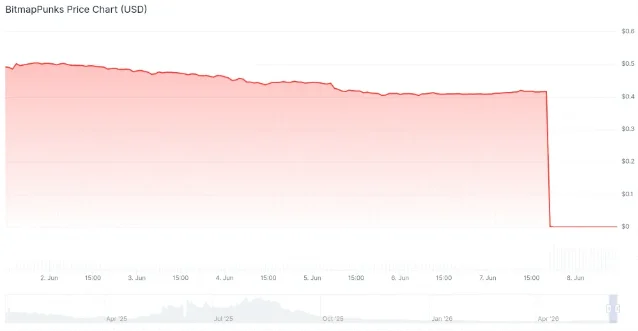
The same vulnerability affected BitmapPunks, which shares a similar core contract architecture with Flooring. BitmapPunks' liquidity pool was fully drained; the token fell from ~$0.44 to near zero over the 24 hours following the attack.
ATM Protocol — ~$243.5K (June 3, BNB Smart Chain)
ATM Protocol on BNB Smart Chain was exploited via a tax logic flaw in its Solidity contracts on June 3, losing approximately $243,500. 9 No secondary media coverage or official post-mortem has been published; the sole confirmed data source is DeFiLlama's exploit database. Attack vector classification: Protocol Logic / Tax Logic Exploit.
Watch-point: ongoing situations from prior weeks
Echo Protocol (Monad, admin key compromise, May 18): investigation closed. Actual loss was $816K — the originally cited $76.7M figure reflected the face value of 1,000 minted fake eBTC tokens, not the amount extracted. 10 The attack chain was: stolen admin key → mint fake eBTC → borrow 11.29 WBTC (~$868K) on Curvance using the fake tokens as collateral → bridge to Ethereum → swap for 384 ETH → mix through Tornado Cash. Root cause: single EOA admin key with no multisig, no timelock, no mint cap. Remaining 955 fake eBTC tokens have been burned.
StablR (May 23, 1-of-3 multisig exploit): USDR trades at $0.994; EURR remains deeply depegged at $0.548. Operations remain suspended. 11
THORChain (May 15, GG20 TSS stack exploit, $10–10.7M): No public recovery updates or network restoration announcements during the June 2–8 window.
apxUSD depeg: collateral model under stress
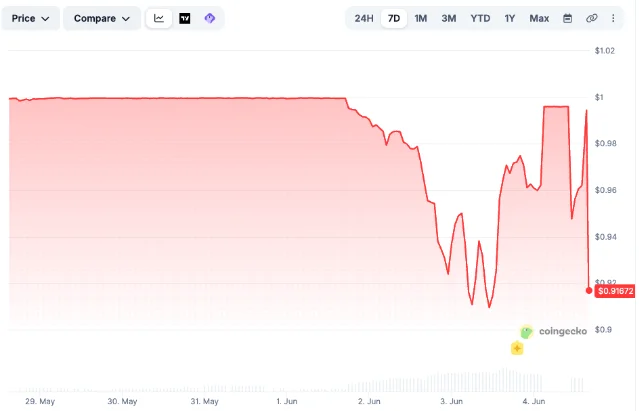
The week's most consequential DeFi stress event was not an exploit. apxUSD, the stablecoin issued by Apyx Finance with a circulating supply of $476M, broke its $1 peg on June 4 and traded as low as $0.90 before partially recovering. 12
The trigger was a 2.13% single-day decline in STRC — Strategy's (formerly MicroStrategy) Series A Perpetual Strike Preferred Stock, which trades on Nasdaq with a $100 par value and 11.5% annual dividend. Apyx Finance has disclosed that 60–90% of the foundation's collateral backing apxUSD is in STRC, with the remainder in stablecoins such as USDC. With Strategy holding approximately 843,706 BTC (~$52B at Friday's prices), STRC's price is a function of both Bitcoin sentiment and equity market conditions. 12
Parker White of Apyx Finance identified the structural fault directly: "Given the preferred stock collateral, there is a liquidity mismatch between crypto that trades 24/7 and STRC, which only trades on the Nasdaq." The depeg occurred primarily after US market close on June 3, when STRC redemption was unavailable but apxUSD redemption pressure in DeFi continued overnight. 12 apxUSD markets on Pendle and Morpho experienced compounding stress during this window, per White's public statement. A formal review of the incident and planned mitigations is pending from Apyx.
Strategy had disclosed in a May SEC filing that $270M+ in STRC is held across DeFi protocols including Apyx and Saturn — meaning the same collateral pool is referenced by multiple DeFi positions simultaneously. 12 For yield farmers holding apxUSD or providing liquidity in apxUSD pools: the depeg risk is not oracle manipulation or flash loan arithmetic — it is an asset that stops trading at 4pm ET every weekday.
Yield anomalies: volatility as a fee engine
DeFiLlama's yield database recorded 119 anomalous APY changes this week — pools where the seven-day APY moved by more than 10 percentage points. A notable shift from Week 23: 72% of this week's rising anomalies are base-rate driven (swap fee revenue), compared with near-zero in Week 23 when incentive emissions dominated. High base-rate yield during a market selloff reflects genuine trading volume, not protocol subsidy, making the signals more durable — though volume can compress quickly once volatility subsides. 13
Rising anomalies
Aerodrome Slipstream (Base) — pool recording 824.7% APY with a +600.1 percentage-point seven-day change — is the standout. Of that 824.7%, fully 806.6% is base APY (swap fees), with only 18.0% from token rewards. TVL is $2.96M — moderate size suggests a concentrated liquidity position capturing an outsized share of fees during the selloff's elevated volume. 13
Uniswap v3 on Base — a pool with $96.3M TVL posted 130.8% base APY, up 66.6 percentage points over seven days. This is the highest TVL among all rising anomalies and entirely fee-driven. The combination of scale ($96M) and entirely genuine yield composition makes it the strongest signal of the set. 13
BenQi sAVAX (Avalanche) — liquid staking derivative for AVAX, rose +26 percentage points to 29.9% base APY on $179.1M TVL — the largest TVL pool among all 119 anomalies. The yield driver is Avalanche network staking rewards; whether the rate increase reflects a protocol-level change or a temporary network activity spike is not confirmed. 13
Collapsing anomalies
Thirty-two of 119 anomalous pools were collapsing rather than rising. The most extreme were almost entirely incentive-driven:
- Aerodrome v1 (Base): -1,032 percentage points from 6,501.8% APY; all reward-driven, $1.4M TVL. Incentive-driven spikes of this magnitude compress when emission schedules reset or the reward token price falls.
- Uniswap v4 (Ethereum): -1,162 percentage points from 201.0% APY; entirely base-rate, $1.4M TVL — the inverse of the Base pools above. A base-rate spike that collapses this fast typically reflects a single high-volume event (such as a new token listing or memecoin moment) that ended.
- Raydium AMM (Solana): -289 percentage points to 94.5% APY; $3.0M TVL, entirely base-rate. Legitimate fee compression as Solana trading volume normalized post-selloff. 13
For farmers entering any of the rising pools above: the Aerodrome Slipstream 824% figure is a trailing seven-day average that includes the selloff's volume spike. Current run-rate APY will be lower as volatility subsides.
Governance: Arbitrum holds its calendar through the drawdown
Week 24 produced two off-chain Snapshot votes, both from Arbitrum DAO, both passing. No other major DeFi DAO — Uniswap, Aave, Lido, Compound, Curve, or Balancer — had proposals close during the June 2–8 window. 14

Continued funding for the Arbitrum Foundation — PASSED (June 4)
The Snapshot temperature check for the Arbitrum Foundation's 2027 operating budget closed June 4 at 10:55 AM ET. 15
| Outcome | ARB votes | Share |
|---|---|---|
| For | 133,737,397 | 66.7% |
| Against | 8,671,843 | 4.3% |
| Abstain | 58,128,152 | 29.0% |
| Total | 200,537,392 |
The proposal requests $16M in USD stablecoins/RWA, 1,740 ETH, and 230M ARB for 2027 operations — revised down from the $45M figure that faced delegate pushback in Week 23 (the prior version carried a projected spend 2.3× DAO annual revenue). Fifty-four percent of the budget is allocated to technical maintenance for Arbitrum One and Nova infrastructure. Projected 2027 total expenditures are ~$27.6M plus 244.9M ARB; the Foundation covers the remainder from existing treasury assets. 15
Analyst Daniel McGlynn framed the timing: "The vote does not wait for the market to feel better." 16 McGlynn noted that "the clearest evidence that coordination did not freeze is that it kept producing decisions, on time, in public, while everyone was supposed to be panicking." 16 The on-chain binding vote on Tally.xyz was scheduled to open June 8; as of 3pm ET it was not yet live. Full results will be captured in Week 25.
Minimize Arbitrum Nova — PASSED (June 4, constitutional)
The constitutional AIP to transition Arbitrum Nova into maintenance mode passed with near-unanimous support: 15
| Outcome | ARB votes | Share |
|---|---|---|
| For | 195,673,198 | 92.1% |
| Against | 4,772 | 0.002% |
| Abstain | 16,844,394 | 7.9% |
| Total | 212,522,365 | — highest turnout of the week |
Nova was launched in 2022 as a proof-of-concept for the AnyTrust/DAC (Data Availability Committee) model, targeting gaming and social applications that prioritize throughput over decentralized security. The AIP authors argued the chain now has "low activity, limited ecosystem attachment, and a non-trivial annual cost footprint" — and that teams with similar requirements can now deploy their own Arbitrum chains using the same AnyTrust stack. The minimization proceeds in three phases: a governance lifecycle phase, a 90-day migration window for applications and users to move to Arbitrum One, and a passive maintenance state with minimal ongoing infrastructure. The proposal explicitly recommends minimization rather than full deprecation given remaining TVL and live applications. 14
Infrastructure: CCIP migration wave and 0x cross-chain API
Chainlink CCIP (Cross-Chain Interoperability Protocol) drew over $1.1B in token value during the June 2–7 window, led by Virtuals Protocol ($700M+ in VIRTUAL token cross-chain infrastructure migrating from LayerZero) alongside Pleasing Market (tokenized commodities) and Zest Protocol (lending). The cumulative total since the April 18 KelpDAO/LayerZero exploit has now reached nearly $5B across 10+ protocols. 17 Khoon Kheng, Virtuals' COO, said the migration followed a security review prompted by the Kelp DAO incident and that autonomous AI agents transacting cross-chain require a higher security bar than conventional DeFi protocols. CCIP validates each cross-chain lane with a minimum of 16 independent node operators and holds SOC 2 Type 2 and ISO 27001 certifications. 17
VIRTUAL trades at $0.57, down 89% from its January 2025 all-time high of $5.07. The migration confirms the security posture shift but does not change the token price trajectory. 17
0x Protocol opened its Cross-Chain API to general availability with 12 bridge partners on day one — including Circle, Chainlink, LayerZero, Stargate, and Across — reporting a median bridge time of 10 seconds and quote response latency under 750ms. The API does not route fees through the ZRX token. 18
What to watch
- Arbitrum $43.5M on-chain vote: The Tally.xyz binding vote opens June 8. Delegate behavior on a large treasury decision during a soft market is the signal, as McGlynn framed it — "Turnout and delegate behavior on a large treasury decision during a soft market will be the signal." 16 Watch for whether the same 66.7% approval margin holds on-chain, and whether delegates push for milestone-based disbursement tranches.
- apxUSD collateral review: Apyx Finance has promised a comprehensive review of the June 4 depeg and planned changes to reduce after-hours volatility. Any structural change to the STRC collateral ratio or the introduction of liquidity buffers will directly affect the risk profile for the $476M apxUSD circulating supply.
- Gnosis Pay post-mortem: Gnosis has not published an official loss figure or root-cause analysis. The incident is architecturally related to the New Market Trading exploit from Week 23; a full post-mortem should clarify whether the Zodiac Delay Module vulnerability is shared with other Gnosis Safe module deployments.
- EigenCloud data divergence: The API -18.20% vs. homepage -38.31% gap has persisted for two consecutive weeks. On-chain contract balance verification is the only way to determine which figure is accurate — the difference is $900M+ in implied TVL.
- BenQi sAVAX rate driver: The +26pp APY increase to 29.9% on $179M TVL should be monitored for whether it reflects a structural Avalanche network staking reward increase (durable) or a one-time activity spike (transient). Avalanche staking reward parameters have not changed publicly as of June 8.
Cover image via Protos.
参考ソース
- 1DeFiLlama Protocols API
- 2DeFiLlama Chains API
- 3WazirX Blog: Bitcoin liquidation cascade June 2026
- 4DeFiLlama EigenCloud protocol page
- 5DEXTools: Crypto Bridge Hacks Top $340M in 2026
- 6Bankless via Yahoo Finance: Gnosis Pay module attack
- 7Protos: Rough weekend for DeFi
- 8Bitcoin Foundation: Flooring Protocol exploit
- 9DeFiLlama Hacks Database
- 10BeInCrypto: Echo Protocol hack autopsy
- 11CoinDesk: StablR freezes USDR and EURR
- 12The Defiant: apxUSD loses dollar peg
- 13DeFiLlama Yields API
- 14Tally.xyz: Arbitrum governance
- 15CryptoRank: Arbitrum Foundation $43.5M budget proposal
- 16Daniel McGlynn: Crypto Drawdown 2026
- 17The Defiant: Chainlink CCIP $1.1B migration wave
- 18The Defiant: 0x Cross-Chain API general availability
このコンテンツについて、さらに観点や背景を補足しましょう。