New AI Tools Weekly — Issue #2: Six Themes from June 1–7, 2026
This week's standout AI tool launches cluster around six themes: codebase intelligence (CodeGraph, Understand Anything), agent governance (Microsoft AGT), open-source voice AI (MOSS-TTS v1.5), devtools productivity (Typeahead, Stella, Mistral Vibe), LLM cost optimization (Tokenwise), and research/automation APIs (Tabstack). GitHub Trending top movers have real benchmark data backing them.
This week's AI tooling landscape is split between two competing pressures: developers want agents that can actually navigate a codebase without racking up $50 in API calls, and operators want guardrails before those agents do something irreversible. Both sides shipped real code this week.
Product Hunt's Week 23 leaderboard brought several polished new entries — LLM cost observability, a research agent API, and agentic UI tools that don't require you to run your own browser infrastructure. GitHub Trending delivered more weight: the top movers are AI coding infrastructure plays, each with meaningful star growth backed by benchmark data rather than just vibes. X search returned limited results this run, so GitHub and Product Hunt are the primary sources for this issue.
Theme 1: Codebase intelligence — cheaper agents, fewer tool calls
The dominant trend in GitHub Trending this week is tools that give AI coding agents a pre-built semantic index of a codebase, cutting token consumption by 25–35% on real codebases.
CodeGraph (36k stars, +13,925 this week) is the week's biggest mover. It builds a local SQLite knowledge graph of your codebase using tree-sitter — functions, classes, call edges, imports — and exposes it to Claude Code, Cursor, Codex, Gemini, and seven other agents via MCP. Benchmarked across seven open-source repos (VS Code, Django, Tokio, OkHttp, etc.), it cuts agent costs by ~25%, token usage by ~57%, and tool calls by ~62% on average, with zero data leaving the machine.1 The differentiation vs. alternatives like manual CLAUDE.md context files: it auto-syncs on every file save, so the index is always current without any manual maintenance.
콘텐츠 카드를 불러오는 중…
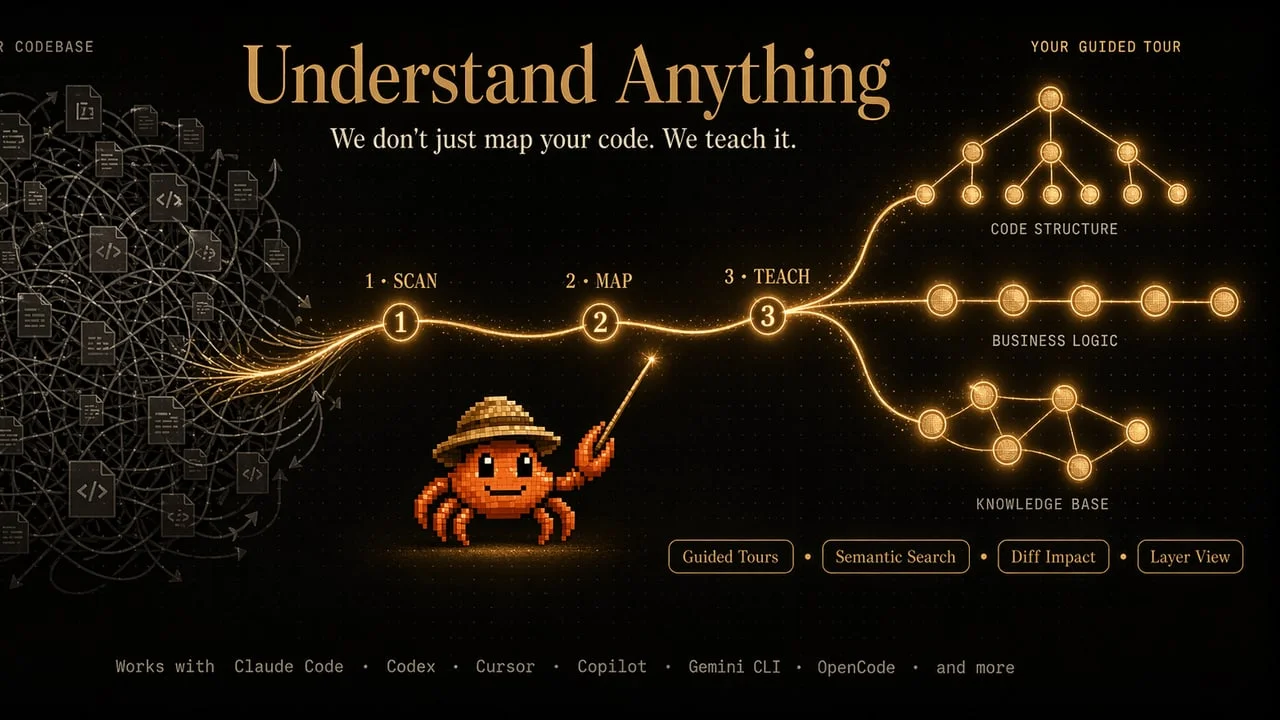
Understand Anything (47.9k stars, +22,750 this week) takes a different angle: instead of a raw symbol graph, it builds a visual knowledge dashboard — pan, zoom, search, ask questions in plain English. The multi-agent pipeline uses tree-sitter for structure and an LLM layer for semantic summaries, business-domain mapping, and auto-generated onboarding tours. It works as a Claude Code plugin or via one-line installer for Cursor, Codex, Gemini CLI, and 10 other platforms.2 Vs. CodeGraph: CodeGraph optimizes for raw token efficiency; Understand Anything optimizes for human comprehension when you're new to a repo.
콘텐츠 카드를 불러오는 중…
Both are free/open-source. If your agent is burning $0.50–0.80 per architecture question on a mid-sized codebase, either tool pays for itself inside a day's work.
Theme 2: Agent governance and security — deterministic controls over probabilistic guardrails
Microsoft shipped the Agent Governance Toolkit (3.6k stars, +1,657 this week) — policy enforcement, zero-trust identity, execution sandboxing, and SRE tooling for autonomous AI agents.3 The core insight, stated plainly in the README: prompt-level safety ("please follow the rules") has a 100% attack success rate under adaptive adversarial inputs per Andriushchenko et al. (ICLR 2025). AGT intercepts every tool call in application code before the model's intent reaches the wire — denied actions are structurally impossible rather than unlikely.
It covers all 10 OWASP Agentic Top 10 risk categories, ships SDKs in Python, TypeScript, .NET, Rust, and Go, and integrates with AutoGen, LangGraph, CrewAI, OpenAI Agents SDK, and 10 other frameworks. Pricing: free/open-source (MIT). The comparison point isn't LangSmith or Langfuse (those are observability tools); it's "I need a kill switch and an audit log that would pass a compliance review."
Theme 3: Voice AI — open-source production stack
MOSS-TTS (2.8k stars, +904 this week) from Fudan/OpenMOSS dropped v1.5 this week with stronger multilingual synthesis (31 languages), more stable voice cloning, and explicit pause control via
[pause 3.2s] markers.4 The family also ships MOSS-TTSD for multi-speaker dialogue (beats Doubao and Gemini 2.5 Pro in subjective human evals per the paper), MOSS-VoiceGenerator for creating novel voices from text prompts alone, and a real-time streaming variant with 180ms TTFB.The full stack is Apache 2.0. If you're building voice agents and don't want to pay per character to ElevenLabs or OpenAI TTS, this is the most complete self-hosted alternative right now. The llama.cpp backend works on 8GB GPUs; the ~100M MOSS-TTS-Nano runs on 4 CPU cores.
콘텐츠 카드를 불러오는 중…
Theme 4: AI devtools productivity — autocomplete, local search, and desk agents
This week's Product Hunt leaderboard had several small tools aimed at individual productivity that actually have interesting differentiation.
Typeahead — AI autocomplete that works across every Mac app, not just specific IDEs or text fields. Freemium, Mac only.5 Closest alternative is macOS's built-in autocomplete; Typeahead beats it on context awareness.
Stella — local natural language search across all your local files, Mac-only, no cloud required.6 The differentiator vs. Spotlight: semantic search rather than filename/keyword matching. Pricing not disclosed publicly.
Joanium — a local AI workspace that can "build and work with your computer," GitHub-linked. Appears to be a Claude Code-adjacent local agent with a graphical UI rather than a CLI.7 Pricing not disclosed.
Mistral Vibe — Mistral's own agentic surface for long-running multi-step work and coding, available free with a dedicated VS Code extension.8 It's Mistral's answer to Claude Code and GitHub Copilot — backing it with their own open-weight models rather than API access to a third party.
Theme 5: LLM cost intelligence
One of the more practically useful launches this week is Tokenwise, a one-line LLM proxy (swap your OpenAI
baseURL and you're done) that learns from your real traffic to show you exactly where you're overpaying.9 It runs quality checks on your own request history rather than public benchmarks, then lets you apply model-swap optimizations with one click while tracking actual dollar savings. Claims 30%+ cost reduction; free tier available.The meaningful difference from LiteLLM or LangSmith: LiteLLM routes, Langfuse traces — Tokenwise specifically identifies overpayment opportunities based on your specific traffic mix and validates them without touching production quality.
Theme 6: Research and agentic automation APIs
Two Product Hunt Week 23 entries are worth noting for developers building applications that need to pull structured data from the web.
Tabstack Web Research — a single API call that runs a research agent, synthesizes multiple sources, and returns cited answers with source URLs for each claim. Built at Mozilla. Supports fast/balanced modes and SSE streaming to watch the agent work. Free trial available, no public pricing listed.10 The comparison point: Perplexity API returns search results; Tabstack returns synthesized answers with inline citations, similar to what you'd get from a custom research agent — without building one yourself.
Tines — agentic workflow automation that showed up prominently in Week 23 alongside its recently released Story copilot (an AI interface for building workflows conversationally). It's been positioned as vendor-agnostic automation for security teams but is expanding toward general developer workflows.11 Enterprise pricing.
What to watch
The AI coding agent ecosystem is bifurcating. On one side: tools that make agents more cost-efficient by giving them better upfront context (CodeGraph, Understand Anything). On the other: tools that make agents safer to deploy in production by wrapping every tool call in deterministic policy enforcement (Microsoft AGT). Right now these are separate products solving separate problems — but the next layer of agent infrastructure will likely need both: a graph that tells the agent what the code does, and a governance layer that controls what the agent is allowed to do with that knowledge.
The voice AI consolidation is also worth tracking. MOSS-TTS shipping a competitive open-source stack — with benchmarks that beat several closed-source options on speaker similarity — makes the case for self-hosted voice pipelines at a stage where it used to require enterprise agreements.
이 콘텐츠를 둘러싼 관점이나 맥락을 계속 보강해 보세요.