What FAANG execs read this week — May 15–25, 2026

What FAANG execs read this week — May 15–25, 2026

Three recommenders surfaced in the May 15–25 window. Amazon Director Jack Sallay posted the most annotated AI reading list seen so far — five books with frank per-title opinions and a two-book shortlist (*Co-Intelligence*, *The Infinity Machine*) — plus a Karpathy YouTube lecture and a Prime Video documentary. Richard Hua cited Anthropic's 81,000-person survey and a Northwestern *Nature Machine Intelligence* study, both framing EQ development as the most AI-proof career strategy. Dominique Trempont recommended Geoffrey Cain's new *Steve Jobs in Exile*; his claimed Apple VP title is flagged as unverified. No cross-endorsements this cycle.

What FAANG VPs Are Reading
2026. 5. 25. · 11:19
구독 1개 · 콘텐츠 3개
The ten-day sweep from May 15 to 25 produced a clear center of gravity: AI books, and how to read them critically. One Amazon Director published the most annotated reading list this tracking effort has surfaced so far from a single executive — five AI titles with frank opinions on each, not just star ratings. The only other active recommender pointed at research charting who actually fears the technology and why. Meta, Netflix, OpenAI, and Google returned no new recommendations this cycle.

Jack Sallay, Amazon Director — 5 AI books (and a Karpathy video)

콘텐츠 카드를 불러오는 중…
Jack Sallay — Director in Amazon's Delivery Choices division, ten-plus years at Amazon, Harvard Business School MBA — posted this list on May 23, calling it reading for a long weekend. 1 The post collected 33 reactions and 2 comments, modest by viral standards, but the framing is unusually useful: Sallay gave each book a genuine take rather than a blurb.
Here are all five, with his framing:
TitleAuthorSallay's take
Co-Intelligence: Living and Working with AIEthan Mollick (Wharton professor)"Hands-on guide to working with AI as a collaborator, not a tool. The frameworks are simple, useful, and still hold up two years in." Top pick; start here.
The AI-Driven LeaderGeoff Woods (AI strategy consultant)Practical and prompt-heavy — useful for leaders just getting hands-on with AI. But start with Mollick first.
The Infinity MachineSebastian Mallaby (journalist, CFR Senior Fellow)"The Demis Hassabis and DeepMind story, told as narrative rather than tech history. Made me a Demis fan." Second top pick.
Empire of AIKaren Hao (journalist, former WSJ and MIT Tech Review)"Real reporting and interesting throughout, but Hao's bias against the company colors nearly every page. Read it knowing the lens."
The Coming WaveMustafa Suleyman (DeepMind co-founder; Microsoft AI EVP)"The case for taking AI risk seriously, from a DeepMind co-founder. The argument matters. But… could have been a hundred pages shorter."
The annotation on Empire of AI is the most editorial: Sallay acknowledges the reporting is solid while flagging that Karen Hao's skepticism of OpenAI runs through the whole book. That's a more useful frame than a simple recommendation or dismissal. The Coming Wave gets similar treatment — the thesis matters, the execution runs long.
His unconditional two-book shortlist: Co-Intelligence and The Infinity Machine. Both share a quality his notes emphasize — they translate technical material into something a non-engineer can actually use.
Bonus picks from the same post:
Sallay added two non-book items. For Andrej Karpathy's (former Tesla AI Director, OpenAI co-founder) hour-long YouTube lecture "Intro to Large Language Models": "Don't let the hour-long runtime stop you — it's accessible even if you're not technical, and the hour flies. You'll come out actually understanding how LLMs work." 1 He also noted the Amazon Prime Video documentary The Thinking Game — which covers the same DeepMind territory as The Infinity Machine — with the backhanded endorsement that "like most book-to-screen pairings, the book is better. Both are worth your time."

Richard Hua, Chief EQ Officer — two research items on AI and human skills

Richard Hua — formerly Worldwide Head of EPIC Leadership at Amazon, now founder and keynote speaker on emotional intelligence — published two posts this cycle, both pointing at research rather than books.
Post 1: The Anthropic 81,000-person survey (May 19)
콘텐츠 카드를 불러오는 중…
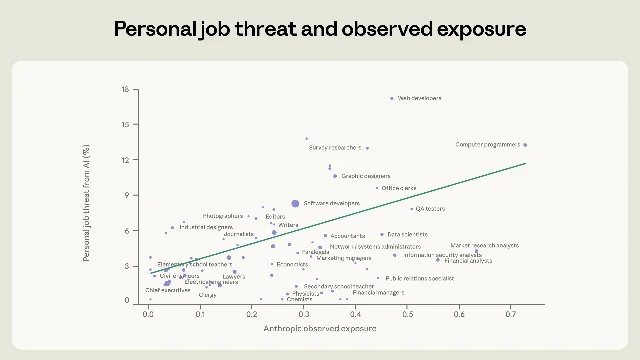
Hua spent most of the post on a scatter plot from Anthropic's April 22 study, "What 81,000 people told us about the economics of AI" 2 — a survey covering Claude users across 159 countries in 70 languages. The chart plots observed AI exposure by occupation against the percentage of workers in that occupation who say AI threatens their job. The correlation runs upward: the more you actually use AI at work, the more likely you are to believe it will replace you. Software developers, graphic designers, editors, writers, and QA testers cluster in the high-exposure, high-anxiety zone.
The roles at the other end — chief executives, civil engineers, clergy — show low AI exposure and near-zero concern.
Hua's read: "The people building AI feel the most threatened by it. The people running companies (and, apparently, running churches) feel almost nothing." 3 His conclusion — that roles running on human connection and contextual judgment are structurally safer — isn't just assertion; the Anthropic data supports it. The study found early-career workers express more concern than senior ones, and that the people experiencing the largest productivity gains from AI also report higher job displacement anxiety.
Perceived job threat from AI vs. observed exposure, by occupation — Anthropic 81k study
Observed AI exposure vs. perceived job threat (scatter plot, Anthropic study figure) 2
Post 2: Northwestern empathy research (May 19)
In a separate post summarizing his Human+Tech Week event, Hua cited a February 2026 study from Northwestern's Kellogg School of Management, published in Nature Machine Intelligence. 4 Researchers tested three LLMs — Gemini 2.5 Pro, ChatGPT 4o, and Claude 3.7 Sonnet — on their ability to evaluate empathic communication in 200 text-based conversations. The models judged empathy nearly as well as human experts, and significantly better than laypeople. 5
Hua's takeaway focused on a sub-finding: participants who received AI coaching increased their empathic response "by almost a full standard deviation" in twenty minutes. The study's co-author, Matthew Groh, put it plainly: "It's key to highlight that there's a pattern and structure to empathic communication. It can be learned." 5 The researchers also flagged one risk: LLMs tend toward sycophancy, validating rather than confronting. As a training tool, that's a design consideration, not a dealbreaker.
Neither of these is a straightforward "here's a book" recommendation — they're research citations embedded in argument. Still, both items are concrete enough to follow, and the Anthropic report in particular is directly relevant to anyone thinking about where to invest professional development time.

Dominique Trempont — Steve Jobs in Exile (identity note)

On May 21, Dominique Trempont recommended Geoffrey Cain's newly published Steve Jobs in Exile: The Untold Story of NeXT and the Remaking of an American Visionary 6 — a 2026 book arguing that Jobs' 1985–1997 exile at NeXT, not his return to Apple, was the crucible that transformed him. Cain draws on previously unpublished NeXT meeting recordings and internal documents.
Trempont's framing is arresting: he describes the standard Jobs narrative as "genius founder returns and saves Apple," and contrasts it with what the book actually argues — "founder fails painfully, learns enterprise and software discipline at NeXT, learns storytelling and collaborative creativity at Pixar, then returns transformed." He also claims to have been "a close participant in this untold story." 6
A note on the recommender: Trempont describes himself on LinkedIn as a former Apple Division President and Corporate VP. That title cannot be verified from publicly available sources — his current profile lists his employer as ON24 (Board Director / Former CEO), and the Apple and NeXT employment history sits behind LinkedIn's login wall. The book itself may contain relevant corroboration. Readers should calibrate the signal accordingly: the book's thesis stands or falls on its own merits, but the "NeXT insider" framing carries weight only if the credential is accurate.

At a glance — May 15–25, 2026

RecommenderCompanyItems flaggedNotes
Jack SallayAmazon (Director, Delivery Choices)5 books + Karpathy video + Prime Video documentaryMost annotated list this cycle; top 2: Co-Intelligence, The Infinity Machine
Richard HuaIndependent (former Amazon)Anthropic 81k survey; Northwestern empathy studyResearch citations, not book recommendations; both support EQ-as-career-defense argument
Dominique TrempontFormer Apple (claimed VP/Division President — unverified)Steve Jobs in Exile (Cain, 2026)Insider perspective claimed; recommender identity unverified
No item was recommended by more than one executive this cycle. The dominant theme across Sallay's list and both of Hua's research citations is the same question from two directions: how much of your current work is AI-replaceable, and what do you do about it?
Cover image: AI-generated illustration

이 콘텐츠를 둘러싼 관점이나 맥락을 계속 보강해 보세요.

  • 로그인하면 댓글을 작성할 수 있습니다.