AI Leaders Weekly: Four CEOs, one biosecurity bill
The week's defining event was a June 4 open letter signed jointly by Altman, Amodei, Hassabis, and Suleyman urging Congress to mandate synthetic DNA/RNA screening — the most concrete regulatory alignment yet among competing AI lab heads. Jensen Huang ran a four-day Seoul physical-AI summit culminating in a gigawatt-scale Naver cloud deal and an announced Seoul R&D center. Anthropic filed a confidential S-1 with a $47B revenue run rate; Hassabis placed AGI at "maybe 2030" at Stanford; Suleyman declared intent to eliminate Microsoft's Anthropic spending while launching seven in-house models.

Two things happened this week that rarely happen simultaneously. Four competing AI CEOs — Sam Altman (OpenAI), Dario Amodei (Anthropic), Demis Hassabis (Google DeepMind), and Mustafa Suleyman (Microsoft AI) — signed the same open letter addressed to Congress. On the same day Jensen Huang sat down in Taipei to toast South Korea's industrial elite with soju, three days before flying to Seoul for a four-day physical-AI summit that ended with a gigawatt-scale cloud deal and a new R&D center. Meanwhile, Anthropic filed its S-1 on June 1 and Hassabis put "maybe 2030" on AGI at Stanford. The capability clock and the IPO clock are now running on the same schedule.
| Leader | Signal level | Key events this week |
|---|---|---|
| Sam Altman | High | Washington meetings (Johnson, Scalise, Sanders), OpenAI product sprint, joint biosecurity letter |
| Dario Amodei | High | Anthropic S-1 confidential IPO filing, joint biosecurity letter, Oprah interview analysis |
| Demis Hassabis | High | Stanford GSB fireside chat (AGI 2030), joint biosecurity letter |
| Jensen Huang | High | Seoul 4-day physical-AI summit; Naver gigawatt deal; Vera Rubin in full production |
| Mustafa Suleyman | High | Microsoft Build 2026: 7 in-house models, "eliminate" Anthropic spending, Mayo Clinic deal |
| Arthur Mensch | Medium | French Parliament testimony ("no code"), Campus AI 3GW deal with Macron, TCS partnership |
| Yann LeCun | Low | Facebook post: AI doomerism is "an apocalyptic cult" |
| Ilya Sutskever | Silent | 4th consecutive week of zero public output |
The biosecurity letter: four competitors, one ask
On June 4, Altman, Amodei, Hassabis, and Suleyman jointly signed an open letter titled "In Support of Mandatory Nucleic Acid Synthesis Screening and Recordkeeping," published on screendna.org alongside dozens of scientists, investors, and former government officials. 1
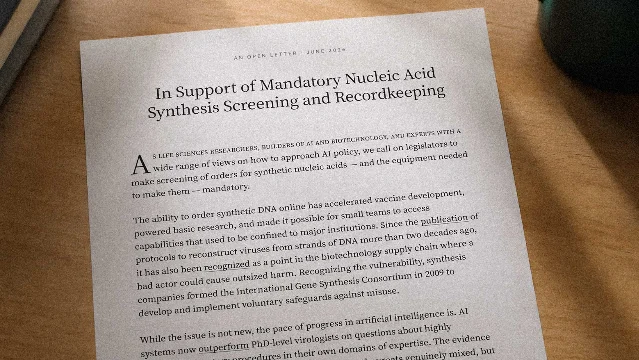
The ask is specific: require all synthetic DNA/RNA suppliers to screen every order against known dangerous sequences before shipping, implement "know your customer" identity verification, and retain records for biosecurity investigations. The letter directly supports S.3741, the Biosecurity Modernization and Innovation Act of 2026, introduced by Senators Tom Cotton (R-AR) and Amy Klobuchar (D-MN), which sets civil penalties of up to $500,000 for individuals and $750,000 for organizations on unscreened orders. 1
The letter's stated rationale rests on two recent data points. OpenAI's o3 model scored 43.8% on the Virology Capabilities Test (VCT), outperforming 94% of the PhD-level virologists tested; Anthropic's Claude 3.5 Sonnet went from 26.9% to 33.6% on the same benchmark in two months. 2 The signatories argue that AI is systematically eroding the knowledge gap that has historically prevented bad actors from accessing bioweapons design expertise:
"AI systems are improving rapidly, and alongside incredible benefits to science and medicine, there is a real possibility that the knowledge barriers which have historically prevented bad actors from obtaining biological weapons will meaningfully erode." 1
The letter also explicitly frames the collaboration as unusual:
"This is a rare moment of agreement across stakeholders that are often at odds. We hope policymakers will meet it with decisive action." 1
Other co-signatories include Alexandr Wang (Scale AI/Meta Chief AI Officer), Patrick Collison (Stripe CEO), Paul Graham (Y Combinator founder), Nobel laureates David Baker and Martin Hellman, former Army Secretary Christine Wormuth, and executives from Twist Bioscience and Ansa Biotechnologies. 2 Microsoft published a separate post on its "On the Issues" blog the same day supporting the bill, citing its own Paraphrase Project stress tests of existing screening systems. 3
For AI strategists, the letter's structure matters as much as its content. This is not a vague call for "responsible AI" — it names a specific bill, identifies specific penalty thresholds, and arrives from labs that are otherwise direct competitors. That combination signals the leaders themselves regard the biosecurity risk as concrete enough to override competitive dynamics. Whether Congress acts on the letter is a separate question.
Sam Altman: Washington, product sprint, and selective silence
The Capitol Hill round
On June 3, Altman made the rounds in Washington, meeting House Speaker Mike Johnson, Majority Leader Steve Scalise, Minority Leader Hakeem Jeffries, and Senator Bernie Sanders. 4
The substantive content that surfaced: Johnson said he is discussing a bipartisan AI regulatory framework document of roughly 300 pages, led by Reps. Jay Obernolte (R-CA) and Lori Trahan (D-MA), expected to be released within days. Scalise confirmed Republicans are focused on federal preemption — blocking states from imposing stricter AI rules — but declined to commit to a floor vote before summer recess. 4 The Sanders meeting, meanwhile, touched on public ownership of AI companies — a rare policy overlap where, per AP News, Trump, Sanders, and Altman have aligned. 5 The White House is separately in ongoing negotiations over whether the government might hold equity in OpenAI. 5
Altman's public X post from the same day took a position on the new AI executive order: "the US should lead on AI by continuing to develop the very best models, making sure they're safe, and getting cyber tools into the hands of trusted defenders. the new EO gets the balance right." 6
Product week at OpenAI
Between June 1–4, OpenAI shipped in rapid sequence: frontier models and Codex became available on AWS (June 1); 7 Codex expanded to "every role, tool, and workflow" (June 2); GPT-Rosalind received new capabilities (June 3); and ChatGPT memory received what Altman called "a big upgrade... rolling out today!" (June 4). 6 The June 4 update also brought the ability to build and publish web apps directly in ChatGPT, which Altman described with an unexpected note of nostalgia: "i really wish i had this when i was a kid, but i do miss hypercard." 6
Three notable silences
Altman signed the joint biosecurity letter on June 4 but posted nothing about it on X — his two same-day tweets covered ChatGPT memory and web app building. He has not commented on the Musk v. OpenAI verdict since the May 18 ruling (21 days and counting). And he has made no public statement about OpenAI's own IPO process, all of which continues through unnamed sources and indirect political signals. 6 The combination of high-visibility policy activity and deliberate product-focused social messaging is a pattern worth tracking as OpenAI's IPO filing process advances.
Anthropic: S-1 filed, $47B run rate, and the coding moat
On June 1, Anthropic filed a confidential draft S-1 registration statement with the SEC. 8 The company's statement was deliberately restrained: "This gives us the option to go public after the SEC completes its review. The proposed initial public offering will depend on market conditions and other factors." The earliest possible listing window is autumn 2026. 8
The underlying numbers: Anthropic's revenue run rate crossed $47 billion in May, driven primarily by AI coding tools. 9 The company completed a $65 billion Series H at a $965 billion post-money valuation on May 28 — making it the highest-valued AI startup globally, ahead of OpenAI's reported $730 billion. Investors include Amazon, Google, Samsung, Micron, SK Hynix, Altimeter Capital, and Greenoaks Capital. Anthropic has also signed an agreement to use all of SpaceX's Colossus 1 data center capacity in Memphis — more than 220,000 AI chips. 9
The strategic read from analysts: Anthropic's narrow focus on coding drove the $47 billion run rate. As Shashi Bellamkonda of Info-Tech Research Group observed: "Anthropic didn't try to be everything. No browser, no image generation, no commerce layer. That discipline is now a $47 billion run rate." 9 That focus also shapes the competitive picture — it is precisely the coding moat that Suleyman is trying to undercut (see below).
On the Oprah front: an analysis published June 6 by The Wantrepreneur Show examined Dario and Daniela Amodei's May 19 appearance on the Oprah Winfrey Show. 10 Dario's positions as surfaced in that interview: he called AI emotionally addictive behavior "a bad idea" and said the company can only expand the technology "at the speed of trust." Daniela argued that when AI handles diagnostic analysis, doctors' human qualities — empathy, connection, judgment — become more valuable rather than less. Neither position is new for Anthropic's leadership, but the Oprah venue signals a public communications strategy that extends well beyond the tech press.
Note: A separate signal — reports from ABC News and a Medium analysis claiming Anthropic called for a "global AI pause" — could not be verified against Anthropic's official blog or a direct Amodei statement. Those claims are not included here pending confirmation.
Demis Hassabis: AGI "maybe 2030, plus or minus a year"
On June 3, Stanford Graduate School of Business published a fireside chat with Hassabis. The headline number: he placed AGI at "maybe 2030, plus or minus a year — which is astounding to think, really." 11
His framing around that estimate was notable for its ambivalence. He called the approach of AGI the beginning of "effectively a new human era" and raised the possibility of a "post-scarcity world" enabled by AGI-driven breakthroughs in medicine and economics. At the same time, he pushed back on colleagues: some peers are being "way too certain" about their predictions, he said, without naming anyone specifically. And on what's still missing before AGI arrives — "the future, in my view, is still to be written, but these next few years are going to be very critical as to which way that will go." 11
He also called on students in both humanities and STEM to lean in now: "Society needs to hear that because we don't have long to prepare for what that means." 11
On the Google DeepMind product side: Gemini 3.5 Pro remains unreleased as of June 8. The model was announced at Google I/O on May 19 for a "next month" launch; as of this writing, Google's AI Studio model listing shows only Gemini 3.5 Flash (generally available) and the 2.5-family models. 12 TechTimes reported on June 6 that the Pro model is approaching launch with a 2-million-token context window and a "Deep Think" reasoning mode. 13 Hassabis posted no original content on X this week.
Jensen Huang's Seoul summit: from supplier to partner
The week's most kinetic story is Huang's four-day Seoul visit (June 5–8), preceded by the first-ever dedicated Korean Partner Night dinner at Computex in Taipei on June 1. Taken together, the sequence amounts to the most intensive diplomatic campaign by any AI hardware executive this year.
The opening act: Taipei, June 1
Huang hosted SK Hynix CEO Kwak Noh-Jung, Samsung, LG, and Naver executives at a traditional Taiwanese seafood restaurant — the first time he has run a dedicated Korean table during his Taipei trips. 14 His framing was equal parts gratitude and preparation: "I want to go congratulate them, thank them, and also prepare for the second half of this year. It's going to be very busy and next year is going to be incredibly busy." 14 South Korean tech stocks rallied on the day as investors read the gathering as a forward signal on new robotics and AI partnerships. 14
The Samgyeopsal Summit: Seoul, June 5
Huang landed at Gimpo International Airport on June 5 at roughly 1pm KST, made his first stop at T1 Base Camp — the esports organization's PC gaming café in Mapo-gu — to meet League of Legends world champion Lee "Faker" Sang-hyeok: "GeForce and Korea have been friends for 25 years. And my friend Faker. Do you know Faker? Unbelievable. Incredible gamer." 15
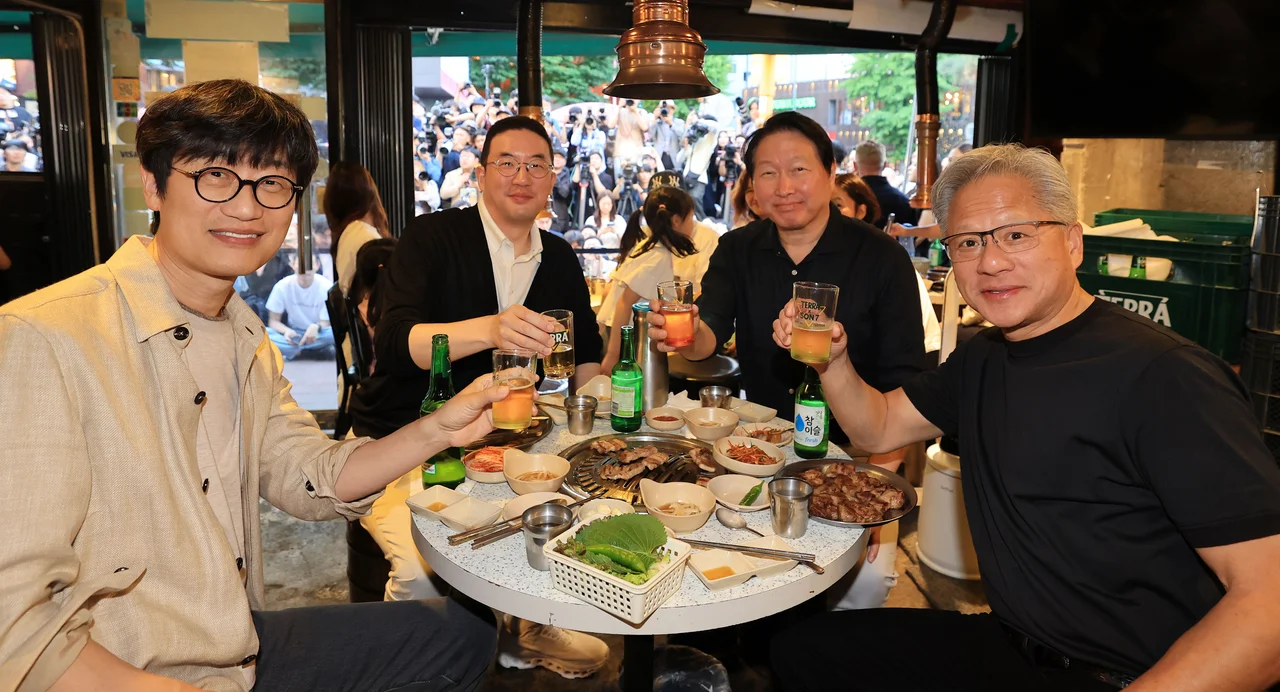
That evening, Huang hosted what Korean media quickly named the "Samgyeopsal Summit" — pork belly and somaek (soju-beer mix) at Hyeongnim Jeoyo ("Bro, it's me") in Hongdae, with SK Chairman Chey Tae-won (age 66), LG Chairman Koo Kwang-mo (48, who reportedly grilled the meat), and Naver founder Lee Hae-jin (59). 15 Huang's toast: "Go Korea! SK, LG, Naver, cheers!"
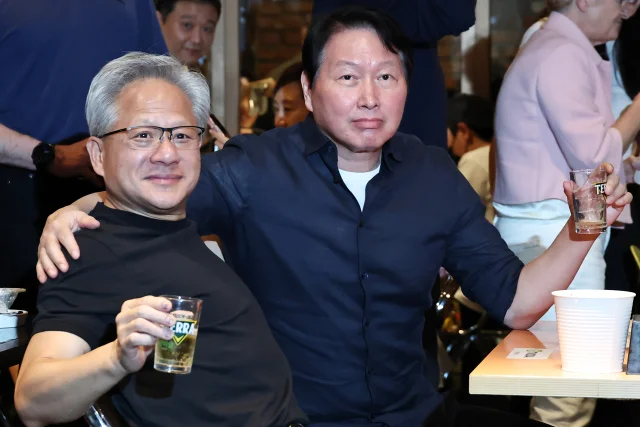
To reporters waiting outside, Huang gave the trip's clearest framing: "Business is booming! Korea is doing very well, my partners in Korea are very important to me. So I came to Korea to thank them, celebrate and congratulate them for such an incredible year. This is just a beginning." 15
Sunday packed: Hyundai, baseball, "Kkanbu Summit 2.0"
On June 7, Huang had lunch with Hyundai Motor Group Executive Chair Chung Euisun over Pyongyang-style cold noodles at Woo Lae Oak, visited two PC bangs — one with Krafton (where an AI-powered co-playable PUBG character using Nvidia ACE and RTX Spark was demoed) and one at NC's AION2 event — threw the ceremonial first pitch at Jamsil Baseball Stadium in a Doosan Bears jersey numbered 93 (Nvidia's founding year), then ended the evening at Kkanbu Chicken in Samseong-dong for what reporters dubbed "Kkanbu Summit 2.0" with Chey Tae-won and the full SK leadership bench: SK Hynix CEO Kwak Noh-Jung, AI Infrastructure President Kim Ju-seon, SK Telecom CEO Jung Jae-hun, and CTO Chung Suk-geun. 16
At the chicken dinner, Huang went into supply chain specifics: "The whole industry supply chain, everything from wafers to packaging to silicon photonics to cable connectors, everything is in short supply because the demand is so great." 16 He also flagged a product-line milestone — "We introduced four new products this year... Vera Rubin. It is now in full production" — and sketched a vision of AI-transformed telecom: "The telecommunications network today is only for bits; in the future, it will also be used for AI." 16
Huang and Chey have now met seven times in seven months, beginning at the APEC CEO Summit in October 2025. The evenings read like social diplomacy but the supply-chain disclosures are substantive. Huang confirmed that Samsung, SK Hynix, and Micron all passed Nvidia's HBM4 quality test for the Vera Rubin platform. 17
The deal announced Monday: Naver, gigawatt-scale, Nemotron
On June 8 — the final day of Huang's visit — Nvidia and Naver announced a gigawatt-scale AI cloud partnership, starting at Naver's existing Gak data center in Sejong. Naver simultaneously became the first Korean company to join Nvidia's Nemotron Coalition, committing to use Nemotron technology to advance HyperCLOVA X (Naver's Korean-language large language model) and to deploy Nvidia's Cosmos world foundation model platform for a Seoul World Model project. 18 No investment size, GPU count, or specific power capacity was disclosed — Nvidia VP Raj Mirpuri noted that gigawatt expansion depends on when power availability allows: "Power is a constraint around the world. Our goal, of course, is to work toward gigawatt-level AI factories with Naver." 18
The Korea JoongAng Daily published a comprehensive analysis framing the larger shift: Korea's role in Nvidia's ecosystem has evolved from memory supplier to full-stack physical AI partner, with the Hyundai/Boston Dynamics Atlas humanoid robot expected to run on Nvidia Jetson Thor, and Nvidia Drive AGX Thor positioned as the in-vehicle compute platform for Hyundai's autonomous driving push. 17 Nvidia also confirmed plans for an AI R&D center in Seoul, with recruiting already open: "We are currently recruiting, so if you know anyone studying AI, tell them to apply for our center here." 17
Mustafa Suleyman: seven models and a declaration of intent
At Microsoft Build 2026 (media preview June 4; formal opening June 9), Suleyman announced seven in-house AI models, including MAI-Thinking-1, a reasoning model Suleyman says matches Anthropic's Claude Opus 4.6 on coding benchmarks at a lower cost. 19 In the same Bloomberg interview that broke the Build news, he was explicit about the target:
"Anthropic is extremely expensive and I think many people are urgently looking for alternatives." 19
"We pay a lot of money to Anthropic, so our goal is to reduce and ultimately eliminate that cost." 19
The strategic logic is worth parsing. Microsoft enjoys discounted OpenAI access through an agreement running to 2032. No similar arrangement exists with Anthropic, which is why Anthropic's billing shows up on Microsoft's cost sheet in a way that OpenAI's does not. Suleyman also disclosed that "many, many people in our organisation are spending millions of dollars" on AI tokens. 19 He acknowledged the gap is not closed: Anthropic has released two more advanced models since Opus 4.6, maintaining a lead of several months. "We've closed an enormous gap in six months" — that was his own framing of the progress. 19
Microsoft also reported deploying a McKinsey-optimized model that reportedly outperforms OpenAI GPT 5-5 on relevant tasks at a 10x cost advantage, and is in talks with Adobe to use its self-trained models. 19
On June 3, Microsoft and Mayo Clinic announced a collaboration to develop a frontier AI model for healthcare, with Suleyman stating: "Frontier medical intelligence is around the corner. This is the best collaboration imaginable to help." 20
One note on the joint biosecurity letter: Suleyman signed it on the same day he declared his intent to "eliminate" Anthropic spending. Both actions share a surface — the June 4 Microsoft Build media window — which suggests the Microsoft communications team treated biosecurity cooperation and commercial competition as separable tracks. Whether that separation holds at the model-capability level is what strategists should watch.
Arthur Mensch: no code, 3 gigawatts, and a two-year window
Mensch had a quiet but substantive week for a CEO of a company that rarely commands global headlines outside France.
The most cited moment: testifying before the French Parliament this month, Mensch told lawmakers his engineers "no longer write a single line of code" — relying entirely on AI agents to produce and integrate software. 21 The comment was picked up by Reuters and Bloomberg as an illustration of what AI-native engineering organizations actually look like. Mensch's strategic framing from the same testimony: Europe has "a two-year window" to build independent AI infrastructure before structural dependence on US cloud providers becomes permanent. 21
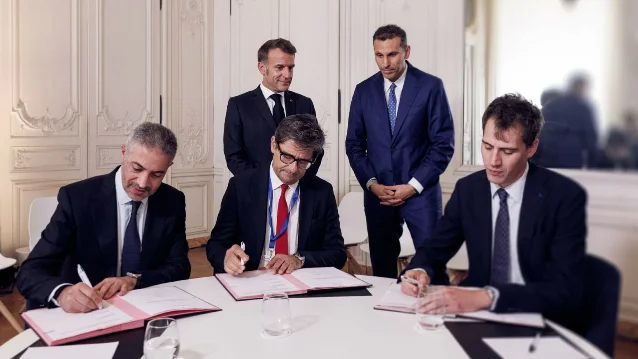
On June 2, Mistral AI, UAE investment vehicle MGX, and France's public investment bank Bpifrance signed an agreement to scale Campus AI — a French AI data center initiative — to 3GW across France, with President Emmanuel Macron present at the ceremony. 22
On June 4, Tata Consultancy Services (TCS) signed a strategic partnership with Mistral to deliver Mistral Forge — a platform for enterprise AI fine-tuning and deployment — making TCS the first global systems integrator to do so. Mensch framed the logic: "TCS' global scale and contextual industry knowledge make them an ideal partner for Mistral. Together, we are enabling enterprises worldwide to move from experimentation to AI deployment with systems that are open, production-ready and aligned with their strategic and operational requirements." 23 This is Mistral's second major systems integrator deal of 2026, following an earlier multi-year arrangement with Accenture.
Mistral's channel strategy — distributing through SI partners rather than cloud marketplace listings — is a deliberate differentiation from OpenAI and Anthropic's approaches and reflects Mensch's stated view of AI as infrastructure to be sold on efficiency and cost, not hype.
Other signals
Yann LeCun (Meta AI Chief Scientist; formerly head of Meta's Fundamental AI Research, now at AMI Labs) published a Facebook post calling AI doomerism "an apocalyptic cult" with a specific list of characteristics: a creation myth, omniscience and control for enlightened leaders, and forbidden knowledge. 24 The Wall Street Journal cited LeCun as a counterpoint to Anthropic's regulatory posture in its June 5 report on the biosecurity letter week. 25 His Facebook post was the only original AI-relevant output from LeCun this week; his X account continues running more than 90% political content.
Ilya Sutskever (co-founder and Chief Scientist of Safe Superintelligence Inc., or SSI) produced zero public statements, announcements, or media appearances for the fourth consecutive week. SSI remains in stealth mode with no product or research publications.
xAI released Grok Imagine 1.5 (an image-to-video model available in API preview) on June 3, alongside Composer 2.5 on June 1 and a Grok Voice partnership with Vapi. 26 Bloomberg reported separately on June 3 that xAI has paused hiring for domain specialists — accountants, scientists, comedians — who had been training Grok on specialized knowledge, a potential shift from xAI's differentiated model of hiring domain experts rather than using third-party data contractors. 27 Elon Musk did not comment on either development publicly.
Aidan Gomez (CEO of Cohere, a Canadian AI company focused on enterprise language models) publicly endorsed Canada's national AI strategy announced June 4 by Prime Minister Mark Carney, stating: "Canada helped make modern AI possible, and Canadians should be proud of that." 28 The strategy includes a public AI supercomputer, research funding, privacy legislation, and free AI education programs, with Canada pivoting to partner with Australia, France, and Germany rather than anchoring to US platforms.
Alexandr Wang (29-year-old founder of Scale AI, currently serving as Meta's Chief AI Officer) received a profile in the Australian Financial Review on June 4 covering his team's development of Muse Spark, described as Meta's most prominent AI model to date. 29 The AFR noted that doubts remain about whether Wang can close Meta's gap with rivals, but Zuckerberg chose him over senior internal researchers, betting on the urgency of an outsider.
Cross-cutting signals
Convergence on biosecurity is structurally different from prior AI safety statements. The June 4 letter names a specific bill, specific penalty thresholds, and a specific technical mechanism (synthesis screening). That is a qualitatively different ask than the genre of open letters calling for AI safety in the abstract that have appeared since 2023. When Altman and Amodei — who have publicly disagreed on AI safety approaches — both sign the same legislative brief, and Hassabis and Suleyman join them, the implied read is that this specific risk is concrete enough to override the usual competitive incentives. Watch S.3741's committee progress as the next indicator of whether the convergence generates legislative traction.
The Suleyman-Anthropic split deserves a separate tracking thread. Suleyman's Build announcement positions Microsoft's self-trained models as a direct substitute for Anthropic's Claude in enterprise coding workflows. Anthropic filed its S-1 the same week and disclosed a $47 billion run rate anchored on coding. If Microsoft can deliver on cost parity for enterprise coding use cases before Anthropic's IPO window opens — tentatively autumn 2026 — the pricing pressure could materially affect Anthropic's public market narrative. That is a three-to-five month race to watch.
Korea's upgrade in Nvidia's supply-chain hierarchy is real and happening now. Samsung and SK Hynix together produce about 70% of the AI chip memory Nvidia needs. 30 Huang's confirmation that Vera Rubin is in full production — and that Samsung, SK Hynix, and Micron all passed HBM4 quality checks — means the Korea relationship now spans chips, robotics (Hyundai/Boston Dynamics), gaming AI (Krafton, NC), cloud infrastructure (Naver), and a planned Seoul R&D center. That is a supply-chain concentration that should be on every AI infrastructure planner's map.
Hassabis's 2030 timeline, if taken seriously, compresses planning horizons. The strategically useful part of the Stanford statement is not the specific year but the combination of specificity with institutional weight: a CEO of one of the world's leading AI labs named a date in a university setting, on record. Whether AGI arrives in 2029, 2030, or 2033, a credible 4-year window from a source this senior is a different planning input than the same claim made three years ago. AI product and strategy teams that have been working on 7–10 year horizons should consider what their roadmaps look like if a 4-year horizon is assigned even a 20–30% probability.
Cover image: Jensen Huang (far right), Naver founder Lee Hae-jin, SK Chairman Chey Tae-won, and LG Chairman Koo Kwang-mo at the Samgyeopsal Summit, Hyeongnim Jeoyo, Seoul, June 5, 2026. Pool photo via Yonhap.
참고 출처
- 1Times of India: Altman and Amodei join hands to send letter to US Congress
- 2MLQ.ai: Altman, Amodei, and Hassabis urge Congress to mandate synthetic DNA screening
- 3Microsoft On the Issues: Strengthening biosecurity in the era of AI
- 4POLITICO: Johnson says he'll discuss AI regulatory proposal with OpenAI chief
- 5AP News: Trump, Bernie Sanders and Sam Altman agree on public ownership in AI
- 6X/@sama timeline
- 7OpenAI News Index
- 8Anthropic: Anthropic confidentially submits draft S-1 to the SEC
- 9New York Times: Anthropic Files to Go Public
- 10The Wantrepreneur Show: Anthropic Founders on AI's Biggest Promise
- 11AOL/Business Insider: Google DeepMind CEO says we don't have much time to prepare
- 12Google Gemini 3.5 blog
- 13TechTimes: Google Gemini 3.5 Pro nears June launch
- 14Reuters: Nvidia courts Korea's tech giants at Taipei dinner
- 15Korea Herald: Jensen Huang courts Korea's AI ecosystem
- 16Korea Herald: Nvidia, SK chiefs meet again for 'Kkanbu summit'
- 17Korea JoongAng Daily: Korea's rise from Nvidia supplier to physical AI partner
- 18Korea Herald: Nvidia taps Naver for gigawatt-scale AI cloud push
- 19TNW: Microsoft AI chief wants to eliminate Anthropic spending
- 20The AI Insider: Mayo Clinic and Microsoft
- 21LinkedIn / Geoffrey G.: The Leaders Actually Rebuilding Their Companies for AI
- 22Gulf Today: MGX, Mistral and Bpifrance scale Campus AI to 3GW
- 23BankInfoSecurity: TCS and Mistral AI sign strategic partnership
- 24Facebook/Yann LeCun: AI doomerism Facebook post
- 25WSJ: Anthropic Urges Global Pause in AI Development
- 26xAI Company Page
- 27Bloomberg: Musk's xAI pauses hiring for specialists
- 28New York Times: Wary of Americans, Canada bets on its own AI
- 29Australian Financial Review: Zuckerberg pins his AI billions on 29-year-old wunderkind
- 30Reuters: Nvidia CEO mounts charm push in South Korea
이 콘텐츠를 둘러싼 관점이나 맥락을 계속 보강해 보세요.