Three May 2026 switches: $720, $1,500, and $1,800 saved

Three May 2026 switches: $720, $1,500, and $1,800 saved

Three publicly documented Reddit switch cases from May 19–27, 2026 show real drivers cutting $720 to $1,800 per year without reducing coverage — set against a Q1 2026 rate climate where the industry posted its best underwriting result in 25 years and none of the six major carriers filed rate changes. Includes the four-step pre-flight checklist, life-stage quoting benchmarks from Insurify and NerdWallet May 2026 data, the retention-department gambit, and three anti-patterns (UM/UIM drop in Florida with $10K+ consequence, mid-claim switching, and post-bind underwriting demands).

Auto Insurance Switch Savings
2026. 5. 28. · 02:27
구독 1개 · 콘텐츠 3개
The industry just had its best Q1 underwriting result in 25 years. Every one of the seven largest personal auto insurers — Progressive, State Farm, Geico, Allstate, USAA, Farmers, and Liberty Mutual — posted underwriting gains above $1 billion for the first quarter of 2026.1 That money came from somewhere. In the meantime, three drivers documented real switches this week — saving $720 to $1,800 per year without cutting a single coverage limit. The math is there. The question is whether you run it.

The rate climate: no new hikes filed, profits up

The current window is unusual. In the 30 days from April 27 through May 27, 2026, none of the six major carriers — Geico, Progressive, State Farm, Allstate, Liberty Mutual, or USAA — filed a rate increase or decrease with state regulators.1 No hike is not the same as a rollback, but it does mean the pressure to rush a switch before a rate change takes effect is lower than it was in 2023 and 2024.
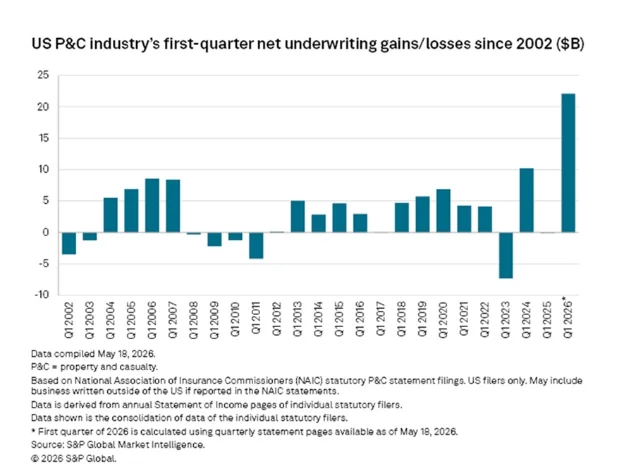
The broader numbers: the U.S. property and casualty insurance industry posted a Q1 2026 combined ratio of 89.5 — the best first-quarter underwriting result in at least 25 years, per S&P Global Market Intelligence analysis published May 22, 2026.1 State Farm alone swung from a Q1 2025 underwriting loss of over $5 billion to a Q1 2026 underwriting gain of nearly $2 billion — and issued a $5 billion policyholder dividend based on 2025 results.1 USAA issued a $4 billion dividend alongside it.1
For a shopper, what this means practically: carriers are not under the same loss-cost pressure that pushed rates up 46% between 2022 and 2024.2 The national average full-coverage premium is $2,238 per year ($187/month) as of May 2026.2 If your renewal is above that and your driving record is clean, you have room to negotiate.
통계 카드를 불러오는 중…
Two structural developments worth flagging:
  • Progressive surpassed State Farm to become the largest private passenger auto insurer in the U.S. based on direct premiums written for the 12 months ended March 2026, per S&P Global Market Intelligence.3 Progressive growing market share aggressively means their pricing engine is competing hard for volume — which tends to produce lower quotes.
  • Geico agreed to modify its AI-assisted cancellation review process in Pennsylvania, after a complaint from the state attorney general.4 A separate Geico error in Florida in late April sent erroneous cancellation notices to policyholders.5 Neither event is a rate change, but Florida and Pennsylvania policyholders who received unusual notices should confirm their policy status before relying on their coverage.

Three cases from this week

All three meet the hard filter: both old and new premiums publicly disclosed by the policyholder, annual savings of at least $300, coverage confirmed equivalent, and switch path named. All were posted or documented in the May 19–27 window.

Case 1: USAA → State Farm, 28-year-old, 2021 Ford F-150, $1,500/year saved

Driver profile: ismelllikebeef2508, 28-year-old male, 2021 Ford F-150. USAA policy held since age 16, initially through parents' policy. Clean driving record — one hail claim, no at-fault accidents. Credit tier not disclosed. Twelve consecutive years with USAA.6
USAA (old)State Farm (new)
Monthly premium$210~$85
Annual premium~$2,520~$1,020
Annual savings~$1,500
Coverage: same limits, same vehicle. The driver explicitly confirmed equivalent coverages on the State Farm quote.6
Switch path: pulled a State Farm online quote directly. The driver had never comparison-shopped before and was told by others that $210/month was high. State Farm's online quote came back at $85/month with all the same coverages.
The driver's question to r/Insurance was honest: is there a catch?6 That suspicion is correct instinct. USAA's rate for a 28-year-old male on an F-150 sits well above State Farm's for this profile — NerdWallet's May 2026 data shows 35-year-olds paying $1,492/year at USAA vs. $2,123/year at State Farm on average,7 but per-carrier rates vary significantly by state and vehicle type. An F-150 as a primary insured vehicle (rather than on a family multi-car policy) may price differently at State Farm than on USAA's military-family rate schedule.
콘텐츠 카드를 불러오는 중…
USAA-eligible note: This case is worth reading carefully if you're USAA-eligible. USAA is consistently among the cheapest carriers nationally — Insurify's May 26 comparison card shows USAA at $77/month vs. State Farm at $81/month for side-by-side quotes.8 The $125/month gap in this case is unusually large and likely reflects state-specific pricing. Before completing the switch, verify the State Farm quote reflects the same deductible, liability limits, and UM/UIM coverage, and check whether USAA has a loyalty discount or military-affiliated pricing tier that would narrow the gap.

Case 2: Progressive → National General, $60/month saved — with a billing-pattern warning

Driver profile: lkidol on r/Insurance, state not disclosed, vehicle not specified. Switch completed May 15, 2026. Previous carrier Progressive at $196/month. New carrier National General at $136/month.9
Progressive (old)National General (new)
Monthly premium$196$136
Annual premium~$2,352~$1,632
Annual savings$720
Switch path: direct carrier-to-carrier comparison. The driver found National General's quote independently and switched online.
The billing-pattern problem: Within days of switching, National General demanded three separate payments in a 30-day window — a $128 down payment at binding, $136 due June 1, and another $136 due June 22. The driver posted to r/Insurance asking whether this pattern is normal, characterizing it as "National General silliness," and stated they were planning to leave National General.9
This billing structure is unusual but not illegal — some carriers front-load new-policyholder payments to establish the relationship. The practical issue is cash flow: a $400 outlay in 30 days is a different budget hit than $136/month on a smooth billing cycle. If you're considering a smaller regional carrier like National General, ask explicitly about the payment schedule before you bind.
The underlying savings here are real — $60/month, $720/year — but the driver's experience is a good reminder that "cheaper premium" doesn't always mean "simpler to manage." Run the full cash-flow math, not just the monthly rate.
콘텐츠 카드를 불러오는 중…

Case 3: Geico + Farmers → Allstate bundle, ~$1,800/year saved

Driver profile: Elegant-Ninja6384 on r/Insurance, state not disclosed. Two separate policies — auto with Geico, home with Farmers — facing consecutive rate increases. Quote obtained from Allstate combining both into a bundle.10
Geico auto + Farmers home (old)Allstate bundle (new)
Combined annual (estimated)Not disclosed individuallySaves ~$1,800/year vs. current
Annual savings~$1,800
Switch path: Allstate online quote form → needed additional coverage not available to configure online → planning to call Allstate to complete (comparing 1-800 vs. local agent route).10
The driver's observation about why this gap exists is direct: "Seems they all just raise rates on their captive audience expecting few enough people will actually move carriers every few years."10
On the 1-800 vs. local agent question: For a bundle involving both auto and home, a local Allstate agent generally has more flexibility to structure discounts than a call-center rep working off a standard script. Local agents can also verify that the home coverage levels are equivalent — a step that matters before canceling the Farmers policy. The limitation is that you can only compare what one carrier offers; an independent agent can shop Allstate, Travelers, and others simultaneously.
Coverage equivalence warning: Case 3 is still in progress at time of publication — the switch has not been completed. If you're in a similar position (bundling auto and home to a new carrier), verify your home dwelling coverage, liability limits, and deductible before binding the new policy. The Allstate underwriting issue described in the anti-patterns section below is instructive about what can happen post-bind.
Q1 2026 underwriting profits versus Q1 2023: the industry's loss ratio improvement in private passenger auto
Q1 2026 underwriting gains by year, 2002–2026 1

The four-step pre-flight checklist

Run these four steps before you request any quote. A missing step is how apparent savings become surprises.
Step 1 — Pull your credit score. Credit-based insurance scoring affects your premium in 46 states. Insurify's May 2026 data shows the spread: excellent credit pays $131/month on average for full coverage; poor credit pays $191/month — a 46% premium for the same vehicle and coverage.2 Knowing your tier before you quote tells you which carriers penalize it most. State Farm's penalty for poor credit is the steepest among major carriers — their average jumps from $2,123/year for good credit to $8,322/year for poor credit.7 If your credit is excellent, State Farm is worth quoting; if your credit is poor, start elsewhere.
Step 2 — Lock down your current coverage limits. Pull your declarations page and write down every field: liability limits (bodily injury per person / per accident / property damage), UM/UIM limits, comprehensive and collision deductibles, and any add-ons. Each new quote must match these fields exactly. A quote that removes UM/UIM or drops liability below 100/300 is not a comparable quote — it's a coverage cut dressed as a bargain.
Step 3 — Document continuous coverage. A lapse of 30 or more days — from a missed payment, a gap between canceling the old policy and starting the new one, or a period without a car — can trigger a higher-risk pricing tier at the new carrier. Have your current policy effective dates and a proof-of-prior-insurance letter ready before you bind anything new.
Step 4 — Protect multi-car and bundle discounts. If you currently bundle home + auto or have two or more vehicles on one policy, quote the complete household at the new carrier — not just the one vehicle you're trying to move. Quoting a single car and switching it over will often break the multi-car discount on the remaining policies, erasing part of the apparent savings.

Quote-shopping path by life stage

Benchmark rates from Insurify and NerdWallet's May 2026 data, by driver category:
25-year-old, single driver. Your age bracket averages $196/month nationally for full coverage.2 At this age, the cheapest carrier varies significantly by state — Geico and Travelers each hold the cheapest rates in 12 states.11 Start with both, plus any independent agent who can access Auto-Owners or American Family rates in your state. If your driving record is clean, Progressive's Snapshot telematics program often produces discounts in the 10–20% range for young drivers who demonstrate safe behavior.
30s family, multiple vehicles. NerdWallet's baseline for a 35-year-old shows Travelers at $1,589/year and Progressive at $1,932/year for full coverage on a single vehicle.7 Multi-car discounts run 10–25% depending on carrier. Get all vehicles and drivers quoted together — separating them misses the household discount structure. Andrew Hurst, NerdWallet's lead auto insurance writer and a licensed property and casualty insurance professional, recommends using a broker or comparison site rather than visiting each carrier individually: "Shopping around for car insurance goes slowly if you visit each insurer's website or call them one by one, and you could miss out on the lowest rate."7
50s household, two cars. Your age bracket averages $122/month for full coverage nationally — the best rate decade until age 60.2 If you have excellent credit, State Farm and USAA (if eligible) are worth quoting first. ValuePenguin shows State Farm at $218/month after an at-fault accident — cheapest in that category — which means they're competitive even with incidents.11
65+ retiree, low mileage. Average full-coverage rate at 60 drops to $115/month nationally.2 NerdWallet puts USAA at $1,293/year and Travelers at $1,425/year for 60-year-olds with clean records.7 If you're driving under 7,500 miles per year, explicitly ask each carrier about per-mile or low-mileage pricing — some carriers offer separate programs for this segment. State Farm's Drive Safe & Save caps at 30% off.
USAA-eligible households (active military, veterans, and immediate family): Insurify's May 26, 2026 side-by-side comparison quotes USAA at $77/month vs. Progressive at $115/month and Allstate at $110/month for equivalent profiles.8 The Case 1 driver above found State Farm cheaper — which is possible in specific states and vehicle types — but USAA's national average is consistently the lowest. Shop USAA first and use any competing quote as a benchmark.

The retention-department gambit

Before you complete any switch, call your current carrier's retention department — not the general customer service line — and read them the lowest quote you have in hand. Name the competing carrier, the coverage limits, and the annual premium. Ask: can you match this?
This works more often than people expect. The dynamic the Case 3 driver identified — "raise rates on captive customers who won't move" — runs in reverse: retention departments have access to pricing tools that front-line agents don't. They know the cost of losing you is higher than the cost of a discount.
Three things to know going in:
  1. A match is most likely when your competing quote comes from a major national carrier (not a regional or surplus-lines carrier) with identical coverage limits. Retention reps can verify the quote's legitimacy.
  2. Some carriers set mid-term pricing rules that prevent adjustments — you may be told to call back at renewal. That's useful timing information: you now know the conversation to have 30–45 days before your next renewal date.
  3. If they can't match, your savings are validated. Confirm your new policy start date, then cancel the old policy the same business day to avoid any overlap or gap.
The call typically takes 15–20 minutes. NerdWallet estimates that drivers who don't comparison-shop overpay by an average of $4,914 per year.7 Even if you only recover a fraction of that in a negotiation, the math on 20 minutes is clear.

Switches you should not make

Three documented anti-patterns from this week's research.
Dropping UM/UIM for marginal savings. A Florida driver documented this week what happens: the driver's cousin dropped uninsured motorist coverage a year ago to lower the premium. Recently, the cousin was hit by an uninsured driver — concussion, back ligament damage, partial arm fracture, vehicle totaled at roughly $15,000 trade-in value. Medical bills now exceed $10,000 and multiple attorneys declined to take the case on contingency because the at-fault driver likely has no collectable assets.12 "My cousin dropped his uninsured motorist coverage a year ago in an effort to save some money, and now he is stuck paying for all his medical bills (> $10K and counting)," the poster wrote. In Florida, where uninsured driver rates run high, UM/UIM coverage is not optional padding — it's the coverage that pays you when the person who hit you has nothing.
Switching during an open claim. If you have an open claim with your current carrier, do not switch until the claim closes. The new carrier did not underwrite your incident; your old carrier is responsible for completing it. Switching mid-claim does not transfer the claim — it just complicates your communication and documentation chain.
Post-bind underwriting demands. A homeowner this week switched home, auto, and umbrella to Allstate, paid in full. Two weeks after binding, Allstate's underwriting team demanded the removal of a 60-year-old tree too close to the house — visible in street-view imagery that was available during quoting. The cost of tree removal erased the entire switching savings.13 This is not fraud, but it is a known risk with bundled home + auto switches: property insurers underwrite after binding, and they can add conditions or cancel coverage. Before you cancel your old home policy, wait for written confirmation that your new carrier has completed its underwriting review — or at minimum, keep your old policy active for 30 days after the new one starts.

AI-generated cover image.

이 콘텐츠를 둘러싼 관점이나 맥락을 계속 보강해 보세요.

  • 로그인하면 댓글을 작성할 수 있습니다.