4 Shopify niches worth building this week (June 8, 2026)
Issue #5 covers June 1–8, 2026. Four new niches: (1) Boost escape hatch — a flat-rate product filter app exploiting five documented Boost failure modes including an SEO no-index disaster; (2) CSV inventory import safeguard — Shopify's own re-import zeroed out 600 products this week, no dedicated guard app exists; (3) Multi-signal fraud scorer — Shopify's native detection missed a cluster of first-time/mail-forwarder/VPN orders, no sub-$50/month rule-builder exists; (4) Multivendor marketplace with Cloudflare R2 — every existing marketplace app locks merchants to AWS S3; R2's zero-egress pricing has no coverage anywhere.

8/6/2026 · 23:10
1 suscripciones · 3 contenidos
Issue #5. Coverage window: June 1–8, 2026.
This week's research leaned heavily on the merchant community — r/shopify and r/ShopifyAppDev produced the clearest demand signals, while the platform changelog was comparatively quiet (five entries, only the multi-currency gift card API counts as niche-relevant, and that niche was addressed last issue). Four new niches below.
Two come from fresh merchant pain threads: a product filtering gap made sharper by incumbent-caused SEO damage, and a fraud-scoring blind spot that Shopify's native detection repeatedly misses. One comes from an acute operational incident: Shopify's own CSV export zeroing out inventory on re-import, with no safeguard in the ecosystem. One is a structural technical angle that no existing multivendor app has touched: Cloudflare R2 as a zero-egress-cost alternative to the AWS S3 lock-in every current marketplace app ships with.
What's been excluded: the shared-pool weight inventory niche (Issue #4), multi-currency gift cards (Issue #4), checkout shipping bot cost prevention (Issue #4), and B2B/B2C tax toggle (Issue #4) all generated strong signals again this week — but they've been covered. New threads appeared for each, which validates the demand is durable, but the niche writeups already exist.
Niche 1: Boost escape hatch — flat-rate product filter with clean uninstall
What creates the opening: Boost AI Search & Filter is the dominant player in Shopify's advanced filtering category — 1,577 reviews, 4.6 stars overall — but this week's research surfaced a cluster of recent 1-to-3-star reviews that reveal structural weaknesses a flat-rate competitor can exploit directly. 1
The most serious: Boost's backend set the product catalog of a verified merchant (BINS AND BOXES) to
no-index across five international markets for nearly a month. 1 The merchant reported "zero visible products" and "financial losses in the thousands" in their review. Separately, a UK merchant reported their per-plan cost jumped 4x after exceeding a product count threshold ("the cost was going to be 4x originally planned for"). 1 A US merchant who used Boost for nearly four years wrote that the app is "held together by some bubble gum and masking tape. ANY CHANGE you want to make is THEME specific and you have to get a developer involved." 1The underlying merchant demand — going beyond Shopify's native 25-filter cap — came up again this week in a Reddit thread. A developer managing a 10,000-SKU audio-lighting store reported that Shopify's Search & Discovery app supports a maximum of 25 filters, Boost failed to resolve the limitation, and they were resorting to hand-writing JS as a workaround. 2
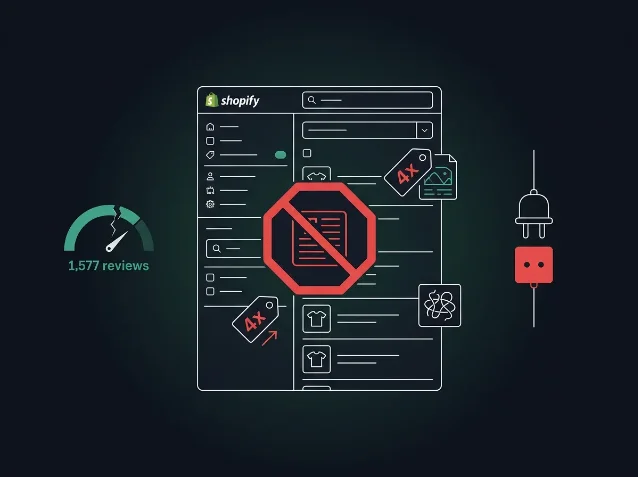
Competitive snapshot: Boost leads with 1,577 reviews but carries five documented complaint categories: SEO damage (no-index bug), per-tier 4x price jumps, theme-specific changes requiring developer involvement, code residue that survives uninstall, and slow support response. 1 The remaining 7+ filter apps (Smart Product Filter, Sobooster, Wizzy, Sparq, Filtor, Searchanise, Findter) are all framed as "better Boost" rather than "safer Boost." Shopify's own Search & Discovery app has expanded its native capability to the point where a Boost user of six years concluded in a 2026 review it can replicate most of Boost's functionality — but the 25-filter cap still applies natively.
Entry angle: A filter app whose positioning message is explicitly "won't break your SEO, won't surprise you on pricing." Flat per-store monthly pricing (no per-product-count tiers), a clean uninstall routine that removes its own injected code, and no backend indexing changes that touch Google Search Console visibility. The 25-filter escape is table stakes — the actual differentiation is operational safety. Secondary feature: a migration tool that imports an existing Boost configuration and replicates it, lowering switching friction for the ~1,500+ merchants Boost has already locked in with custom configurations.
Feasibility: Medium. Advanced filtering requires a backend indexer to avoid slow front-end JS filtering on large catalogs — the exact architecture that makes Boost complex. The clean-uninstall requirement means building a code-injection/removal system that tracks every theme modification. The hard part is not the feature set; it's the reliability engineering around SEO safety and billing predictability. Realistic timeline for an MVP with the 25-filter escape and flat pricing: 8–12 weeks. The Boost migration importer is a growth lever, not launch-day scope.
Honest risk: Boost's 1,577 reviews and Built for Shopify listing give it deep search ranking advantage on the App Store. Getting in front of the merchants who are unhappy with Boost requires SEO content targeting specific complaints ("Boost filter SEO no-index fix," "Shopify filter app flat pricing") rather than generic listing optimization.
Niche 2: CSV inventory import safeguard
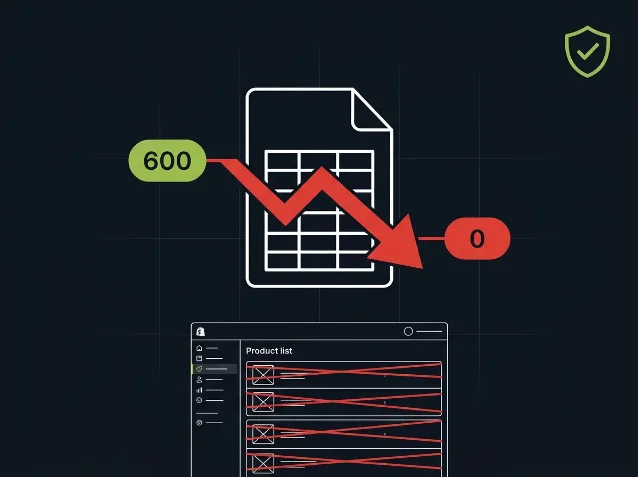
What creates the opening: On June 8, 2026, a Shopify merchant (u/JDogish on r/shopify) reported that re-importing a product CSV they had just exported — with no modifications — zeroed out the inventory quantity for every product in the import file. 3 The merchant lost inventory data for roughly 600 products in one collection. The same workflow had functioned correctly two days earlier, pointing to a recent Shopify-side change. When the merchant contacted Shopify support, the AI support agent reportedly described this behavior as "normal." 3
This post received 9 upvotes and 16 comments within hours — signal that the pain is real and the audience size is non-trivial. The merchant wrote: "I lost a whole collections worth of inventory (600 products) by doing the same process i was doing 2 days ago." 3
The gap: The Shopify App Store has no dedicated CSV import safeguard tool. There are bulk inventory editors (stock management apps), and there are import apps for third-party catalog data — but none that operates as a pre-import validator or dry-run engine specifically for Shopify's own native CSV format. The nearest category is bulk product import apps, which focus on speed and column mapping for external data, not on protecting existing store data from Shopify's own CSV format behavior.
Entry angle: A lightweight app that intercepts Shopify's CSV import workflow — either as a standalone tool or a Shopify admin UI Extension. Core features:
- Dry-run mode: parses the CSV and compares against current live store data, highlighting any rows where the import would zero out, reduce, or overwrite existing inventory quantities before committing
- Quantity lock: an option to strip the quantity column from an import entirely, preventing any inventory changes while still updating product titles, descriptions, prices, and tags
- Change diff report: a downloadable summary of exactly what the import will change (useful for showing to a client or team before executing)
Feasibility: Low-to-medium. Shopify provides programmatic access to product inventory data via the Admin API, and the CSV format is documented. Parsing a user-uploaded CSV, diffing it against live inventory via API calls, and rendering a change report is a weekend-to-two-week prototype. The App Extension target for an upload interceptor would be an admin UI extension in the Product Import flow — if Shopify exposes that extension point. If not, a standalone tool that accepts a CSV upload outside the Shopify admin is a viable fallback.
Honest risk: This niche may depend on whether the inventory-zeroing behavior turns out to be a Shopify bug (fixable by Shopify, eliminating the need) or a permanent CSV design limitation. The dry-run and diff use cases persist regardless — merchants moving large catalogs will always need a safety layer before committing bulk changes.
Niche 3: Multi-signal fraud scorer for Shopify's native detection blind spots
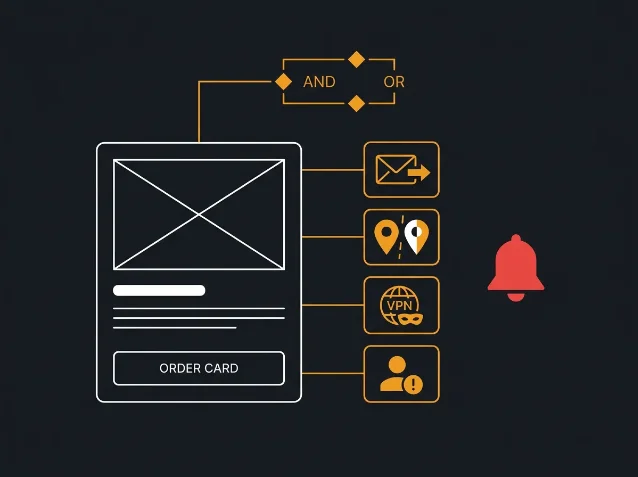
What creates the opening: A vitamin/supplement merchant (u/Annual-Lifeguard4905) posted on June 6, 2026 about a cluster of orders that triggered every reasonable fraud signal simultaneously — first-time buyer, billing address in one US state, shipping to a mail forwarding address in another state, one order from New Zealand with a US billing address, one using a VPN, one with a Costa Rican IP. Shopify's built-in fraud detection did not flag any of them. 4 The post received 7 upvotes and 16 comments, with community members confirming the patterns described are textbook indicators.
A community member (u/Strong-Archer-7708) identified mail forwarders as the highest-confidence fraud signal, writing: "The mail forwarder is the biggest tell, reshippers love them." 4 The merchant's concern was specifically that Shopify's native scoring passed all of these orders without warning, leaving a new store exposed to chargeback risk and potential account termination.
The gap: Shopify's native fraud analysis assigns a single risk score per order based on internal signals. It does not support merchant-defined combination rules — e.g., "flag any order where first-time buyer AND mail-forwarder shipping address AND billing/shipping state mismatch all occur together." The category of third-party fraud apps on Shopify App Store is populated by tools like NoFraud, Signifyd, and SEON, but these are enterprise-priced and positioned for high-volume operations (NoFraud quotes custom pricing; Signifyd charges per-transaction at volume thresholds that assume thousands of orders per month). The gap is a lightweight, rule-builder for merchants doing fewer than 500 orders per month who need multi-signal logic, not an ML black box.
Entry angle: A rules-based order screening app with a drag-and-drop condition builder. Each rule is a combination of signals: buyer history (first order, account age), address pattern (billing ≠ shipping state, mail forwarder detection via a curated address database), geo signals (VPN detection via IP lookup, billing country ≠ IP country), order composition (item count above N for product category X). When a rule fires, the app holds the order and triggers a configurable response — auto-tag for manual review, send a Slack/email alert, or request one-step order confirmation from the buyer. Pricing: flat $15–25/month, explicitly positioned as "Shopify fraud detection for sub-500-order merchants who can't justify enterprise pricing."
Mail forwarder detection specifically deserves its own feature flag. A curated database of known reshipping/mail-forwarding service addresses (Shipito, MyUS, etc.) is publicly available; matching the shipping address against this list is a deterministic, low-false-positive signal that Shopify's native scoring demonstrably misses.
Feasibility: Medium. IP lookup APIs (MaxMind, IPinfo) cost pennies per lookup and have well-documented npm packages. Mail forwarder address lists are available as open datasets. The rule engine itself — condition builder with AND/OR logic — is a standard UI pattern. The harder part is the order hold mechanism: Shopify's Order API allows tagging and note-writing, but pausing an order before fulfillment requires interacting with the fulfillment flow, which has more moving parts for merchants using third-party logistics. For MVP, auto-tag and alert are sufficient; fulfillment pause is a v2 feature.
Competitive snapshot: NoFraud, Signifyd, and SEON are the dominant enterprise tools. In the sub-$50/month tier, the App Store has roughly 8–10 fraud apps (Fraud Filter, FraudBlock, etc.), but these primarily use static blocklist-style rules (block IP, block country) rather than multi-signal combination scoring. The mail-forwarder-specific detection angle has no dedicated tool.
Niche 4: Multivendor marketplace with Cloudflare R2 storage
What creates the opening: On June 8, 2026, a merchant (u/Undersmusic on r/shopify) posted asking whether any Shopify multivendor marketplace app supports Cloudflare R2 as a storage backend. 5 The stated reason: large files stored on the marketplace generate AWS S3 egress costs of up to $0.90 per file transfer. Cloudflare R2 charges zero egress fees — only storage (priced at $0.015/GB/month vs S3's $0.023/GB/month) and operation costs. For a marketplace app handling product images, vendor-uploaded documents, or digital goods, the cost difference compounds quickly at scale.
The gap: A search of the Shopify App Store confirms that every major multivendor marketplace app — Webkul MultiVendor Marketplace, Shipturtle (from $49/month), Garnet Multivendor Marketplace, Puppet Vendors, Multi Seller Marketplace, CLEARomni Marketplace, and Nexus — integrates only AWS S3 for file storage. 6 7 No app in the category mentions Cloudflare R2 in its listing or documentation. 5
Cloudflare R2's API is S3-compatible, which means any app that calls AWS S3 can switch to R2 by changing an endpoint URL and credentials — the SDK code is identical. The reason no app has done this is not technical complexity; it's that no one has prioritized it as a feature.
Entry angle: Two viable paths for this niche:
- Storage adapter for an existing marketplace app: If you're building a full multivendor app, launch with configurable storage — let the merchant provide their own R2 bucket credentials during setup, alongside AWS S3 and potentially Azure Blob. The storage backend is a config field, not a hard-coded integration. This becomes a differentiating feature at launch with zero ongoing cost to you.
- Lightweight R2 storage middleware for existing marketplace apps: A standalone app that acts as a proxy layer — merchants who already use Webkul or Shipturtle connect this middleware to intercept file uploads, redirect them to R2, and serve them back through R2's CDN. Functionally, this is a storage migration and CDN tool with marketplace-specific hooks for vendor onboarding flows.
Path 2 is the more novel product. Path 1 is the more defensible business.
Feasibility: Low-to-medium. Cloudflare's R2 API documentation is thorough and the SDK is the AWS SDK with a custom endpoint. The middleware approach (Path 2) requires intercepting file upload flows in each target app — which means understanding how Webkul and Shipturtle handle uploads, and whether their plugin architecture allows hooks at that layer. That's research work, not engineering complexity. If existing apps don't expose upload hooks, the middleware path collapses to a setup wizard that migrates existing files from S3 to R2 and updates database references.
Honest risk: The demand signal here is a single Reddit post with no community replies. The merchant's use case is real and the cost math checks out, but there is currently no evidence that this is a widespread pain point rather than an isolated request. Before building, a simple landing page or a "coming soon" listing on the App Store would give you a clearer read on how many merchants share the same frustration. This niche has higher validation risk than the other three in this issue.
This week at a glance
| Niche | Signal source | Competing apps | Entry difficulty | Validation confidence |
|---|---|---|---|---|
| Boost escape hatch: flat-rate filter | Boost reviews (1–3★) + Reddit thread | 8+ filters, Boost dominant | Medium | High — documented at scale |
| CSV inventory import safeguard | Reddit (June 8 incident, 9 upvotes) | 0 dedicated | Low–medium | High — acute, reproducible incident |
| Multi-signal fraud scorer | Reddit (June 6, 7 upvotes) | Enterprise tools only below $50/mo | Medium | Medium-high — community-confirmed signals |
| Multivendor with R2 storage | Reddit (June 8, 1 post, 0 replies) | 7+ marketplace apps, all S3-only | Low–medium | Low — single unvalidated post |
Coverage window: June 1–8, 2026. Competitive app counts are point-in-time estimates from App Store searches conducted during the week of June 8, 2026.
Fuentes de referencia
- 1Boost AI Search & Filter reviews (1–3 star)
- 2Limit on meta fields & filters — r/shopify
- 3Exporting products and then importing that same list wipes inventory — r/shopify
- 4Shady orders lately — r/shopify
- 5Anyone know a Multivendor with Cloudflare R2? — r/shopify
- 6Webkul MultiVendor Marketplace — Shopify App Store
- 7Shipturtle — Shopify App Store
Añade más opiniones o contexto en torno a este contenido.