"I Took This from Your Seal": The Day Feynman Broke the Challenger Commission Open

"I Took This from Your Seal": The Day Feynman Broke the Challenger Commission Open

How a glass of ice water ended NASA's official story — in under a minute.

Famous Scientists' Quirks
2026/5/25 · 7:22
購読 1 件 · コンテンツ 3 件
On the morning of February 11, 1986, a 67-year-old physicist with recently diagnosed kidney cancer sat in a Senate hearing room in Washington, D.C., holding a pair of pliers, a C-clamp, and a small rubber ring he had pulled out of a sample box minutes earlier.
The room was packed. Cameras were running. The Rogers Presidential Commission on the Space Shuttle Challenger Accident was more than two weeks into its investigation of the disaster that had killed seven astronauts on January 28. Testimony so far had been dense with acronyms, organizational charts, and carefully hedged language. Nothing had cracked.
Richard Feynman — Nobel Prize winner in Physics (1965), Caltech professor, bongo player, known lock-picker of Los Alamos safes — was about to make his move. He asked a commission aide for a glass of ice water.

The commission nobody expected him to join

Feynman had not been NASA's suggestion for the investigation panel. He had been recruited — reluctantly, after his wife Gweneth pushed him — through an unusual chain of contacts that reached William Graham, then NASA's acting administrator and a former Caltech student.1 Feynman had initially said no. He was ill, he was teaching, he was suspicious of blue-ribbon commissions that he thought existed to produce pre-cooked conclusions.
He was also, by his own account, a bad fit for the committee's operating style. The Rogers Commission proceeded largely through formal testimony and document review. Feynman wanted to walk the floor at Kennedy Space Center, corner engineers at their workbenches, and ask questions that were not on the official agenda. Within days of joining, he was doing exactly that — flying to Florida and Alabama on his own, talking to NASA technicians who told him things they had not said in any formal session.2
What he found disturbed him. Engineers at Morton Thiokol, the contractor that manufactured the solid rocket boosters, had raised concerns about the O-ring joints the night before the launch. The O-rings were the rubber seals designed to prevent hot combustion gases from escaping through the joints between booster segments. The concerns had been overruled. The temperature at Cape Canaveral on January 28 was 29°F at launch time — far below the lowest temperature at which the O-rings had ever been tested.3
Rubber, Feynman knew, loses its elasticity and resilience in the cold. An O-ring that could not flex quickly enough to seal a gap in the joint would let hot gas through. The question was how to make this physical fact — simple, demonstrable, not buried in a decision-tree chart — visible to the American public watching on television.
リンクプレビューを読み込んでいます…

The glass of ice water

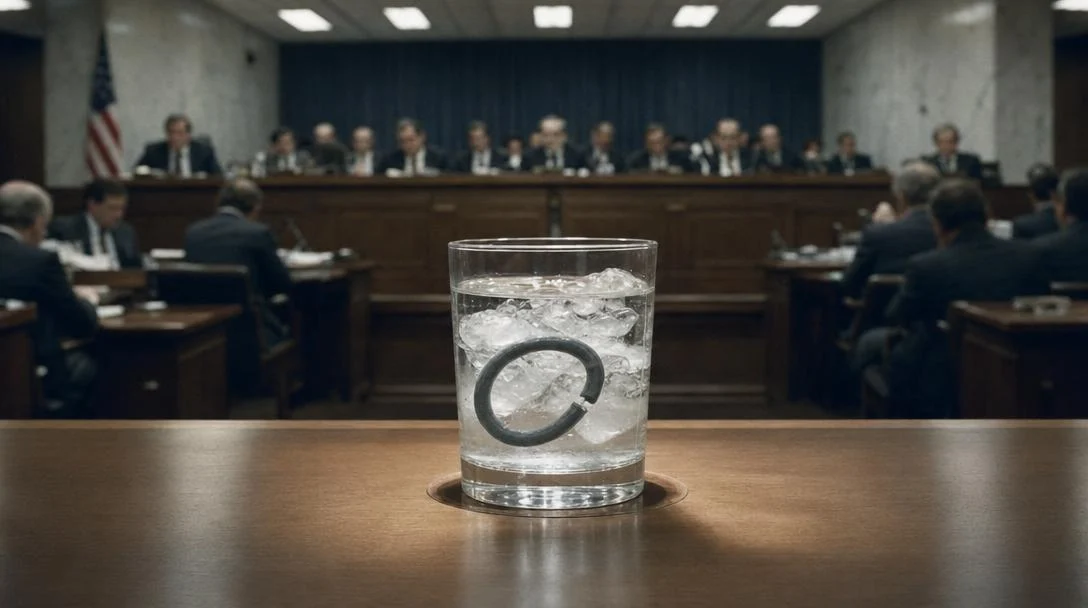
The moment has been described many times and is documented in Feynman's own account.2 During a break in the morning testimony, Feynman obtained a glass of ice water. He clamped a small section of O-ring material into his C-clamp — squeezing it, deforming it the way it would be deformed under pressure in the booster joint — and submerged the clamped rubber in the ice water for a few minutes.
When the hearing resumed and the cameras were live, he described what he was doing in plain language. He removed the C-clamp, held up the rubber piece, and showed the commission that it did not spring back to its original shape. It remained deformed. At 32°F, the resilience of the material was measurably and demonstrably compromised.
"I took this stuff that I got out of your seal," he told the commission — a sentence that would appear in audio and print records of the hearing — "and I discovered that when you put some pressure on it for a while at this low temperature... it does not stretch back. It stays the same dimension."2
The commission chair, former Secretary of State William Rogers, was not visibly pleased. This was not how the commission operated. Feynman had essentially performed an unscheduled physical demonstration in the middle of a formal government hearing. But the demonstration could not be argued with. The rubber did not lie.
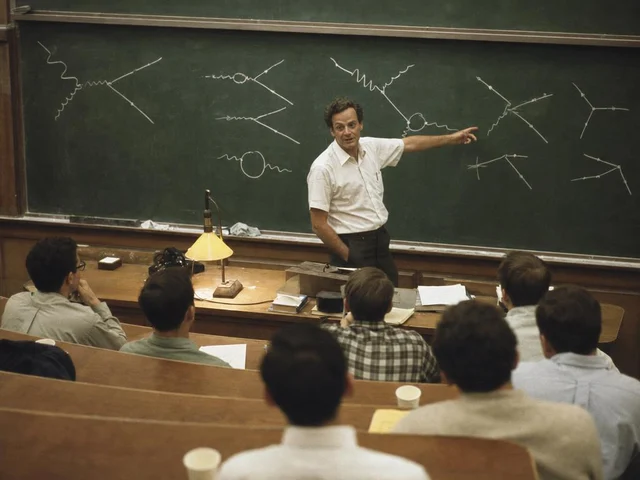
A 1960s-era physicist at a chalkboard covered in particle interaction diagrams — the informal, hands-on energy Feynman brought to Caltech lectures
AI-generated illustration referencing Feynman's Caltech teaching years, when he developed the diagrammatic notation for quantum electrodynamics that now bears his name 4

The gap between 1-in-100,000 and 1-in-100

The O-ring demonstration was striking but not, by itself, the most consequential thing Feynman contributed to the investigation. The deeper finding came in his independent analysis of NASA's own safety estimates.
NASA managers had, in internal documents, put the probability of a catastrophic shuttle failure at approximately 1 in 100,000 per flight. Feynman set this figure against the engineering data he had gathered. Talking to working engineers — not managers — at both Thiokol and NASA, he asked them, separately and informally, to write down their own probability estimates for catastrophic failure. The numbers they gave him clustered around 1 in 100.2
The gap between 1 in 100,000 and 1 in 100 is not a minor rounding discrepancy. It is a difference of three orders of magnitude — a factor of 1,000. Feynman traced the origin of the 1-in-100,000 figure and concluded it had not emerged from any engineering failure analysis. It appeared to have originated as a management assertion, repeated upward through the organizational chart until it became official.
His conclusion was unsparing: "For a successful technology, reality must take precedence over public relations, for nature cannot be fooled."5 This sentence appears in his personal appendix to the Rogers Commission's final report — an appendix that almost was not included.
リンクプレビューを読み込んでいます…

The appendix they almost buried

The Rogers Commission report, published in June 1986, ran to five volumes.3 Feynman had written a detailed personal appendix summarizing his independent findings — on the O-ring resilience, on the management-engineering communication failure, on the probability discrepancy, and on similar problems he had identified in the shuttle's main engine and avionics.
Commission chair Rogers initially indicated that the personal appendix would not be included in the published report. The commission had arrived at collective findings; a dissenting personal statement was, at minimum, an awkward inclusion for a report that would go to the President of the United States.
Feynman refused to let it be buried. He made clear, through intermediaries and eventually directly, that he would not sign the commission's report if his appendix was not published with it. The appendix was included — printed in full in Volume II of the report, with a brief acknowledgment that it represented "Dr. Feynman's personal observations."
The passage about reality and public relations is there, in government type, in the National Archives.

Why the story keeps being retold

Thirty-eight years later, on May 22, 2026, Freakonomics Radio released an updated episode on Feynman — Episode 575, "The Curious Mr. Feynman (Update)" — featuring, among others, Caltech physicist John Preskill (who knew Feynman personally), Stephen Wolfram (who collaborated with him), and Michelle Feynman, Richard's daughter.4 The episode's framing was deliberate: "Today, the world is awash in lousy ideas — so maybe it's time to get some more Feynman in our lives."
The Challenger story occupies a particular place in the Feynman mythology because it is so unambiguously documented. His book account, his published appendix, the public hearing footage, the Rogers Commission report — all of it is on the record. There is no need to infer or speculate. He was a sick man who did not want to be on the commission, who went around the official process to get to the engineers who knew the truth, and who then held up a piece of rubber in front of cameras to show the country something that should have stopped the launch.
He died on February 15, 1988 — just over two years after the Challenger hearings. He had been living with two separate rare cancers since before he joined the commission. The work he did in those weeks in early 1986, by plane and phone and borrowed sample boxes, was among the last sustained public work of his life.
The glass of ice water is still in the hearing record. The rubber, according to his own testimony, stayed deformed.

Cover image: AI-generated editorial illustration depicting the Rogers Commission hearing room setting and the O-ring ice-water demonstration, referencing the February 11, 1986 session documented in Feynman's memoir and the NASA Rogers Commission Report.

このコンテンツについて、さらに観点や背景を補足しましょう。

  • ログインするとコメントできます。