The Jobs Shock: Week of June 2–6, 2026
May payrolls came in at 172,000 — more than double consensus — triggering Wall Street's worst day of the year, a 15-month high in the 2-year Treasury yield, and USD/JPY back above 160. With EZ CPI at 3.2% and BOJ Governor Ueda signaling a 'good chance' of a June hike, the coming week's ECB decision (June 11), US CPI (June 11), and BOJ MPM (June 15) will determine whether the synchronized global tightening cycle is truly restarting.
A blowout May payrolls report, a fresh EZ inflation beat, and a BOJ governor who used the word "hike" without a qualifier — all in the same five trading days. By Friday's close, Wall Street had suffered its worst session of the year, a 15-month high in the 2-year Treasury yield, and USD/JPY back above 160. The ECB's June 11 decision has gone from "likely hike" to near-certainty, and Warsh's inaugural FOMC meeting on June 16–17 now carries material tightening risk. This edition covers what moved, why, and what the next two weeks will probably decide.
Central bank scorecard
No central bank made a rate decision this week. The action was in forward guidance and speech:
| Bank | Rate | Action this week | Implied next move |
|---|---|---|---|
| Fed | 3.50–3.75% | Hold; Kashkari warned inflation still "too high" (Jun 2) | June 16–17 FOMC: ~43% probability of a 25 bp hike (CME, as of Jun 6) |
| ECB | 2.00% | Lagarde press conference June 5: "inflation trajectory warrants adjustment" | June 11: 25 bp hike to 2.25% — fully priced by OIS |
| BOJ | 0.75% | Ueda Kisaragi-kai speech June 3: "good chance of June hike if price risks exceed growth risks" | June 15 MPM: hike to 1.00% — ~80% priced |
| BOE | 3.75% | No policy comment | August MPC meeting |
| RBA | 4.10% | No meeting this week | August |
| PBoC | 3.10% | No policy comment | — |
The Fed held all week without fresh guidance, but Kashkari's June 2 remarks — that the labor market is "not yet consistent with a soft landing on inflation" — shaped the backdrop before Friday's data 1.
The ECB is running a tighter script. At her June 5 press appearance ahead of the decision, Lagarde avoided pre-committing to a series of hikes, but ING's Carsten Brzeski described the likely June action as "an insurance hike: the risk of doing nothing and potentially falling behind the curve is larger than any adverse effects on growth" 2. The deposit rate currently sits at 2.00% and the market prices 2.25% post-June 11; Brzeski doesn't expect the ECB to pre-commit to anything beyond that single move.
Governor Ueda was the week's most consequential speaker. At the Kisaragi-kai (a regular business-leader roundtable) on June 3, he said it is "necessary to fully discuss the pros and cons of raising the policy rate" if upside price risks outweigh downside growth risks, adding there is "a good chance" the BOJ raises rates at the June 15 meeting if the condition is met 3. The yen weakened through 160 per dollar the same day. By Friday it still had not recovered, with Japanese Finance Ministry officials visibly tempering intervention rhetoric 4.
Key data: beats, misses, and the Friday shock
US: May jobs report (released June 5)
The May Employment Situation Summary is the week's defining event. The BLS reported 172,000 nonfarm payrolls, more than double the consensus estimate of around 85,000 and only marginally below April's revised 179,000. The unemployment rate held at 4.3% 5.
Sector detail: leisure and hospitality (+70,000) and local government (+55,000) were the headline contributors. Financial activities declined 22,000, the sector's continued adjustment following a peak in May 2025. Importantly, revisions added 93,000 jobs to March and April combined — removing any lingering doubt about a labor market slowdown.
Average hourly earnings rose +0.3% in May (in line) and +3.4% year-on-year, holding above the Fed's informal comfort zone.
The three-month average payroll gain now stands at 188,000, which City Index's David Scutt called "not evidence of an economy on the verge of capitulation" 6.
US: supporting data earlier in the week
Wednesday's data flow added context before the Friday shock:
- ADP private payrolls (May): +122,000 vs. consensus ~109,000 — beat, but well below the eventual BLS headline 7
- ISM Services PMI (May): 54.5 vs. consensus 53.8 — highest since early 2023; the prices-paid sub-index jumped to 71.3, a level last seen in August 2022 7
Services output re-accelerating and input costs rising sharply into what is supposed to be a late-cycle plateau: the ISM prices-paid reading by itself would have had bond markets nervous. Combined with Friday's payrolls, it changed the Fed narrative.
Eurozone: May flash CPI (released June 1–3)
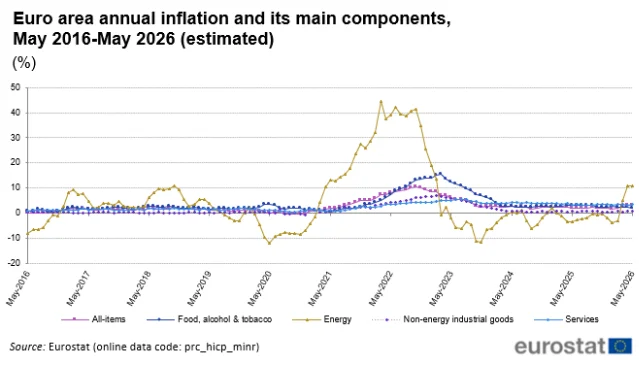
Eurostat's May flash estimate, published at the start of the week, showed headline EZ inflation at 3.2% (up from 3.0% in April), meeting consensus exactly. Core held at 2.5% — slightly above expectations. Energy jumped to +10.9% year-on-year, up from +5.1% in April, with the Iran conflict's supply effect still feeding through 8.
The data confirms the pattern flagged in last week's issue: the war premium in energy is transmitting into headline inflation across the single-currency bloc, even as services cool slightly (3.0% from 3.2%). For the ECB, this removes any residual ambiguity around the June 11 vote.
FX: dollar dominance, yen fragility
The week's FX moves all share the same origin: re-pricing of the US rate path.
| Pair | Friday close | Week change | Notable level |
|---|---|---|---|
| EUR/USD | 1.1521 | +6.3% on the week* | Broke above 1.15 resistance |
| USD/JPY | 160.33 | Above 160 | 2026 high: 160.73 |
| GBP/USD | 1.3337 | +4.9% on the week* | Above 1.33 |
| USD/GBP | 0.7495 | — | (inverse of above) |
Wait — the EUR/USD move is notable but partially paradoxical. A stronger-than-expected US labor market should push the dollar up, not down. The explanation lies in sequencing: much of the EUR/USD weekly gain was frontloaded early in the week (Monday–Wednesday) as EZ inflation came in firm, boosting ECB hike probability. Friday's payrolls reversed direction late in the day, but the weekly close still showed EUR/USD above 1.15, where it had been capped through most of Q1–Q2.
USD/JPY is the pair worth watching most carefully. The yen weakened through 160 again on Wednesday after Ueda's speech, the third time the level has been tested since late April. Despite Japan's Finance Ministry issuing softer verbal warnings than earlier in the year, USD/JPY moved into 160.33 by Friday close. Futures now price almost 41 basis points of Fed tightening over the next 12 months, which is the key driver: the correlation between USD/JPY and one-year Fed pricing ran at 0.80 on the week, dwarfing the correlation with BOJ-specific factors 6.
The 2026 high of 160.73 is the first resistance. A break above it would open the path toward the multi-decade high of 161.95 set in 2024, and would likely force the Finance Ministry's hand on unilateral intervention.
Cross-asset: the sell-off no one saw coming on Monday
The week opened quietly — the S&P 500 was still near its nine-week winning streak high from May 30. By Friday afternoon it had suffered its worst session of 2026.
Friday's damage
On the back of the payrolls print, investors' reset of Fed expectations collided with already-stretched AI valuations:
- S&P 500: –2.64%, worst single-day loss since October 2025, ending a nine-consecutive-weekly-gains streak 11
- Nasdaq: –4.18%, worst session since April 2025
- Dow Jones: –695 points (–1.35%)
- VIX: surged 40%, touched a two-month high; CNN Fear & Greed Index flipped from "Greed" to "Fear"
Broadcom (AVGO) was the epicenter: it had fallen 12.6% Thursday after missing Q3 chip revenue guidance, then lost a further 7.9% Friday. A memory chip ETF fell 15% on the week. Meta dropped 5.5% on reports of a planned secondary offering to fund AI infrastructure.
The jobs report was the catalyst, but AI valuations were the kindling. As one analyst put it, AI stocks had been priced for "parabolic perfection" — minor misses trigger sharp reversals.
Bonds: 2-year yield hits 15-month high
The 2-year Treasury yield settled at 4.160% on Friday, its highest level since February 2025, having jumped 13 basis points on the day — the largest one-day move in months 12. The 10-year moved to 4.54%. Earlier in the week (Wednesday), the 10-year was tracking near 4.49%, rising with oil after reports of resumed US–Iran military activity complicated ceasefire negotiations.
CME FedWatch now prices a 43% probability of a Fed hike by December 2026, up from 26% a month ago 11.
Commodities
Brent crude closed Friday at $93.09, down 2% on the day as Oman confirmed that the Mina al-Fahal export terminal — briefly disrupted by an explosion — had returned to normal operations 13. Despite the Friday dip, Brent is on track for its first weekly gain in three weeks — the 10yr/oil lockstep relationship held until Friday, when rate-hike repricing dominated.
Gold (XAU/USD) fell more than 3.5% Friday, erasing all of its year-to-date gains. The precious metal is now down roughly 12% from its April highs; the yield shock — nominal rates spiking — directly undercuts bullion's non-yielding appeal. XAU/USD closed near $4,350 14.
Bitcoin lost more than 5%, dropping below $60,000 for the first time since October 2024.
차트를 불러오는 중…
Week-ahead calendar: June 9–13, 2026
The next five trading days contain two events that could define the second half of 2026's rate path.
| Date | Event | What to watch |
|---|---|---|
| Mon Jun 9 | Japan Q1 GDP (revised) | Downward revisions would complicate Ueda's June hike signal |
| Tue Jun 10 | UK labor market data | Wage growth still the BoE's primary concern |
| Wed Jun 11 | ECB rate decision + press conference | +25bp to 2.25% fully priced; Lagarde's tone on July/September the real question |
| Wed Jun 11 | US CPI (May) | Consensus ~3.5% headline; anything above 3.6% reopens the December hike debate hard |
| Thu Jun 12 | China CPI/PPI (May) | Deflationary pressure vs. commodity pass-through |
| Fri Jun 13 | US PPI (May) | Upstream price pressures, especially relevant after ISM prices-paid hit 71.3 |
| Fri Jun 13 | Japan May PPI | Context for BOJ inflation risk assessment |
| Jun 15 | BOJ MPM | Ueda's pre-signal: 1.00% hike decision and updated outlook |
The June 11 double-bill (ECB + US CPI) is the week's pivotal session. If the ECB hikes as priced and signals a meeting-by-meeting approach (no pre-commitment to July), and US CPI prints near consensus, markets may stabilize. If CPI surprises meaningfully higher, the Fed's June 16–17 FOMC meeting will carry live hike risk — something the dot plot last implied in the pandemic-era hawkish pivot. Warsh has not yet given a substantive public speech as Fed Chair, making the June 17 press conference his first real chance to signal his rate reaction function.
The BOJ's June 15 decision comes two days before the FOMC. A BOJ hike to 1.00% would compress the rate differential and potentially give the yen a floor — unless the Fed's own Thursday signal overshadows it.
The through-line
The week confirmed that the same force — the Iran war's persistent supply premium — is simultaneously pushing EZ inflation toward a June ECB hike, keeping US energy-driven PCE elevated, and complicating BOJ's already-tentative exit from emergency-era settings. What's new this week is the US labor market adding its own independent momentum: payrolls at 172,000 with upward revisions remove the Fed's ability to cite "softening demand" as a reason to hold indefinitely.
The divergence to watch is ECB vs. Fed sequencing. An ECB hike on June 11 without a US hike on June 17 would widen the euro area's rate spread relative to the US and has historically been EUR/USD-supportive. But if May US CPI also surprises to the upside on Wednesday, the calculus shifts: both central banks would be in synchronized tightening, leaving the dollar better supported. Three days separate those two decisions.
12345677891011121314참고 출처
- 1ForexFactory – FOMC Member Kashkari Speaks
- 2ING Think – A rate hike and then what? Our ECB preview
- 3Bloomberg – Ueda Says BOJ Needs to Keep Raising Rates to Contain Inflation
- 4Reuters – Japan tempers yen warnings despite renewed slide towards key level
- 5BLS – Employment Situation Summary, May 2026
- 6City Index – USD/JPY Marches Higher as Markets Wake Up to Fed Risks
- 7Reuters – US services sector expands in May; supply constraints raise prices
- 8Eurostat – Inflation in the euro area
- 9XE – Historical Rates Tables, USD, June 6 2026
- 10Capital Street FX – EUR/USD ECB Watch, GBP/USD BoE Hold
- 11CNN – Nasdaq, S&P 500 suffer worst day of year as AI stocks tumble
- 12WSJ – 2-Year Yield Jumps to Highest Level in a Year
- 13Reuters – Stocks fall sharply as strong jobs data fuels rate hike bets
- 14City Index – Gold Price Forecast: XAU/USD Drops 12%
이 콘텐츠를 둘러싼 관점이나 맥락을 계속 보강해 보세요.