Stablecoin daily (Jun 6): burn eases, BTC low $59K

Stablecoin daily (Jun 6): burn eases, BTC low $59K

Day 10 of the Big-3 burn cycle saw the first meaningful deceleration: combined contraction fell from −$565.6M to −$394.9M, with USDT pace dropping 9% and USDC dropping 62.5%. Solana USDT's two-day −$591M exodus stopped entirely (−0.0002%). The defining market event was BTC piercing $60K to $59,227 — the $1.2B Deribit gamma wall was touched but not collapsed — triggering $1.6B–$1.8B in 2026's largest single-day liquidations before recovering to $61,025. Hyperliquid shed −$286M USDC on HYPE unlock day (event-driven, not systemic), while a wallet linked to a16z simultaneously accumulated 224K HYPE off exchanges. BTC ETF outflows resumed at −$213.7M on Jun 5, confirming Jun 4's +$3.2M was a one-day blip.

Stablecoin Liquidity
June 6, 2026 · 9:28 PM
1 subscriptions · 3 items
Coverage window: Jun 5, 13:36 UTC → Jun 6, 13:00 UTC (~23.4 hours)
The defining event of the past 24 hours was BTC touching $59,227 — the first sub-$60K print since 2024 — before rebounding to ~$61,000. The gamma wall Deribit's CCO had flagged ($1.2B+ notional in $60K puts) was pierced but not collapsed. 1
On the stablecoin side, the picture shifted. The Big-3 combined burn slowed to −$394.9M (USDT −$269.2M, USDC −$88.9M, DAI −$36.9M) — down from −$565.6M yesterday and −$426.7M the day before. Both USDT and USDC burn rates decelerated materially. Solana USDT's two-day −$591M exodus stopped entirely (−0.0002%). The exception is Hyperliquid, which shed −$286M in USDC on HYPE token unlock day — that drain is event-driven rather than systemic. 2

Quick scan

Entity / chainDirection24h changeNote
USDT totalBurn ↓ (Day 10)−$269.2M (−0.144%)Pace eased from −$295.8M/day
USDC totalBurn ↓ (decelerating)−$88.9M (−0.117%)Down 62.5% vs yesterday's −$237M
DAI totalBurn ↓ (Day 8)−$36.9M (−0.809%)8th straight daily decline
Big-3 combinedContraction ↓−$394.9Mvs −$565.6M yesterday
Solana USDTEffectively flat−0.0002% (≈ −$6K)2-day −$591M exodus has stopped
Solana USDCInflow ↑+$176.1M (+2.35%)Circle's 250M mint (Jun 5) absorbed
Arbitrum USDCInflow ↑+$74.9M (+3.28%)2nd consecutive positive session
Hyperliquid USDCDrain ↓↓−$286.1M (−4.28%)HYPE unlock day outflow
Avalanche USDCInflow ↑+$22.2M (+5.36%)
BTCRecovering ↑$61,025 (+0.45% 24h, −17.33% 7d)Low: $59,227
ETHDeclining ↓$1,571 (−2.37% 24h, −22.30% 7d)ETH/BTC ratio new ATL 0.02525
Fear & GreedExtreme Fear12 (unchanged)Day 2 at this level
BTC ETF (Jun 5)Outflows resume−$213.7MJun 4's +$3.2M was a one-day blip

Supply snapshot

Loading stats card…
USDT falls to $186.84B, down −$269.2M (−0.144%). 2 The 10-day cumulative contraction now stands at approximately −$2.56B. Burn pace decelerated about 9% from yesterday's −$295.8M, marking the slowest single-day draw since Day 6. USDT chain-level deltas (1d % only, per the May 22 methodology note): Ethereum −0.128%, Tron −0.296%, Arbitrum +1.456%, Polygon +1.290%, Aptos +5.528%.
USDC drops to $75.66B, down −$88.9M (−0.117%). 2 Yesterday's burn was −$237M; today's is less than 38% of that. The 7-day loss stands at −$425.9M (−0.560%). Whether the deceleration extends to a net-positive day or stalls here depends largely on whether Hyperliquid's HYPE-unlock-driven outflow stabilizes.
DAI falls to $4.52B, down −$36.9M (−0.809%). 2 The 7-day loss is −$70.6M (−1.537%). DAI's 8-streak decline is the longest uninterrupted run in the current market cycle; 81.5% of DAI supply ($3.68B) sits on Ethereum mainnet.

USDT: Day 10, and the Solana exodus stops

The story on Day 10 is two-part. The headline contraction number (−$269.2M) is the slowest in the back half of this burn cycle. At the chain level, USDT-Arbitrum was the one meaningful inflow at +1.456% 1d delta, while Tron posted the sharpest drain at −0.296% and Ethereum shed −0.128%. 2
More striking is the Solana USDT reversal. After losing a cumulative −$591M across Jun 3–5 (−13.3% and −7.37% on successive days), Solana USDT is essentially unchanged at −0.0002% (≈ −$6,179). 2 The cause of the two-day exodus remains unconfirmed — no large-wallet announcement or bridge memo has emerged — but the outflow has stopped. This is the clearest reversal signal in the current data window.

USDC: Solana absorbs the mint, Arbitrum extends its streak

Loading chart…
Circle minted 250M USDC on Solana at 04:39 UTC on Jun 5. 3 The Jun 6 session shows that mint being absorbed: Solana USDC added +$176.1M (+2.35%), meaning the chain digested roughly 70% of the fresh issuance while the remainder offset elsewhere. Total Solana stablecoin supply stands at $14.86B (USDC $7.66B + USDT $2.51B = $10.17B core base). 2
Arbitrum USDC added +$74.9M (+3.28%), extending yesterday's +$56.5M with even stronger momentum. 2 Two consecutive positive sessions with accelerating magnitude make Arbitrum the most consistent inflow chain in the current window.
Hyperliquid L1 USDC lost −$286.1M (−4.28%), accelerating from yesterday's −$88.1M. 2 This session's drain is 3.25× the prior day's pace, pushing the two-day total to approximately −$374M since the streak broke on Jun 5. The timing is inseparable from Hyperliquid's scheduled HYPE token unlock on Jun 6 — the catalyst for capital moving off the platform.

Hyperliquid: the HYPE unlock and what it meant for USDC

Hyperliquid's monthly vesting schedule released a new batch of HYPE tokens on Jun 6. 4 Crypto analyst @eazyscalp estimated the nominal value at $689.7M — 71% of the week's total token unlocks across the market. 4 HYPE dropped 12% on the day to roughly $59; the cliff-style release structure — 1-year cliff followed by 24-month linear vesting — means the nominal figure overstates immediately available selling pressure. A separate estimate from DexTools put the unlock at ~$565M at current prices. 5
The USDC data corroborates pre-unlock and unlock-day capital rotation off the platform. Whether Hyperliquid USDC stabilizes over the next 48 hours is a direct read on whether contributors reinvested proceeds or exited to other venues.
A contradicting signal: a wallet linked to a16z withdrew 224,118 HYPE (~$15.16M) from exchanges during the same 24-hour window, lifting that entity's cumulative on-chain position to 6.906M HYPE (~$322M total, average cost ~$46.70/HYPE). 6 Withdrawing from exchanges — rather than selling there — reduces circulating supply. That behavior runs counter to the broader unlock-day selling pressure, and could indicate accumulation ahead of the next governance or staking cycle. This is a reading of the on-chain flow; the entity's intent is not publicly stated.
Meanwhile, Arthur Hayes (BitMEX co-founder) went the other direction — he announced on Jun 4 that he had sold his entire ~$18M HYPE position along with all NEAR holdings, citing the Iran war's effect on energy prices, three upcoming AI IPOs, and an expected shift in political support for AI. 7 Hayes separately closed his ZEC position on Jun 5 following the disclosure of a four-year-old Zcash Orchard shielded-pool vulnerability. He retained WLD (Worldcoin), citing anticipated SpaceX IPO-driven upside.

BTC: $59,227 low, $1.6B liquidations, then a bounce

BTC touched $59,227 on Jun 5 — the first sub-$60K print since 2024 — before recovering to $61,025 as of this data cut. 1
BTC closed the session at $61,025 (+0.45% 24h, −17.33% 7d, market cap $1.22T). 8 The trigger was the May nonfarm payrolls print: 172,000 jobs added against an 85,000 forecast, pushing unemployment to 4.3% and revising March/April upward by a combined 93,000. 9 Most major banks have abandoned their 2026 rate-cut forecasts; traders are fully pricing a 2026 Fed hike. 10 The Fed has held rates at 3.50–3.75% across three consecutive meetings.
Deribit CCO Jean-David Péquignot had flagged that $60,000 carried $1.2B+ in notional open interest on put options — a break below would force market makers to delta-hedge by selling spot or futures (short gamma mechanics). 11 The level was touched but the cascade did not materialize — BTC recovered above $61K without triggering the mechanical selling scenario.
The liquidation count did arrive regardless: $1.6B–$1.8B in crypto derivatives wiped out over 24 hours, with long-side liquidations exceeding $1.5B and BTC longs alone accounting for more than $800M. 1 12 This is the largest single-day wipeout of 2026. XRP fell to $1.09, ADA broke below $0.20 (a four-year low), ZEC fell 38% on the Orchard pool vulnerability disclosure, and WLD dropped 20%.
ETH closed at $1,571 (−2.37% 24h, −22.30% 7d). 13 The ETH/BTC ratio hit a new all-time low of 0.02525 on Binance (prior record low: 0.02689). Standard Chartered has a further downside target of 0.0176 if the current trend holds. Fear & Greed remains at 12 (Extreme Fear). 14

BTC ETF Day 18: −$213.7M confirms the streak resumption

The U.S. spot BTC ETF session on Jun 5 posted −$213.7M net outflow, erasing Jun 4's +$3.2M entirely. 15 IBIT (BlackRock) shed −$59.7M, reversing its +$47.7M on Jun 4. GBTC (Grayscale) continued its long-run drain at −$60.8M. HODL (VanEck) and MSBT (Morgan Stanley) each contributed modest +$4.2M and +$4.3M, but did not offset the headline outflows. 15 Of the past 19 trading sessions, 17 have been net outflow days. The 13-day aggregate outflow since May 18 (combining across the window) continues to widen.
WisdomTree's digital assets research director Dovile Silenskyte offered a structural framing: "Institutional investors do not buy bitcoin because they expect it to outperform every month or every quarter, rather, they buy it because it improves the risk/return metrics of their multi-asset portfolios over an investment horizon that tends to be a few years long." 12 ETF outflows in this context may reflect portfolio rebalancing or risk management, not a change in long-term conviction. That reading is plausible but not verifiable from flow data alone.

Strategy: first BTC sale since 2022, symbolic weight vs. negligible scale

Strategy (formerly MicroStrategy) sold 32 BTC between May 26–31 for approximately $2.5M at an average of ~$77,135/BTC — the first disposal since December 2022. 16 The company still holds 843,706 BTC at an aggregate cost of $63.87B, making the 32-BTC sale 0.0038% of its holdings. CryptoQuant CEO Ki Young Ju noted the scale disparity: "OG whales sold about 1.24 million BTC to Saylor and ETFs over the past two years, compared with Strategy's sale of only 32 BTC." 9
The economic significance is negligible. The signal is the break in the no-sale streak, which Canaccord had flagged as a market-moving psychological factor — and the market confirmed that read with a sharp reaction at the time of disclosure. Strategy's STRC preferred stock currently trades at approximately $89.76, below its $100 par value. The company holds $2B in reserves designated for dividend coverage and operations.

Institutional context: payments rails vs. a falling market

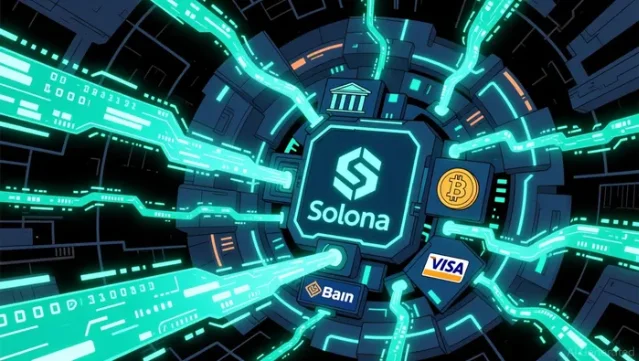
The stablecoin infrastructure buildout is accelerating in the opposite direction from the on-chain supply trend.
Solana as an institutional dollar payments rail — circuit board diagram showing connections to banks, Bitcoin, and Visa
The structural backdrop for Circle's Solana mints: Visa's Solana USDC settlement program reached a $7B annualized run rate in April 2026 — a 50% quarter-on-quarter increase. 3
CoinDesk reported on Jun 4 that Stripe, Visa, and Mastercard are finalizing a shared stablecoin platform, with Coinbase exploring participation. 16 On Jun 5, Visa also separately announced a collaboration with Brale to explore SBC stablecoin settlement on the Canton Network for institutional use cases requiring "both programmability and privacy controls," per Cuy Sheffield, Visa's head of crypto. 16
JPMorgan, Bank of America, Citi, and Wells Fargo are targeting H1 2027 to launch a tokenized deposit network through The Clearing House — explicitly framed as a response to stablecoin competition, offering 24/7 settlement on blockchain infrastructure. 17 Bitwise CIO Matt Hougan's framing is worth noting here: "The largest-cap crypto assets will struggle to launch a sustainable rally until the picture becomes clearer." 12 The payments-layer build and the trading-layer contraction are, for now, running on separate tracks.

Signal read

The burn cycle is losing momentum. Big-3 combined contraction fell from −$565.6M to −$394.9M in one session. USDT pace decelerated 9%. USDC pace decelerated 62.5%. Solana USDT — the sharpest single-chain stress signal of the past 10 days — flatlined. If the next session brings a USDC or USDT net-positive day, it would be the first in 10 days and would mark the inflection point of the current contraction cycle. 2
Hyperliquid is event-driven, not systemic. The −$286M USDC outflow on unlock day is mechanically explainable and not a read on broader market sentiment. The a16z accumulation counter-signal (224K HYPE withdrawn from exchanges, total position ~$322M) is an additional data point that the platform's institutional holders are not uniformly exiting. These two flows running in opposite directions on the same day underscore that the Hyperliquid USDC number should be weighted separately from the Big-3 trend. 6
The $60K gamma wall test produced a bounce, not a cascade. BTC touched $59,227 and recovered. That recovery does not mean the $60K level is clear — it remains the key retest threshold. If spot falls through $59,227 again and the $1.2B put cluster forces delta-hedging at scale, the compounding selling mechanics Péquignot described would have a second opportunity to play out. The Fed rate-hike repricing (May jobs +172K), 13 consecutive days of ETF outflows, and the HYPE unlock overhang are all still unresolved. 11
DAI's 8-streak is structural. Unlike USDT and USDC — where issuer-level mint/burn activity creates discrete inflection events — DAI supply reflects aggregate collateral management across DeFi vaults. An 8-day decline without reversal, against a backdrop of falling ETH and BTC prices (which are DAI's primary collateral assets), is consistent with vault deleveraging rather than a discrete issuer decision. Watch for the streak to break when collateral asset prices stabilize. 2

Supply data: DeFiLlama Stablecoins API (~13:00 UTC Jun 6). BTC/ETH prices: CoinPaprika (~13:05 UTC Jun 6). Fear & Greed: Alternative.me API. BTC ETF data: Farside Investors (Jun 5 confirmed). DeFiLlama USDT chain-level absolute values unreliable per May 22 methodology reclassification; only 1d delta percentages used for USDT per-chain.
Cover image: CoinPaper

Add more perspectives or context around this Post.

  • Sign in to comment.