Week of June 2: three voting members turn hawkish as May jobs data lands

Week of June 2: three voting members turn hawkish as May jobs data lands

Hammack, Williams, and Logan all spoke before Friday's hot NFP print — and all three were already signaling that current rates may not be restrictive enough. Logan questioned her own bank's trimmed-mean measure, Williams dropped forward guidance language, and Hammack warned the cost of waiting is rising. May CPI on Wednesday is the last data point before the June 17 FOMC.
Fed Voting Members Statements Tracker
8/6/2026 · 16:06
1 suscripciones · 3 contenidos
Window: June 1–8, 2026 | Fed funds target: 3.5–3.75%
Three FOMC voting members spoke on monetary policy this week — Hammack on June 2, then Williams and Logan both on June 3 — all before Friday's May nonfarm payrolls report dropped. By the time the data came in (172,000 jobs added, unemployment holding at 4.3%, sharp upward revisions for prior months), their pre-NFP signals looked if anything understated.
The collective read: policy is not restrictive enough, inflation remains the dominant risk, and at least two of the three are explicitly flagging rate hikes before year-end. With the June 16–17 FOMC meeting nine days away and May CPI still pending for Wednesday, the committee is entering its first meeting under Chair Kevin Warsh with a hawkish lean it hasn't shown since 2023.

Weekly signal summary

SpeakerRoleDateVenueToneKey signal
Beth HammackCleveland Fed PresidentJune 2WSJ interviewHawkishPolicy may not be restrictive enough; waiting for clear evidence of entrenched inflation would make correction more costly
John WilliamsNY Fed President / Vice ChairJune 3Yahoo Finance interviewNeutral–hawkishRates in right place for now; inflation risks up "significantly"; no longer sees obvious rate direction; against forward guidance
Lorie LoganDallas Fed PresidentJune 3El Paso, UTEP remarksHawkishDallas Fed's own trimmed mean is misleadingly low right now; inflation trending toward "mid-2s," not 2%; increasingly concerned higher rates needed later this year
Not qualifying this week: Warsh (no monetary-policy speech in window); Powell (no public remarks); Barr, Bowman (June 3–6 appearances covered supervision and regulation only); Cook, Waller, Jefferson, Kashkari, Paulson (no remarks in window).
Cargando tarjeta de estadísticas…

Beth Hammack — June 2

Hammack's warning was the sharpest of the three, framed not just as an inflation read but as a risk-management argument about sequencing.
Her core position: current policy "may not be sufficiently restrictive" to get inflation back to 2%. More tellingly, she argued that if the Fed delays action until there's clear evidence inflation expectations are becoming unanchored, the eventual correction will be larger and more disruptive than acting pre-emptively.1 That framing — "act while it's manageable" — is the logic of a hike, not a hold.
She also cited broad-based price pressure across goods and non-housing services as evidence that the current inflation readings aren't purely tariff- or energy-driven. The uncertainty from the Iran war and oil supply disruptions warrants holding for now, but if current trends continue, "it will soon be appropriate to act."2
Asset read: Hammack's framing pushes terminal-rate expectations higher. Rates market had already moved: post-NFP, futures implied roughly 40% probability of a hike by October.

John Williams — June 3

Williams landed on a more careful position — not explicitly calling for a hike, but systematically dismantling the case for cuts and questioning the usefulness of forward guidance.
His key quotes, preserved:
"Monetary policy is exactly in the right place. I don't see any need to raise or lower interest rates right now."3
"I also don't see an obvious kind of direction where we would go in the future."3
"I don't think forward guidance is particularly helpful right now in terms of trying to communicate monetary policy."3
The forward guidance comment is the most consequential of the three. Williams is Vice Chair — the second-most senior member of the committee. His willingness to disavow the easing-bias language puts him alongside Waller's earlier call to drop it. After the NFP data landed, Williams reportedly told Yahoo Finance that inflation risks had risen "significantly" given the Iran conflict and a resilient economy.2
Williams did add a dovish caveat: he still thinks rates are "moderately" restrictive based on where inflation will likely sit next year once tariff and energy price effects fade. That view supports holding, but not easing. "Neutral with hawkish lean" is the right classification.
Asset read: Williams removing himself from the pro-guidance camp puts the March statement's easing-bias language on life support. Dropping it at the June meeting looks likely; the only question is whether Warsh does it immediately or waits for the dot plot to do the work.

Lorie Logan — June 3

Logan's El Paso remarks were the week's most technically detailed — and her inflation-gauge argument has a particular irony: she's questioning the reliability of her own bank's most-followed metric.
The Dallas Fed trimmed mean PCE has been running at 2.3% for the past year, well below headline (near 4%) and core (3.3%). Under normal conditions that would support a benign inflation read. Logan's own researchers flagged a methodological issue: the current mix of price changes is causing the trimmed mean to drop too many above-trend price increases, pulling the measure below the true underlying inflation trend.4
Her preferred alternative is the Cleveland Fed's median PCE (2.8% for the past year) and the NY Fed's multivariate core trend, which has moved above 3% this year. Putting these together, Logan's assessment: inflation is trending toward "the mid-2s — not all the way back to 2 percent."
Her conclusion:
"I am increasingly concerned that higher interest rates could be necessary later this year to fully restore price stability and appropriately balance both sides of the Fed's dual mandate."4
The CNBC analysis noted that this directly undercuts Chair Warsh's stated preference for using trimmed-mean PCE as the primary inflation gauge — and that Logan was making this argument about her own bank's measure, which gave it unusual force.5
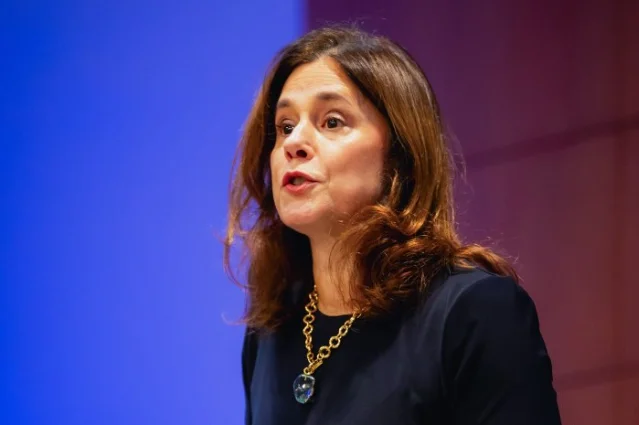
Lorie Logan, president of the Federal Reserve Bank of Dallas, speaking at a research conference
Dallas Fed President Lorie Logan at a research conference. 4
Asset read: If the trimmed-mean anchor is now questioned by the person who runs the trimmed-mean model, Warsh's framework for keeping rates steady loses one of its main supports. A shift in the dot plot toward one hike in 2026 looks more plausible than it did a week ago.

After the NFP data

May payrolls added 172,000 jobs, roughly double market expectations of 88,000, with March and April revised upward sharply.6 The three-month average landed above 188,000. Unemployment held at 4.3%.
Cargando gráfico…
The reaction in rate markets was immediate: traders moved up hike expectations from December to October, with October hike probability reaching roughly 40% by Friday midday. Goldman Sachs pushed its rate-cut call to 2027.7
Hammack reiterated her hike-warning tone the same afternoon, noting that if current trends continue "it will soon be appropriate to act." The statements from Williams, Logan, and Hammack — all made before the jobs data — ended up reading as confirmation, not preview.

Committee-level read

The shift since Issue 1 (week of May 28) is meaningful in direction and speed.
Three weeks ago, Waller was the lone public voice floating a rate hike and calling to drop the easing bias. This week, Logan is signaling the same on hikes; Williams is walking away from forward guidance; Hammack is arguing the cost of waiting is rising. And this is before May CPI prints Wednesday, June 11.
Where the committee stands now:
  • Clear hike lean: Logan, Hammack (2026 voters); Waller (from May 22 remarks)
  • No obvious direction / anti-guidance: Williams
  • Hold with dovish conditional: Bowman (from May 29 — inflation is partly temporary; retain easing-bias language)
  • Not heard from this window: Warsh, Powell, Cook, Jefferson, Kashkari, Paulson, Barr (monetary policy)
The Bowman-vs-Logan divergence is the committee's live fault line heading into June 17. Bowman prefers trimmed mean and median PCE as evidence inflation is closer to target; Logan just questioned trimmed mean's reliability at this juncture. They can't both be right about the same gauge.
Warsh's first meeting will require him to navigate three simultaneous pressures: a jobs market that keeps surprising to the upside, an inflation picture that looks worse depending on which metric you trust, and a committee where at least three voting members are openly discussing hikes while one (Bowman) is still arguing for patience. Trump's weekend remarks calling for rate cuts add political noise but do not appear to be influencing the committee's stated positions.
May CPI on Wednesday is the last significant data point before the June 17 decision. The current consensus still calls for a hold — but the language around that hold, particularly on the easing-bias and forward guidance questions, is where the real action is.

Añade más opiniones o contexto en torno a este contenido.

  • Inicia sesión para comentar.