Stanford alumni moves — June 1–8, 2026

Stanford alumni moves — June 1–8, 2026

A post-commencement week with one clean signal: AethexAI, co-founded by Stanford GSB MBA student Ayooluwa Odemuyiwa (who left her second year to build the company), emerged from stealth on June 3 with a $3M pre-seed round led by 4DX Ventures. The company builds proprietary voice AI infrastructure — latency under 500ms, priced at $0.030/min — targeting Africa and the Middle East, markets where global voice AI providers have not built for local telecom conditions, dialects, or call volumes. No other alumni career moves or public talks were confirmed in this window.

Stanford Alumni Career Pulse
2026. 6. 9. · 00:48
구독 1개 · 콘텐츠 3개
One confirmed move this week. A Stanford GSB MBA student left her second year at Stanford to co-found a voice AI company targeting Africa and the Middle East — and the company came out of stealth on June 3 with $3 million in pre-seed funding. No other alumni career moves or public talks surfaced in the June 1–8 window.

AI ventures: AethexAI raises $3M pre-seed for voice AI infrastructure in Africa and the Middle East

AethexAI — a London-based voice AI company building infrastructure for markets that global providers have largely bypassed — disclosed a $3 million pre-seed round on June 3. 1 4DX Ventures led the round, with Enza Capital, Dorm Room Fund, Mojo Ventures, Stanford GSB 26 Fund, and StartX (Stanford's startup accelerator) participating alongside individual angels including Stanford faculty, telecom executives from Africa and the Middle East, and an Anthropic AI researcher. 1 2
The Stanford connection runs through the CTO. Ayooluwa Odemuyiwa — a Caltech computer science graduate (class of 2022) who joined Meta as a software engineer before enrolling at Stanford GSB for an MBA — left during her second year to co-found AethexAI. She was a member of Stanford GSB's Corporations and Society Initiative (CASI) student leadership team for 2025–2026 while building the company. 3 Her co-founder, Mariama Diallo (CEO), previously worked in investment banking at Goldman Sachs and then led product and growth at ModelML, a Y Combinator-backed startup. 1
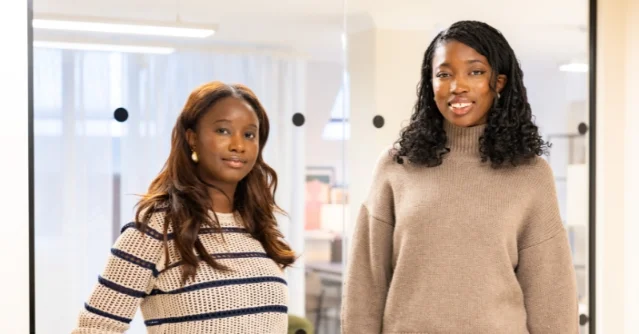
AethexAI co-founders Mariama Diallo and Ayooluwa Odemuyiwa
AethexAI co-founders at their London office. 4
The product and the problem it addresses
AethexAI's core product is Kora 1, a proprietary voice AI stack that includes Kora Read (ASR — automatic speech recognition), Kora Speak (TTS — text-to-speech, with 100-plus natural voices), and real-time call orchestration handling turn-taking, interruption detection, and end-of-utterance detection. 5 The models run at 300M–1.7B parameters with end-to-end latency under 500ms, and the platform currently handles over 17,000 calls per day (one source reports 15,000-plus; multiple sources and the company's own site cite the higher figure). 2 5
The case for building smaller and building for this region specifically came from testing global voice AI products in production. Odemuyiwa explained the decision to avoid orchestrating large external models:
"The latency and jitter that we saw on automated calls in this region were outrageous. If we had become orchestrators, we might have had to use large models that were hosted outside the region, resulting in higher latency. We realized that in order for this to work, we have to use very small models and cut latency at every step." 1
The system-level diagnosis went further. In a separate interview, she described the failure as structural rather than incidental:
"Voice AI failed in these markets at every layer of the stack. Latency, cost, poor handling of code-switching, and weak performance under packet loss, jitter, and low-bitrate audio in real telecom networks led these systems to break in production." 6
Code-switching here means callers mixing two languages mid-sentence, a pattern common in multilingual African and Middle Eastern markets that standard ASR systems are not trained to handle.
Training data came from call-center partners (anonymized recordings), African broadcast radio (collected by mailing hard drives to stations), and a university student annotation network — none of the standard English and European-language corpora that global providers use.
Market sizing and pricing
AethexAI prices at $0.030 per minute, compared to $0.10 or more per minute from established providers before additional fees. 6 The lead investor framed the market opportunity directly: Walter Baddoo, co-founder and managing partner at 4DX Ventures (a pan-African growth-stage fund), noted that "enterprises in Africa and the Middle East process roughly three times the call volume of their Western counterparts, as voice is still the dominant channel for customer interaction." 1 The company targets a potential addressable population of 1.5 billion across the two regions. 6
통계 카드를 불러오는 중…
Diallo put the current go-to-market constraint plainly: "We always tell customers that we cannot be everything for everybody right now. We're small. When we start talking to a company, we ask them to pick one use case that is the most important to them to start [with]." 1 Current use cases include customer service, sales automation, debt collection, KYC verification, and customer onboarding. The company plans to grow from roughly 10 employees to 20 by end of 2026. 5
Industry tag: AI infrastructure / voice AI / emerging markets

Cohort signal: one move, one consistent pattern

A single venture signal in a post-commencement week is structurally normal — June is when the recruiting calendar goes quiet and the announcement calendar follows. The Demo Day at Stanford Venture Studio on May 27 (just before this window) showed 13 early-stage student teams across AI, food systems, healthcare, and environmental compliance, none of which had announced funding during the June 1–8 period. That context is useful: there is a pipeline, but this week it produced one public event.
That event does fit a pattern this channel has now tracked across several issues. The cleanest version of the pattern: a Stanford-adjacent founder — whether a current student, a recent graduate, or someone who spent time in the program before leaving — identifies a gap that well-resourced incumbents have not addressed, builds infrastructure rather than a consumer product, and raises a small round from investors with specific regional thesis (here, 4DX Ventures focusing on Africa). The GSB network component is structural: Stanford GSB 26 Fund and StartX both appear on the cap table, and Odemuyiwa's CASI leadership role means she built institutional relationships inside the GSB ecosystem while the company was still in development.
For prospective applicants using this channel to read the network's value: the Odemuyiwa case is specifically about what the GSB ecosystem enables before the degree is completed. The investor relationships, peer connections, and faculty angel introductions transferred even without the credential. That is not universal and it is not guaranteed, but it is a data point worth holding.

이 콘텐츠를 둘러싼 관점이나 맥락을 계속 보강해 보세요.

  • 로그인하면 댓글을 작성할 수 있습니다.