
AI Briefing — Week of June 8, 2026
Microsoft's Project Polaris ends the OpenAI dependency in GitHub Copilot by August; Congress released the 269-page GAAIA with a three-year state AI preemption clause; the EU AI Act omnibus cleared committee 93-4; Cognition closed $1B at $26B; Suno raised $400M at $5.4B; and Google signed a $29.4B compute deal with SpaceX ahead of its June 12 IPO.

Microsoft spent Build week announcing it no longer needs OpenAI to run its most-used developer product. Simultaneously, Congress published a 269-page bill that would freeze state AI laws for three years, the EU's AI Act omnibus cleared committee 93-4, and Cognition closed $1 billion at a $26 billion valuation less than eight months after its $10.2 billion round. The thread connecting those stories: every major actor in AI is now moving to lock in its position before the regulatory and market windows close. Here's what shifted June 1–8.
Products
Microsoft replaces OpenAI in GitHub Copilot with its own model
At Build 2026 on June 2, Microsoft announced Project Polaris (internally MAI-Code-1), a Mixture-of-Experts architecture coding model that will become the default engine for all GitHub Copilot subscribers starting August 2026, replacing OpenAI's GPT-4 Turbo. 1 GPT-4 Turbo will remain as an opt-in alternative for approximately three months after the cutover before being removed from the default path entirely.
Polaris runs on Microsoft's own Maia AI accelerators and shows "significant quality improvements" on low-resource programming languages including Rust and Haskell. GitHub COO Kyle Daigle described it as "built for high efficiency and performance, but importantly, at a low-token cost." 2
Microsoft also previewed six additional MAI models at Build: MAI-Thinking-1 (35B active parameter reasoning model, 97.0% on AIME 2025), MAI-Image-2.5 (ranked #2 on the image-to-image Arena leaderboard), MAI Transcribe 1.5 (43-language speech recognition), MAI-Voice-2 (15+ new language voice synthesis), and Aion 1.0 Instruct/Plan (on-device SLM for Windows 11). 1 Microsoft also open-sourced the Windows Agent Framework under an MIT license and previewed the Surface RTX Spark Dev Box, capable of running 120B-parameter models locally on 128GB unified memory.
The context: Microsoft and OpenAI ended their exclusive partnership in April 2026, following Microsoft's cumulative $13 billion investment in OpenAI. 2 Polaris is the operational proof that the split is permanent.
正在加载内容卡片…
GitHub Copilot token billing spurs developer backlash — again
The same week Microsoft announced Polaris, Copilot's AI Credits billing (1 Credit = $0.01) continued generating developer anger following its June 1 launch. 3 One Pro+ subscriber reported a projected monthly bill of $847 against a prior $39 flat rate; individual requests consuming more than $6 in credits were documented. A developer on GitHub's own forums described the shift as moving from "a predictable subscription to a stressful meter-based service that hinders my productivity rather than helping it." 4
Cursor, RooCode, and direct Anthropic/OpenAI API access are the alternatives most cited in developer communities. Gartner analyst Arun Chandrasekaran noted that Copilot "may be an early case" as more vendors shift to consumption-based pricing: "The challenge is balancing internal costs against pricing simplicity and predictability for customers."
Meta testing Hatch AI agent at $200/month
Meta is testing a consumer AI agent called Hatch that can write code, build presentations, schedule meetings, and send email autonomously. 5 A Hatch Plus tier is planned at $200/month, directly competing with ChatGPT Pro and Claude Max. The product is currently running on Anthropic's Claude Sonnet for internal testing and is expected to ship on Meta's own Muse Spark model. Internal testing is scheduled to complete by late June 2026.
Models
MAI-Thinking-1 benchmarks against top frontier models
Microsoft's MAI-Thinking-1 scored 97.0% on AIME 2025 and matched Claude Opus 4.6 on SWE-Bench Pro in independent human evaluations, where blind testers preferred MAI-Thinking-1 over Claude Sonnet 4.6. 1 The model uses zero-distillation training and is available via Microsoft Foundry in private preview. Microsoft AI CEO Mustafa Suleiman claimed MAI models outperform GPT-5.5 for McKinsey's custom use case at roughly one-tenth the compute cost. 2
OpenAI expands Codex with six role-specific plugin packs
On June 2, OpenAI released six role-specific plugin bundles for Codex: data analysis, creative production, sales, product design, public equity investing, and investment banking. 6 The bundles collectively cover 62 applications and 110 skills, including Salesforce, Figma, Canva, Snowflake, Tableau, FactSet, and PitchBook. Codex weekly active users now exceed 5 million; non-developer users represent about 20% of that base and are growing more than three times faster than developers.
OpenAI's frontier models including GPT-5.5 and Codex also went live on AWS Bedrock on June 1, covering Commercial and GovCloud regions. 7
Google, Ideogram release open-weight models
Gemma 4 12B (Google DeepMind) launched June 3 under Apache 2.0 — a multimodal open-weight model that runs on a laptop with quantization-aware training (QAT) checkpoints for mobile. 8 On the same day, Ideogram 4 launched as the leading open-weight image generation model by a significant margin. 9 xAI also released Grok Imagine Video 1.5 (preview) on June 4, supporting static-image-to-720p-video generation via text prompts through the xAI API. 10
ChatGPT's new Dreaming V3 memory system, launched June 4, synthesizes conversation history into persistent preferences in the background — no longer requiring manually saved memories. It is rolling out to US Plus and Pro users first. 11
正在加载内容卡片…
Funding
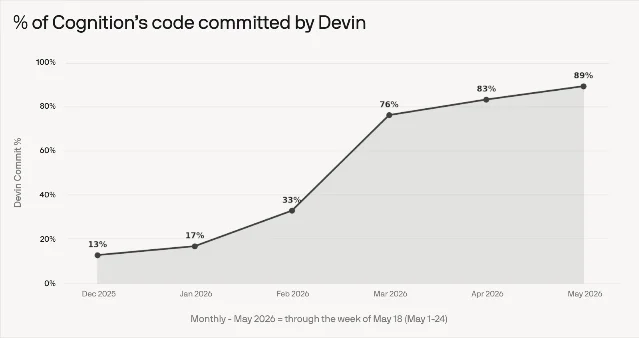
Cognition closes $1B at $26B; 89% of its own code now written by Devin
Cognition (developer of the autonomous software engineering agent Devin) closed more than $1 billion in Series D funding on June 4, at an implied $26 billion post-money valuation — up from $10.2 billion eight months ago. 12 Lead investors: Lux Capital, General Catalyst, 8VC. Returning investors include Founders Fund, Elad Gil, and Bain Capital Ventures; new participants include Ribbit Capital, Atreides, and Layer Global.
Annual recurring revenue is running at $492 million. Enterprise customers include Citi, Goldman Sachs, Mercedes-Benz, Dell, Santander, the US Navy, and the US Army. The most telling internal number: 89% of Cognition's own production code was committed by Devin in May 2026, up from 13% in December 2025. 12 CEO Scott Wu: "Our goal is to build a future where software engineers operate more like architects, creatively structuring problems for armies of Devins to reliably execute on."
Suno raises $400M at $5.4B; Flourish, Generalist AI, PhysicsX, Coralogix also close
Suno (Cambridge, MA — AI music generation platform) raised more than $400 million in Series D on June 3 at a $5.4 billion valuation, led by Bond Capital (Mary Meeker's growth fund). 13 Co-investors include IVP, Forerunner, Union Square Ventures, Lightspeed, and Menlo Ventures. The company's November 2025 valuation was $2.45 billion. Suno faces a class-action copyright suit from more than 1,800 independent artists and has settled separately with Warner Music Group. 13
Other confirmed closes this week:
| Company | Round | Amount | Valuation | Lead investor |
|---|---|---|---|---|
| Flourish (brain-inspired AI, New York) | Growth | $500M | $2.5B | Bezos (~$100M anchor); Lux Capital, GV, Catalio Capital |
| Generalist AI (robotics foundation models, San Mateo) | Series B | $400M | $2B | Radical Ventures |
| PhysicsX (industrial AI, London) | Series C | $300M | $2.4B | Temasek |
| Coralogix (AI observability, Boston) | Series F | $200M | $1.6B | Advent + CPPIB |
Coralogix CEO Ariel Assaraf noted: "The interface layer is slowly getting eroded" — more than half of Coralogix's enterprise customers now interact with the platform through AI agent interfaces rather than traditional dashboards. 17
Anthropic IPO filing; Google writes SpaceX a $920M monthly check
Anthropic, which filed its confidential S-1 with the SEC on June 1 (four days after closing a $65 billion Series H at a $965 billion valuation), is now targeting an October 2026 IPO. 18 Its revenue run rate reached $47 billion in May. The S-1 is not yet public; at least 15 days must elapse after SEC review before a roadshow can begin.
On June 5, Google disclosed via SEC filing that it had signed a 32-month AI compute rental agreement with SpaceX — $920 million per month, totaling approximately $29.4 billion, for roughly 110,000 NVIDIA GPUs. 19 A Google Cloud spokesperson described the deal as bridging "surging customer demand for our agent platform, Gemini Enterprise, which has been even higher than we expected." 19 Combined with SpaceX's May deal with Anthropic ($1.25 billion/month), the two contracts put SpaceX's annualized data center revenue at roughly $26 billion — more than its Starlink, launch services, and AI revenues combined in 2025. 20
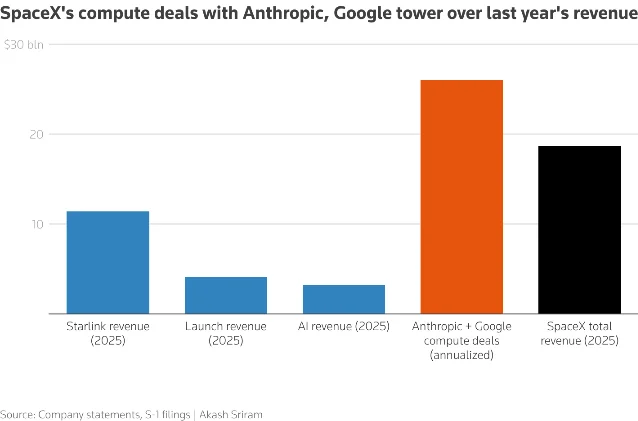
SpaceX is targeting a June 12 IPO at over $1.75 trillion in valuation on $75 billion in raised capital — the potential largest IPO ever — though its AI division ran a $2.5 billion operating loss on $818 million in Q1 revenue. 19
Regulation
GAAIA: 269-page bipartisan bill would freeze state AI law for three years
On June 4, Representatives Jay Obernolte (R-CA) and Lori Trahan (D-MA) released the Great American AI Act (GAAIA), a 269-page discussion draft co-sponsored by four additional members. 21 The bill is not yet formally introduced; it is collecting stakeholder comment at GAAIA@mail.house.gov.
Key provisions:
- Three-year state preemption on AI development law — how models are trained, built, and weighted. States retain authority to regulate AI deployment, use, civil rights, labor, consumer privacy, and child safety. Trahan's FAQ explicitly names California AB 2013 (training data transparency) and SB 942 (AI content watermarks) as laws that would be frozen. 22
- $500M revenue threshold: Frontier AI developers above that threshold must submit to semi-annual audits by NIST-certified Independent Verification Organizations covering cybersecurity, biosecurity, CBRN escalation risks, and loss-of-control scenarios. Maximum penalty: $1 million per day of non-compliance. Both the preemption and audit provisions sunset after three years.
- CAISI codified: The Center for AI Standards and Innovation (formerly the AI Safety Institute) is written into Commerce Department law with $100 million per year in authorized funding for FY2027–29 — nearly seven times the current ~$15 million appropriation. 21
- 15-day incident reporting for material safety events; 24-hour if imminent death or serious injury risk.
- Whistleblower protections for employees and contractors reporting violations.
正在加载内容卡片…
The bill has immediate bipartisan opposition. House Democratic AI Caucus co-chairs Ted Lieu, Valerie Foushee, and Josh Gottheimer issued a statement the same day that they "do not support the discussion draft in its current form" and consider it an insufficient basis for "productive dialogue." 22 Americans for Responsible Innovation president Brad Carson called the preemption clause "a generational mistake" — the bill "takes the current floor on state AI legislation and turns it into a federal ceiling, preventing state lawmakers from addressing emerging AI harms." 23 The AFL-CIO (15 million workers, 63 affiliated unions) called it "a giveaway to the AI industry and a handful of trillion-dollar companies at the expense of American workers." 22 ITI — representing Google, Microsoft, and other tech companies — expressed support. 23
Trump AI executive order: NSA benchmark testing, 30-day voluntary review window
President Trump signed "Promoting Advanced Artificial Intelligence Innovation and Security" on June 2 — the successor to the voluntary EO killed in May. 24 The new order directs:
- NSA to develop classified benchmark tests within 60 days for assessing frontier model cyber capabilities and designating "covered frontier models."
- A 30-day voluntary pre-release window: developers may submit models for government evaluation; the administration gets access 30 days before public launch. (Early drafts set 90 days; the signed version compressed to 30 after internal negotiation.)
- A Treasury-led AI Cybersecurity Information Sharing Hub within 30 days to coordinate voluntary industry participation on vulnerability scanning and patching.
- Section 3(c) explicitly prohibits the order from being read as authorizing "mandatory governmental licensing, preclearance, or permitting." 25
A&O Shearman analysts noted that the voluntary framing "may be near-compulsory in practice" — companies that decline to participate face national security scrutiny and reputational risk. 26
EU AI Act omnibus clears committee 93-4; high-risk deadline pushed to December 2027
On June 2, the European Parliament's IMCO and LIBE committees jointly approved the Digital Omnibus package in a 93-4-15 vote. 27 The package:
- Delays the compliance deadline for standalone high-risk AI systems from August 2026 to December 2, 2027; AI embedded in regulated products (medical devices, toys) moves to August 2, 2028.
- Bans AI systems designed to generate non-consensual intimate images ("nudifier apps") effective December 2, 2026.
- Removes AI-integrated machinery from the AI Act's high-risk regime, routing it to product-specific safety law instead.
Full Parliament vote is scheduled for June 15–18. The Council must then formally adopt before the changes take effect. 27
Colorado's original AI Act replaced; Illinois SB 315 awaiting governor signature
Colorado's SB 24-205 — the original algorithmic discrimination law that would have required high-risk AI impact assessments and carried $20,000 per-violation fines, effective June 30 — was replaced by the narrower SB 189 notification framework before it ever took effect. 22 The DOJ had sued in April to block the original law — the first federal challenge to a state AI statute.
Illinois SB 315 (the Artificial Intelligence Safety Measures Act), which would require annual third-party audits of frontier AI developers, passed the state legislature May 27 and is awaiting Governor Pritzker's signature. 22 If GAAIA's preemption clause passes federally, Illinois SB 315 would be frozen. Pritzker has not yet acted; his term is limited and he is running in the Democratic gubernatorial primary on June 30.
The House AI Security Hearing on June 4 added a concrete data point to the compliance story: of the 1,500 vulnerabilities Anthropic disclosed via its Mythos model program, only 6% have been fixed, per Corridor Security CEO Jack Cable's congressional testimony. 28 Google Threat Intelligence VP Sandra Joyce confirmed the first observed instance of AI being used by cybercriminals to develop a zero-day exploit. 28
The regulatory play for founders this week is simpler than it looks: GAAIA's preemption clause is the most consequential provision regardless of whether it passes. Jurisdictions are already racing to enact state law before any federal freeze takes hold — and every law that clears before GAAIA passes becomes a data point regulators will use to argue the freeze isn't needed.
Cover: Pexels / panumas nikhomkhai
参考来源
- 1Microsoft Official Blog: Microsoft Build 2026
- 2CNBC: Microsoft unveils new AI models
- 3Business Insider: GitHub Copilot Users Get Rude Awakening As AI Pricing Changes
- 4The Register: Angry devs vow to flee GitHub Copilot as metered billing takes hold
- 5The Indian Express: Meta testing Hatch AI assistant
- 6OpenAI: Codex for every role, tool, and workflow
- 7OpenAI: Frontier models and Codex available on AWS
- 8Google Blog: Introducing Gemma 4 12B
- 9Hugging Face: ideogram-ai/ideogram-4-nf4
- 10THE DECODER: xAI updates Grok Imagine to 1.5
- 11OpenAI: Dreaming — better memory for ChatGPT
- 12Cognition: More Devins in More Places
- 13Reuters: AI music startup Suno raises funding at $5.4 billion valuation
- 14Crunchbase: Week's 10 Biggest Funding Rounds, June 5
- 15Generalist AI: Accelerating physical AI
- 16Silicon Republic: PhysicsX raises $300M Series C
- 17TechCrunch: Coralogix raises $200M
- 18TechCrunch: Anthropic files to go public
- 19CNBC: Google to pay SpaceX $920M a month
- 20Reuters: SpaceX lands Google AI compute deal
- 21Office of Congresswoman Lori Trahan: GAAIA Discussion Draft
- 22TechTimes: Federal AI bill freezes state consumer protections
- 23Gizmodo: New bipartisan legislation restricting state regulation of AI
- 24The White House: Promoting Advanced AI Innovation and Security
- 25White House Fact Sheet: AI Innovation and Security EO
- 26A&O Shearman: White House issues executive order on AI and cybersecurity
- 27EU Perspectives: AI rules delay, nudifier ban
- 28TechPolicy.Press: House AI Security Hearing
围绕这条内容继续补充观点或上下文。