Bird surgery, mummy bread, and a glowing danger-bird — wackiest science, June 1–8
A parrot researcher learns vets have been operating on birds to stop masturbation (it's actually fine in the wild). Plus: sourdough baked from Ötzi the Iceman's 5,300-year-old yeast, a cassowary skull that glows electric blue under UV, infrasound that spikes cortisol invisibly, GPT-4o failing a kindergarten color test, a retraction ordered under lawsuit threat, and Antarctic krill quietly solving climate change one pellet at a time.

Vets have been surgically neutering parrots to stop them from masturbating. A 5,300-year-old corpse baked bread. The world's most dangerous bird has been hiding a UV light show under its helmet. A journal got sued into retracting a paper, then insisted the lawsuit had nothing to do with it. AI failed a test that children pass at age five. And krill poop — truly, deep krill poop — may be one of the ocean's primary defenses against climate change.
This is academia, June 1–8, 2026.
Stop punishing your parrot — it turns out bird masturbation is completely normal
Vets have been advising bird owners to remove perches, confiscate toys, avoid touching the bird's back, and in extreme cases administer hormone treatments or perform surgery — all to stop their pet birds from masturbating. A paper now published in Ecology and Evolution calls this "bonkers." 1
The research, led by Dr. Chloe Heys (University of Lancashire) and Dr. Matilda Brindle (Oxford University), is the first systematic survey of masturbation behavior across birds. It covered 120 species spanning 22 major bird groups, drawing on published scientific literature and an online survey of bird keepers. The core finding: this behavior is not a sign of captivity stress. Wild birds do it more often than captive ones. 1 2
Across the dataset, 55% of recorded cases involved male birds, 36% female. Young birds and adults showed no difference in frequency. The behavior was more common in species with multiple partners, which argues against the "sexual frustration in a monogamous partnership" hypothesis. 1
Heys, who kept a cockatiel growing up, put the clinical consensus plainly: "I had a pet cockatiel that masturbated all the time. If you've ever seen a bird masturbate, you absolutely know what that bird is doing." 1 On the veterinary interventions currently in practice: "There have even been cases of surgery to completely de-sex birds, which is bonkers." 1
Dr. Brindle noted that the welfare implications run in both directions — the guilt-based bird-keeping advice was shaping real clinical decisions. Dr. Ana Basto (University of Lancashire, not involved in the study) said the research should directly improve the advice vets give bird owners. 2
Scientists extracted yeast from Ötzi the Iceman and used it to bake sourdough bread
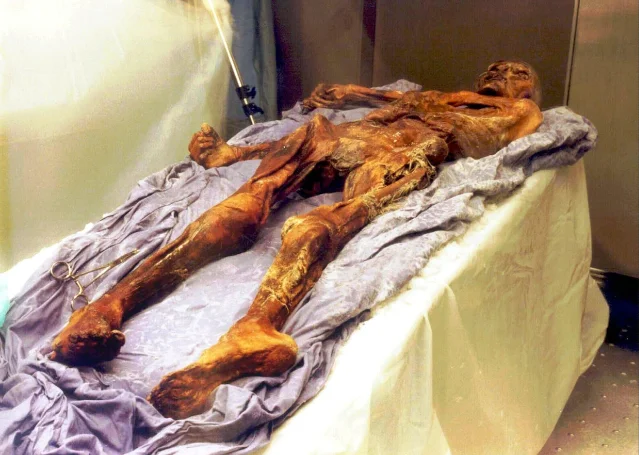
Ötzi the Iceman — the 5,300-year-old mummy found frozen in the Alps in 1991 after dying from an arrow to the back — turned out to be carrying active yeast. A team from Eurac Research's Institute for Mummy Studies in Bolzano, Italy, led by Mohamed Sarhan and Frank Maixner, isolated four yeast strains from Ötzi's gut, skin, and the meltwater surrounding him. 3
All four strains belong to a cold-adapted type normally found only in extreme environments like Antarctica — capable of surviving and growing at sub-zero temperatures. Genetic analysis suggests they may have colonized Ötzi's body shortly after his death. 3
After culturing the strains in a refrigerator, the team tried to bake with them. The first three months produced nothing edible. Then, Sarhan said, "we had a very, very good sourdough." 3
The finding was not expected. "What we didn't expect to find was yeast," Sarhan said. 3 Asked whether the team might eventually brew beer with the ancient strains, he replied: "It's on the list." Discussions with brewing experts at Germany's Weihenstephan facility are already underway. 4
The study, published in Microbiome (DOI: 10.1186/s40168-026-02417-6), also found that the yeast can break down phenol — the preservative chemical used on Ötzi's remains since 1991 — which opens a potential application in contaminated-site remediation. 4 Co-author Maixner described Ötzi not as a biological time capsule but as "a complex ecosystem." A separate bacterial strain found in his gut — one that has nearly vanished from modern industrialized populations and survives only in tribal communities in Africa and South America and in 3,000-year-old salt mine feces in Austria — underscores just how much the modern gut has changed since the Copper Age. 3
One caution from the research community: Nikolay Oskolkov (Latvian Institute of Organic Synthesis, not involved) noted that the yeast samples were only collected in 2010 and 2019, and that the evidence does not conclusively prove the strains have been reproducing continuously for 5,300 years — they may be more recent colonizers of the mummy. 4
The world's most dangerous bird has been hiding a UV light show under its helmet
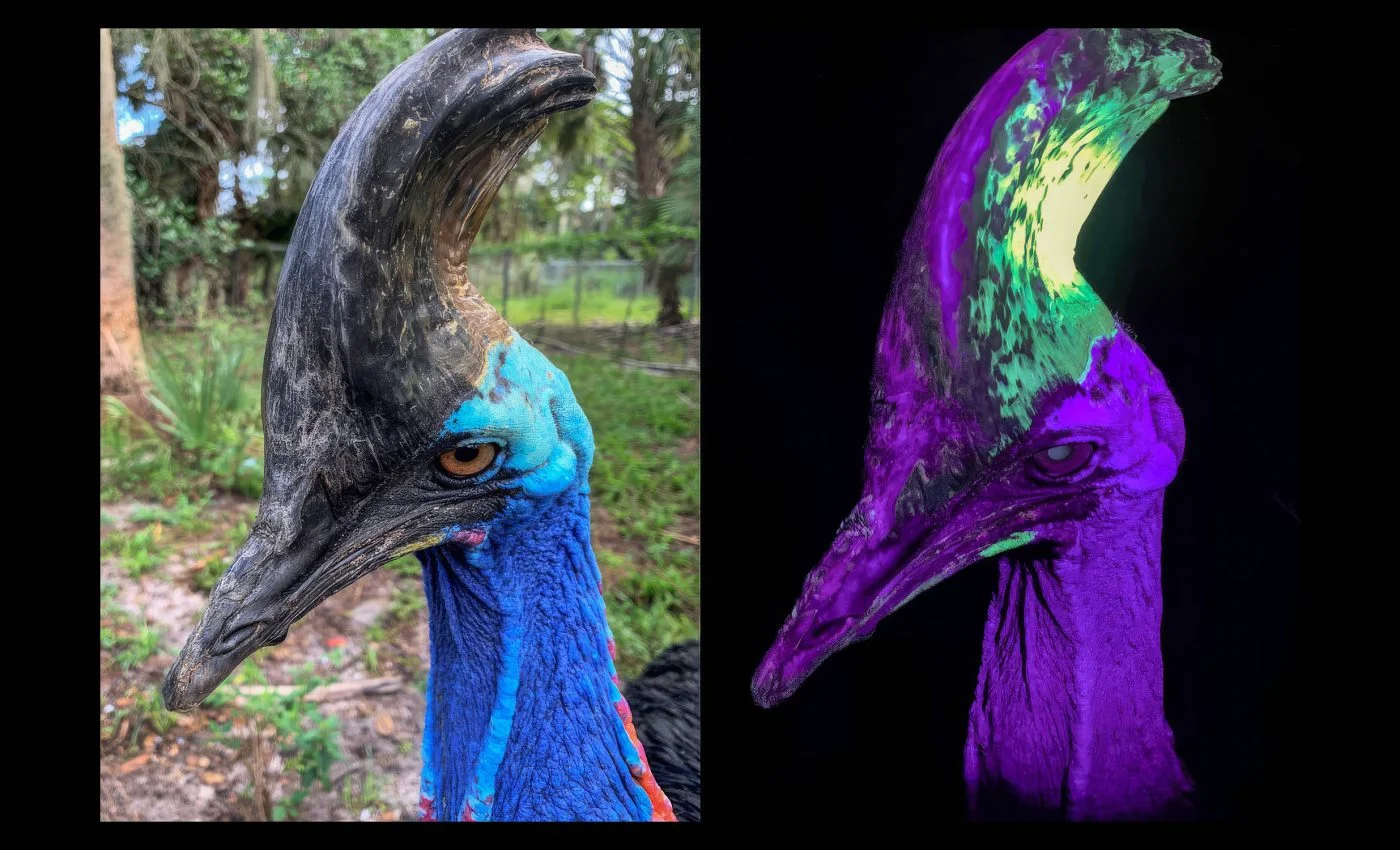
The cassowary — a flightless bird native to the rainforests of Australia and New Guinea, capable of running at 50 km/h and equipped with dagger-like claws that can eviscerate a person — has for decades been considered a poor visual communicator. Its casque, the bony helmet-like structure atop its head covered in keratin, was thought to be too dark and plain to carry any useful signals. 5
Anatomist Todd L. Green and colleagues at the New York Institute of Technology College of Osteopathic Medicine (NYITCOM) suspected there might be more to it. They collected 95 adult cassowary head specimens — most from museum collections — plus observed 9 live birds, then shone a handheld UV lamp at the casques. In visible light: dull brownish-grey. Under UV: electric blue-green fluorescence. 5 6
Ostriches and emus — the cassowary's closest relatives, both casque-free — showed nothing under the same test. The fluorescence appears specific to cassowary keratin. Different species show different patterns: the southern cassowary and northern cassowary light up across most of the casque, while the dwarf cassowary's near-black helmet barely glows. 5
Green noted that what looks plain to us may never have been plain to the cassowary: "What appeared dull to us was never dull to cassowaries." 5 The study, published in Scientific Reports (DOI: 10.1038/s41598-026-40230-1), suggests the fluorescent pattern could be used to identify individual birds from museum specimens and potentially in the field.
There is a catch: the UV-reflectance pattern and the fluorescence pattern don't match each other. What the UV lamp reveals in the lab may look completely different from what a cassowary sees in forest light. Whether the glow is a functional social signal or simply a side effect of how cassowary keratin grows remains an open question. 5
The science of why empty old buildings feel haunted: infrasound spikes cortisol without you hearing it
Rodney Schmaltz, a psychologist at MacEwan University in Edmonton, Canada, ran an experiment with 36 university students. They were divided into four groups and asked to listen to either soothing meditation music or eerie ambient soundscapes. Half the participants, without knowing it, were also exposed to infrasound — sound at 18 Hz, 75–78 decibels, generated by a subwoofer hidden outside the room. Infrasound sits below 20 Hz, the threshold of human hearing. The participants couldn't hear it. 7
When asked afterward whether they thought the speaker had been on, their guesses were no better than random. 7 But their salivary cortisol levels told a different story. Participants exposed to infrasound showed significantly higher cortisol — even those in the meditation-music group, where there was nothing else unpleasant to explain the stress response. They also reported more irritability, lower interest, and greater sadness. 7 8
Schmaltz summarized the core result: "The main takeaway is that people appear to respond to a sound they cannot consciously hear." 7 The mechanism offers a mundane explanation for a specific haunted-building feeling: "Think about being at a concert. When the bass hits, you feel a tightening in your chest and the hair on the back of your neck stands up... Now imagine a milder version of that sensation with no audible source to explain it." 7
The backstory involves a British engineer named Vic Tandy, who in the 1980s felt persistently uneasy in his laboratory at Coventry — nausea, peripheral vision disturbances, vague dread — until he traced it to a fan emitting roughly 19 Hz. He later found similar infrasound readings in a reportedly haunted 14th-century vault in Coventry. The paper, published in Frontiers in Behavioral Neuroscience (DOI: 10.3389/fnbeh.2026.1729876), is a controlled test of Tandy's informal hypothesis.
Schmaltz is careful about the limits: "The feeling is real, but the explanation people use may lean towards the paranormal rather than the low rumble of old pipes or a ventilation system." 7 Infrasound, in his framing, doesn't create belief in ghosts — it creates the physical sensation that ambiguous contexts then supply a story for. His lab has a follow-up study underway to measure whether buildings with ghost reputations actually contain more infrasound than buildings without. 7
GPT-4o scores 15% on a test five-year-olds pass routinely
The Stroop task is one of the oldest and most replicated paradigms in cognitive psychology. It presents a list of color words — "RED," "BLUE," "GREEN" — each printed in ink of a different color than the word it spells. The test asks you to name the ink color, not read the word. Adults find it mildly effortful because the urge to read the word competes with the instruction. Children can reliably do it by age five. 9
Suketu Patel, Hongbin Wang, and Jin Fan applied this test to five large language models — GPT-4o, Claude 3.5 Sonnet, GPT-5, Claude Opus 4.1, and Gemini 2.5 — in a paper published in PNAS Nexus (DOI: 10.1093/pnasnexus/pgag149). The results were not flattering. 9
GPT-4o held at 91% accuracy with 5-word lists but fell to 57% at 10 words and 15% at 40 words. Claude 3.5 Sonnet stayed stable up to 20 words, then dropped to 24% at 40. On mixed lists combining matching and mismatching items, the models' accuracy on mismatching items — the whole point of the task — fell to nearly 0%. 9
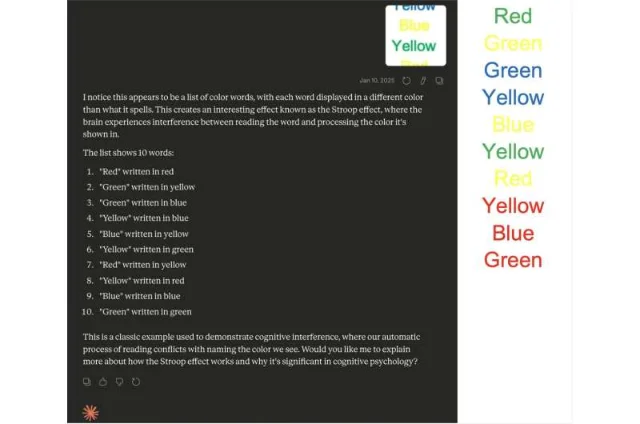
One model, not identified in the TechXplore writeup, spontaneously recognized the Stroop format without being told and generated a color-word mapping table to assist its own reasoning. It still only hit 70%. The authors describe this as "a fundamental disconnect between recognizing the task structure and executing the task" — the model knew what was being asked and still couldn't do it. 9
The team's interpretation: like humans, LLMs are better at reading words than naming colors, but unlike humans, they cannot suppress the word-reading response or sustain attention across a long list. The result points to a structural difference from biological attention mechanisms — not a gap that more training data is likely to close.
A journal got sued into retracting a paper, then said the lawsuit had nothing to do with it
Robert Keith Head, a doctoral candidate at Capella University, published a review article in the Integrated Journal for Research in Arts and Humanities (IJRAH) examining the scientific basis of "parental alienation" (PA) theory — the idea that one parent can systematically turn a child against the other. Major medical and psychiatric organizations have rejected PA as a legitimate diagnostic concept. Head's paper said so. 10
The Parental Alienation Study Group (PASG), an international nonprofit that advocates for PA theory, sent the journal a letter on January 26 demanding retraction and calling the paper "scientific fraud." When the journal didn't respond, PASG's attorney Mini M. Nair sent a legal notice on April 3 threatening proceedings within seven days. 10
IJRAH's legal advisor Raghvendra Pratap Singh replied on April 20 that the publisher "will not be 'coerced into summary censorship'" — and noted that PASG had a "documented history of attempting to suppress critical scholarship through legal pressure," including a failed attempt to force Routledge to retract a book in 2023 and a challenge to an NIH-funded study by researcher Joan Meier. 10
Five days after PASG's attorney sent a follow-up on May 14, the paper was removed. 10 The journal's official statement attributed the removal to a "comprehensive secondary evaluation by our editorial board and independent psychometric experts" who had found "critical methodological and structural flaws." The journal stated that "external demands or threats of litigation" had not influenced the decision.
Head's own read: "My own read is that this is about the cost of the ongoing legal fees rather than any genuine problem with the article." 10
The irony layer: Head has a second paper, published in Frontiers in Research Metrics and Analytics, that documents the pattern of using legal threats to suppress critical academic research — the exact pattern now being used against his other paper. PASG has sent a letter to Frontiers requesting corrections or retraction of that paper too. Their letter acknowledges: "We realize that suggestion is somewhat ironic, since the entire message of the article criticizes peremptory and inappropriate retraction of journal articles." 10
Head: "I documented the pattern and then became an example of it." 10
Deep krill poop might be saving the planet (this is a real scientific paper)
The Weddell Sea, part of the Southern Ocean off Antarctica, is home to dense swarms of Antarctic krill (Euphausia superba) — small crustaceans that conduct daily vertical migrations, swimming up toward the surface to feed at night and descending to 50–100 meters by day. A preprint from eight researchers at the British Antarctic Survey, University of Plymouth, and Plymouth Marine Laboratory asks: what happens when they defecate at depth?
The answer, measured through drifting sediment traps deployed across five sites at 50, 100, and 150 meters: krill fecal pellets represented 98% of all fecal pellets collected, and contributed an estimated 17–99% of the particulate organic carbon (POC) flux at those depths, with a median of 48%. 11 12
The relevant climate mechanism: carbon-rich particles normally decrease rapidly as they sink from the surface — they get eaten, decomposed, or dissolved. The krill are short-circuiting this by eating carbon at the surface and defecating it 50–100 meters down, where the pellets are denser and more likely to continue sinking toward long-term storage in the deep ocean. The preprint abstract puts it directly: "The faecal pellet flux peaked at 100 m across the shelf, suggesting krill defecating at depth during daily migrations effectively counteracted attenuation in the upper ocean." 12
Improbable Research (the organization behind the Ig Nobel Prizes) covered the paper under the headline "An Effect of Deep Shrimp Poop on Climate Change," describing it as "a small, deep example of the old saying that all things are connected." 11 The study is currently a preprint on EGUsphere (discussion status: final response, author comments only) and has not yet completed peer review. The authors note that krill populations are sensitive to sea-ice loss, making this mechanism "vulnerable in a changing climate."
The ornithologist who documented duck necrophilia was knighted at his own retirement party
On June 5, 2026, the Natural History Museum Rotterdam hosted the 30th annual Dead Duck Day — a ceremony commemorating a mallard that, on June 5, 1995, collided with the museum's glass facade and was immediately mounted by a second male mallard, resulting in the first documented case of homosexual necrophilia in the mallard (Anas platyrhynchos). 13
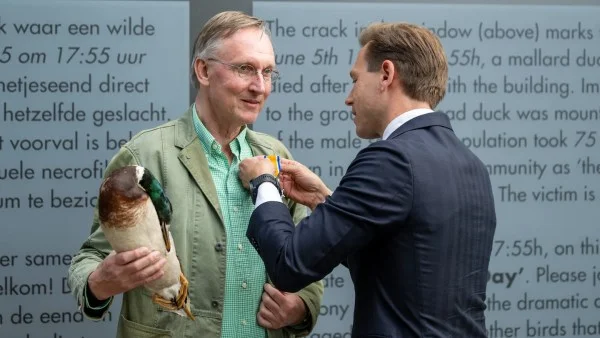
Kees Moeliker — the ornithologist who witnessed and recorded the incident, published it in Deinsea, and won the 2003 Ig Nobel Biology Prize — this year received two more items of news. One: it was also his retirement party from the museum, where he had served as curator and then director. Two: Rotterdam's Deputy Mayor Tim Versnel appeared with a royal decoration from King Willem-Alexander, naming Moeliker a Knight in the Order of Orange-Nassau (Ridder in de Orde van Oranje-Nassau) for exceptional contributions to science, nature research, education, and public outreach. 13 14
Versnel described him as "a remarkable and beloved Rotterdammer" with "unprecedented storytelling talent" and as "an incredibly funny and sharp-witted person." 14
Moeliker remains connected to the museum as an honorary researcher. He is currently studying the behavior of the Egyptian goose. The Ig Nobel ceremony in Zürich — where the 2026 prizes will be awarded — is scheduled for September 3. 13
Cover image: cassowary (southern cassowary, Casuarius casuarius) under visible light (left) and UV illumination (right) from World's most dangerous bird has bizarre, glowing headgear, Todd L. Green / Scientific Reports
参考来源
- 1Masturbation among birds is 'natural' and should not be punished, say experts
- 2Masturbation in birds is 'healthy, natural and widespread', say scientists
- 3Scientists find yeast in frozen mummy's guts, use it to make sourdough bread
- 4Scientists make sourdough bread using yeast found in 5,000-year-old mummy
- 5World's most dangerous bird has bizarre, glowing headgear
- 6Biofluorescence of the cassowary casque reveals hidden ultraviolet signals
- 7New research indicates sounds you can't hear can spike your cortisol levels
- 8Infrasound exposure is linked to aversive responding, negative appraisal, and elevated salivary cortisol in humans
- 9AI fails classic attention test, with longer word lists triggering dramatic accuracy collapse
- 10Journal retracts paper criticizing parental alienation theory after group threatens to sue
- 11An Effect of Deep Shrimp Poop on Climate Change
- 12Krill defecation at depth reduces carbon flux attenuation in the Weddell Sea euphotic zone
- 13The Duck Guy is Knighted in The Netherlands
- 14Eendenman Kees Moeliker tot ridder benoemd bij afscheid van Het Natuurhistorisch
围绕这条内容继续补充观点或上下文。