Saban vs. the SEC, Sorsby waits, Manning rises

Saban vs. the SEC, Sorsby waits, Manning rises

Nick Saban testified before the Senate Commerce Committee in support of the Protect College Sports Act on June 3 — placing himself in direct opposition to the SEC and Big Ten, who jointly opposed the bill the day before. The media rights pooling provision is the real flashpoint; the SEC-Big Ten bloc of 35 schools can block the required 75% threshold and a markup session targeting June 10 makes the next few weeks potentially decisive. On the Sorsby front, Judge Ken Curry heard two hours of arguments on June 1 but has not ruled; the NCAA denied Texas Tech's second appeal on June 6, leaving the court injunction as Sorsby's only path back. In the 2027 Draft, PFN's Jacob Infante made the week's biggest board move, vaulting Arch Manning from #13 to #2, while Heisman co-favorites Manning and CJ Carr are both at +750.
Week of June 1–8, 2026 | Offseason digest — no AP poll until August
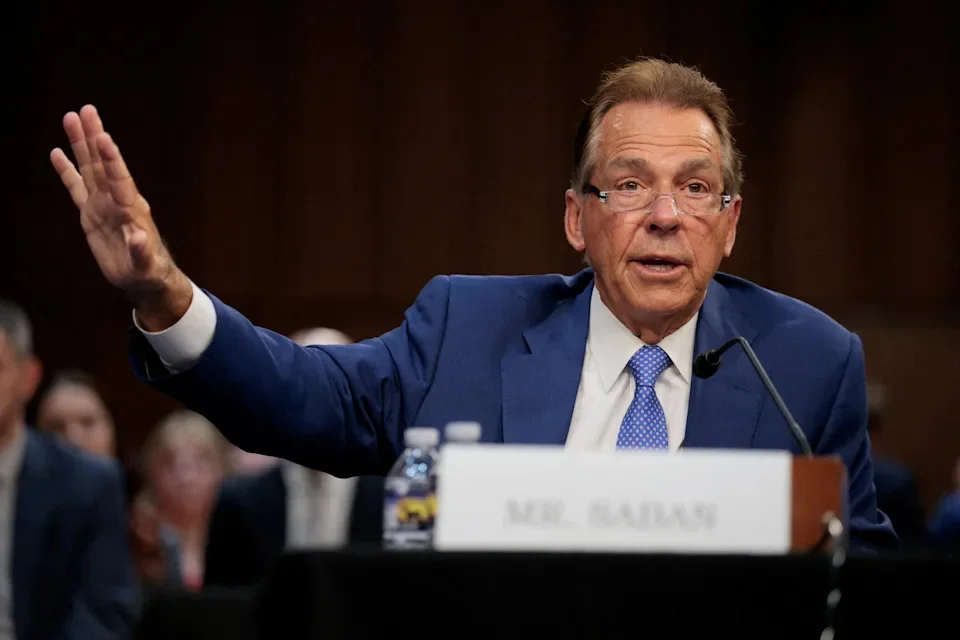
Nick Saban spent six years in retirement watching the sport he helped build drift toward something he no longer recognized. On June 3, he walked into the Senate Commerce Committee hearing room, sat down behind a name placard that read "MR. SABAN," and publicly broke with the Southeastern Conference. The same week, a Lubbock judge kept the sport's most discussed eligibility case in legal limbo, and a PFN analyst made the most aggressive Arch Manning adjustment of the offseason.
Here is what mattered in college football from June 1–8.

The Protect College Sports Act: Saban versus his former conference

Twenty-four hours before the Senate Commerce Committee hearing on the Protect College Sports Act, the SEC and Big Ten dropped a joint statement. Their message: they "do not support the Protect College Sports Act as drafted." 1 The two conferences cited four objections — the bill fails to preempt the patchwork of state NIL laws, shifts rulemaking to Congress, expands litigation risk, and alters the House v. NCAA settlement revenue-sharing structure in ways that could reduce direct payments to athletes.
The timing was a provocation. Sen. Ted Cruz (R-TX), the bill's author, responded the same day with an 88-word statement accusing the Power 2 of wanting to "form a super league." 2 Big Ten Commissioner Tony Petitti pushed back directly: "Any statement that suggests the Big Ten is pursuing or wants a super league is a fabrication. At no point in time have we discussed such a concept with the SEC or anyone else." 2
Then Saban showed up.
The seven-time national champion — who won six of those at Alabama, in the SEC — testified in support of the bill, placing himself on the opposite side of the conference he spent two decades turning into a financial empire. He kept the door open for amendments ("it isn't perfect and I'm sure many, many adjustments need to be made") but argued the underlying structure was necessary:
"Congress does not need to micromanage college athletics. Congress does need to fix the mess in the courts and create a national framework so the people inside college sports can enforce fair rules. Without that legal certainty, every rule becomes another lawsuit, every standard becomes another risk, and the system keeps drifting toward a professional model." 3
He also used a line that cut through three hours of testimony: "If you had the biggest, baddest Ferrari and it was going 100 miles an hour toward the Grand Canyon, you need to tap the brakes." 2
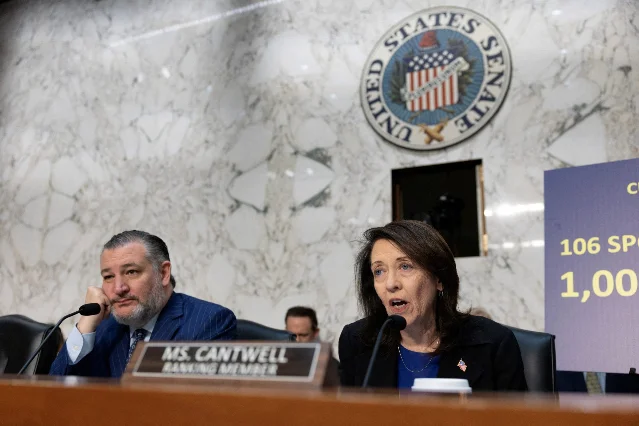
Senate Commerce Committee hearing
Cruz and Cantwell co-chaired a three-hour hearing on the Protect College Sports Act — the first time the two conferences openly opposed legislation they had previously lobbied Congress to pass. 4
What the bill actually does. The Protect College Sports Act, co-authored by Cruz and Sen. Maria Cantwell (D-WA), would give the NCAA an antitrust exemption to enforce: a one-time transfer rule (subsequent transfers require sitting out a year), a five-year eligibility cap, a ban on former professional athletes playing in college, and an anti-poaching provision — the "Lane Kiffin rule" — barring schools from hiring another school's head coach during the sport's season. It also includes a provision allowing FBS schools to pool media rights and distribute revenue collectively, but only if 75% of FBS programs (104 of 138) agree. 2
That media rights provision is the actual sticking point. The SEC, Big Ten, and Notre Dame together represent 35 schools — enough to block the 75% threshold. The SEC presidents and chancellors said it plainly in a May 28 statement: "The conference must retain the ability to act in the best interests of its membership. As such, the SEC does not support assigning its media rights to a third party." 5 Cantwell said pooling could bring in an "additional $4–8 billion" for the sport. 2 Cruz acknowledged the revenue boost doesn't materialize "without the Big Ten and SEC." 2
NIL attorney Darren Heitner noted the gap between the conferences' current posture and their prior lobbying: "For years, SEC Commissioner Greg Sankey and Big Ten Commissioner Tony Petitti told Congress that federal legislation was essential for college sports. They lobbied on Capitol Hill... They aren't refusing to support the Protect College Sports Act because they care about athletes. They're doing it because they care about the bill's media rights pooling provisions." 6
The ACC, Big 12, and American Conference commissioners all sent letters to Congress backing the bill. 6 The Congressional Black Caucus called on Cruz and Cantwell to pause the legislation until college athletics leaders address concerns about "attacks on Black political representation." 4 The White House confirmed it is "reviewing" the bill, and Trump wants lawmakers to "advance legislation that delivers meaningful, permanent reforms," but has not publicly committed to signing it. 5
Where this goes. Cruz scheduled a call with Sankey and Petitti for June 5 to discuss their concerns, but both senators said publicly there is "little wiggle room" on the provisions targeting the Power 2. A markup session was reportedly scheduled for around June 10. Front Office Sports reported the bill is "considered dead if it doesn't pass the Senate before August." 4 Congress goes on recess in August; that leaves roughly four months on the calendar — but in practice, working legislative weeks are far fewer.
The SEC is separately having a "real conversation" about conference-level self-governance and enforcement outside the NCAA, according to Sports Business Journal. 7 Sankey said the SEC has historically held that role — "Conference policies, conference governance, the ability to say no... that's been going on, in my experience, for decades" — and that the conference could expand it. He declined to say how far. 7
The CFP expansion deadline remains December 1, 2026. Sankey has warned that any format must address the "tipping point" at which too many teams in the field renders November games meaningless. He told the Knoxville News Sentinel: "There is a tipping point [when it comes to meaningful games] in November. At any level of expansion, there will be games that didn't matter in a smaller number that now matter in a bigger number." 8 The CFP stays at 12 teams for 2026. The 2027 format decision is still open.

Sorsby: the judge has not ruled, and the NFL is waiting
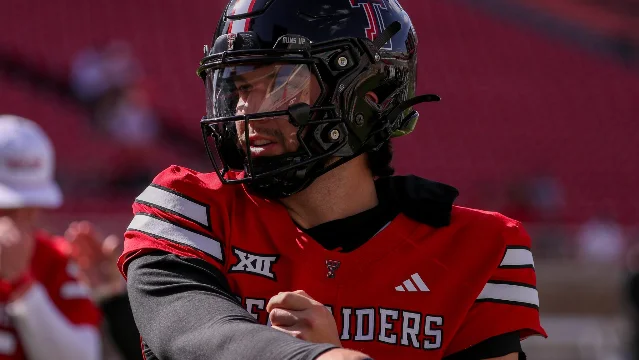
Brendan Sorsby
Sorsby completed a 35-day inpatient gambling addiction program in Arizona before the June 1 hearing; he did not appear in court. 9
On June 1, retired Tarrant County Judge Ken Curry presided over roughly two hours of argument in the 99th District Court in Lubbock. Both sides made their full case. He did not rule. As of June 8, he still has not.
Brendan Sorsby — the Texas Tech quarterback who admitted to placing approximately 2,900 bets totaling at least $90,000 over four years, including at least 40 bets on Indiana football while he was the Hoosiers' starting quarterback — is seeking a temporary injunction that would suspend the NCAA's permanent ineligibility ruling and allow him to play in 2026. Sorsby was not in the courtroom; he recently completed a 35-day inpatient gambling addiction treatment program in Arizona and has returned to the Texas Tech campus.
Jeffrey Kessler (the attorney who negotiated the House v. NCAA settlement) argued for Sorsby: the NCAA violated its own charter's mental health provisions, the punishment is arbitrary and capricious given that Sorsby's gambling never compromised game integrity — he never bet on his own games or leaked information — and removing him from a structured team environment damages his recovery.
NCAA attorney Taylor Askew argued the other side with a line that summarized his entire case: "There is no get-out-of-jail-free card because you're really good at throwing a football." 9 He said Sorsby sought treatment only after law enforcement found him, argued that returning him to a gambling-adjacent environment undermines recovery, and told the court that allowing Sorsby to play would make the NCAA "the first league in the United States to say serial gambling on other teams' sports is OK." 9
Kessler asked for a ruling by June 15. On June 6, the NCAA denied Texas Tech's separate administrative appeal — its second and final rejection of Sorsby's reinstatement. 10 The court injunction is now Sorsby's only remaining path back to college football.
If the injunction is denied, Sorsby has until June 22 to apply for the NFL supplemental draft, with a projected workout window of July 5–12 (including a Dallas pro day) and a draft expected in late July. The NFL will review his gambling history; the 2011 Terrelle Pryor supplemental draft precedent (Pryor was required to serve a five-game suspension as a condition of entry) suggests a suspension is possible. 11
NFL evaluators who spoke with Sports Illustrated are bullish on his physical tools regardless of context. An NFC offensive coordinator said: "His arm is electric. It would've been by far the best in this [2026] class... As a thrower, his arm would be top eight or so in the league." 12 An AFC assistant GM said he was better than Ty Simpson (the 2026 first-round pick, selected by the Tennessee Titans) and described "that combination of athleticism, accuracy and arm" as the profile of a quarterback who can throw off-platform and "extend plays." 12 Draft analyst Tony Pauline projects a late first-round or early second-round landing spot. 11 Albert Breer of SI puts the probability of Sorsby entering the supplemental draft at 55%. 12
The supplemental draft uses a three-tier lottery system based on prior-season record: tier 1 is teams that won six or fewer games, tier 2 is teams that went 7-plus without making the playoffs, tier 3 is playoff teams. Whatever round Sorsby goes in, the selecting team forfeits that same pick in the 2027 regular draft. 11
Texas Tech coach Joey McGuire's position has not changed: "I do believe that there should be consequences, but it's my opinion that he shouldn't be penalized for the rest of this year of his whole career." 13 If Sorsby cannot play, the Red Raiders' fallback is Will Hammond (a redshirt sophomore recovering from an October ACL tear, projected available around Week 3) and Kirk Francis, a transfer with starting experience from Tulsa. 13

2027 Draft board: Manning climbs to #2, Hardy still sidelined, breakout season candidates
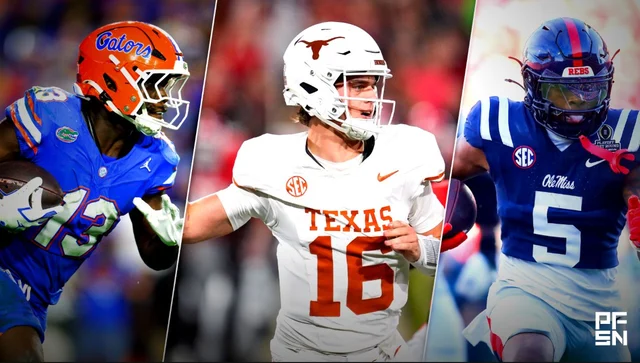
PFN 2027 draft composite
Infante moved Manning from #13 to #2 in a single update — the largest individual board jump of the offseason so far, driven by a trade scenario sending Pittsburgh up from the Dolphins' slot. 14
The biggest mock-draft move of the week came from PFN analyst Jacob Infante, who vaulted Arch Manning (Texas quarterback) from #13 all the way to #2 in his June 6 update. In Infante's scenario, the Pittsburgh Steelers trade up — sending multiple first-round picks to the Miami Dolphins — specifically to acquire Manning. 14 The mock's top three are all quarterbacks: 1) Dante Moore (Oregon, to the Arizona Cardinals), 2) Arch Manning (Texas, to Pittsburgh via trade), 3) Drew Mestemaker (Oklahoma State, to the New York Jets). Infante acknowledged the leap — he had previously written that "projecting Arch Manning as the No. 1 pick in the 2026 NFL Draft was incredibly unfair" — and now describes Manning as "a well-built passer with a strong arm, impressive athletic ability, and a natural sense of timing down the field" who found his rhythm in the back half of last season. 14
Jeremiah Smith (Ohio State wide receiver) falls to #4 in Infante's board behind those three quarterbacks but remains the dominant non-QB prospect in the class. Oklahoma defensive tackle David Stone, confirmed as the overall DT1 by Daft on Draft analyst Cory Kinnan, goes ninth in Infante's mock to the New Orleans Saints. 14 15
The Manning vs. Moore question at #1 overall remains genuinely unsettled. Yardbarker summarized the unresolved technical knock on Manning from The 33rd Team's Steve Palazzolo: "I don't love his front arm. I think it affects his accuracy. The front arm counterbalances your back arm, and you want those in sync. He's so tight [with his front arm] it puts a lot of pressure on the back arm getting to the proper release point." 16 Todd McShay's promised in-depth 2027 quarterback article has not yet been published; his most recent public comment on the class, from The Ringer podcast, was that "Julian Sayin is going to be one of the biggest stories in college football this season." 16
Heisman odds (BetMGM, as of June 5): CJ Carr (Notre Dame quarterback) and Arch Manning are co-favorites at +750 (implied probability 11.8% each). Manning moved from +800 to +750 over the past week; Carr slipped slightly from +700. Trinidad Chambliss (Ole Miss, who received a sixth year of eligibility after a February suspension) is third at +900. Julian Sayin (Ohio State quarterback) is at +1100. Josh Hoover (Indiana, transferring from TCU) is at +1200 — a notable jump tied to his move to the defending national champion, where quarterback coach Curt Cignetti turned Fernando Mendoza into a Heisman winner last year. 17
National championship futures shifted slightly against the top two. Ohio State moved from +550 to +650 (DraftKings, as of June 6); Notre Dame moved from +600 to +700. Texas holds at +700, Indiana at +750. 18 The Buckeyes lost seven defensive players to the NFL Draft after their CFP semifinal run, which likely accounts for the drift.
Ahmad Hardy update. Missouri's 2025 SEC rushing leader — who was shot in the leg at a concert in Mississippi in early May — was discharged from inpatient care in late May. Head coach Eli Drinkwitz confirmed Hardy is in the building and rehabbing. No return timeline exists. ESPN has removed Hardy from its list of top non-QB playmakers for 2026 due to the injury. 19 Hardy's 2025 numbers (2,994 rushing yards, 6.0 yards per carry, 29 touchdowns) were historic; his draft stock for 2027 is rated highly on explosiveness and contact balance but scouts flag limited receiving usage and pass protection experience. Whether he can return and demonstrate third-down capability will determine whether he is a first-round pick or not.
FOX Sports' 10 breakout candidates for 2026, per writer Michael Cohen (published June 7): Josh Hoover (QB, Indiana), Damon Wilson II (Edge, Miami), Andrew Marsh (WR, Michigan), Trey'Dez Green (TE, LSU), Kamari Moulton (RB, Iowa), Aneyas Williams (RB, Notre Dame), Earl Little Jr. (DB, Ohio State), Terrell Anderson (WR, USC), Chaz Coleman (Edge, Tennessee), Noah Rogers (WR, Alabama). 20 Williams stands out for pure efficiency: 9.3 yards per carry, zero fumbles, and 200-plus yards after contact in limited carries for Notre Dame last season.
Pete Golding addressed the LSU speculation directly in a Chris Low (On3) interview, shutting down any suggestion he planned to follow Lane Kiffin to Baton Rouge: "Hey bro, I love you, but don't get it twisted. I didn't come here for you." 21 Golding said he came to Oxford for family reasons and told Ole Miss athletic director Keith Carter that he might stay even if the school chose a different head coach after Kiffin departed. He will call defensive plays at Ole Miss in 2026.

What to watch next week

Three pending developments that will move the needle:
  • Sorsby ruling: Kessler asked Judge Curry for a decision by June 15 — one week before the June 22 supplemental draft application deadline. If no ruling comes by mid-week, expect Sorsby's camp to file for emergency relief.
  • Senate markup session: A committee vote on the Protect College Sports Act was reportedly targeting the week of June 10. No formal announcement was confirmed as of Sunday. The bill's fate may be visible by next weekend.
  • Cruz-Sankey-Petitti call outcome: The June 5 conversation between Cruz and the two Power 2 commissioners had not been reported publicly as of press time. Any statement from Sankey or Petitti about whether they found "wiggle room" will set the tone for the markup week.
Cover image: Nick Saban testifies before the Senate Commerce Committee, June 3, 2026. Photo via Yahoo Sports

参考来源

  1. 1AP News: SEC and Big Ten withhold support for new college sports bill
  2. 2Yahoo Sports: SEC, Big Ten vs. everybody?
  3. 3ESPN: Nick Saban asks Congress to 'bring order' via college sports bill
  4. 4Front Office Sports: College Sports Bill Makes for Strange Political Bedfellows
  5. 5Roll Call: White House 'reviewing' college sports bill ahead of Senate hearing
  6. 6Maize n Brew: Big Ten, SEC make joint statement against Protect College Sports Act
  7. 7Sports Business Journal: Wrapping up college sports spring meetings from SEC to ACC
  8. 8Knoxville News Sentinel (via AOL): Greg Sankey's warning about CFP expansion
  9. 9Lubbock Avalanche-Journal: Live updates from Texas Tech football QB Brendan Sorsby hearing
  10. 10KCBD (via AP): Texas Tech's appeal to NCAA for Sorsby reinstatement denied
  11. 11ProFootballRumors: QB Brendan Sorsby preparing for supplemental draft
  12. 12Sports Illustrated: With supplemental draft a real possibility, NFL evaluators weigh in
  13. 13CBS Sports: Brendan Sorsby gambling investigation: judge to rule on injunction
  14. 14Pro Football Network: 2027 NFL Mock Draft
  15. 15Daft on Draft: NFL Draft David Stone DT1 in summer scouting positional rankings
  16. 16Yardbarker: One question Arch Manning, four other QB prospects must answer before 2027 NFL Draft
  17. 17BetMGM: Heisman Trophy odds and betting favorites for 2026
  18. 18Clemson Wire / USA Today: Latest national championship odds leave Clemson on the outside looking in
  19. 19Yahoo Sports / Last Word on Sports: 2027 NFL Draft Ahmad Hardy early profile
  20. 20FOX Sports: Top 10 breakout candidates heading into the 2026 college football season
  21. 21Sports Illustrated: Pete Golding never once considered following Lane Kiffin from Ole Miss to LSU

围绕这条内容继续补充观点或上下文。

  • 登录后可发表评论。